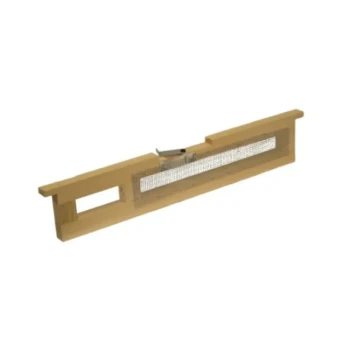
Standard specification wooden beehives serve as the fundamental calibration tool for evaluating pesticide toxicity in the field. They provide a controlled, measurable production environment that allows researchers to isolate the effects of chemical exposure from structural variables, ensuring that data regarding colony health is both accurate and comparable.
The Core Value: In pesticide risk assessment, uniformity is synonymous with validity. By standardizing the physical habitat, researchers transform the complex biology of a honeybee colony into a quantifiable dataset, allowing for precise comparisons of brood development and mortality rates between treated and untreated groups.
The Science of Standardization
Establishing a Controlled Baseline
To determine if a pesticide harms bees, researchers must first eliminate the hive itself as a variable. Standard specification hives utilize uniform frame dimensions and joint structures. This mechanical consistency ensures that every colony in an experiment begins with the exact same available volume and internal architecture.
Enabling Quantitative Analysis
The primary role of these hives is to facilitate precise measurement. Because the frames are uniform, researchers can accurately calculate the surface area of the brood (larvae). This makes it possible to quantify worker bee biomass and honey yield—critical metrics that reveal the sublethal effects of pesticide exposure.
Operational Advantages in Toxicology
Reducing Experimental Interference
In pesticide studies, stress from the observer can skew results. Standard Langstroth hives feature a modular design that allows for the rapid installation or removal of experimental feeding devices. This enables researchers to introduce specific chemical doses or collect samples without significantly disturbing the colony’s normal life activities.
Accurate Comparative Monitoring
When assessing environmental impact, researchers often deploy colonies across different crop areas. Standardized hives serve as identical experimental units, allowing for a systematic comparison of population dynamics. This uniformity is essential for objectively assessing how agricultural environments and chemical treatments influence foraging capacity and overall colony strength.
Critical Considerations for Data Integrity
The Limit of Physical Standardization
While the wooden hive provides a standard volume, it does not automatically account for external biological threats. Anomalies in data—such as a sudden drop in weight or population—must be cross-referenced against other factors like Small Hive Beetle (SHB) infestation. Visual inspections using standard tools are necessary to confirm that colony decline is due to the pesticide being tested and not an invasive pest.
The Necessity of Weight Monitoring
The hive structure facilitates measurement, but does not capture real-time activity on its own. To evaluate the daily impact of a chemical on foraging capacity, standard hives should be paired with high-precision scales. These devices record 24-hour weight fluctuations, providing the necessary data to detect subtle changes in feed consumption or foraging behavior that visual inspections might miss.
Making the Right Choice for Your Research
To effectively evaluate pesticide impacts, your equipment choice dictates the quality of your data.
- If your primary focus is Regulatory Toxicology: Prioritize hives with strict dimensional accuracy to ensure brood area and biomass measurements are legally defensible and reproducible.
- If your primary focus is Field Foraging Impact: Utilize standard modular hives paired with precision scales to monitor daily weight fluctuations and population dynamics across different crop zones.
Standardization turns the chaotic environment of an apiary into a rigorous laboratory for preserving pollinator health.
Summary Table:
| Key Role | Specific Function | Data Impact |
|---|---|---|
| Baseline Control | Uniform dimensions and internal architecture | Eliminates structural variables to isolate chemical effects |
| Quantitative Analysis | Standardized frame surface area | Enables precise calculation of brood area and worker biomass |
| Operational Ease | Modular design and interchangeable parts | Minimizes colony stress during dose introduction and sampling |
| Comparative Study | Identical experimental units | Facilitates objective monitoring across different agricultural zones |
Elevate Your Research with Precision Beekeeping Equipment
At HONESTBEE, we understand that data integrity starts with equipment quality. We provide commercial apiaries and distributors with premium, standard-specification wooden beehives and advanced machinery—from hive-making to honey-filling—engineered to meet the rigorous demands of large-scale operations and toxicological research.
Whether you are managing a commercial enterprise or supplying the industry's largest distributors, our comprehensive wholesale portfolio offers the reliability and uniformity you need to ensure accurate colony assessments and superior yields. Contact HONESTBEE today to discuss how our specialized hardware and industry consumables can support your success in preserving pollinator health.
References
- Krystyna Pohorecka, Andrzej Bober. Residues of Neonicotinoid Insecticides in Bee Collected Plant Materials from Oilseed Rape Crops and their Effect on Bee Colonies. DOI: 10.2478/v10289-012-0029-3
This article is also based on technical information from HonestBee Knowledge Base .
Related Products
- Wholesales Dadant Size Wooden Bee Hives for Beekeeping
- Wooden Bee Hive Frames for Beekeeping and Wholesale
- Assembled Wooden Bee Frames with Plastic Foundation for Durability and Convenience by HONESTBEE
- HONESTBEE Wired and Assembled Wooden Bee Frames Foundation for a Thriving Hive
- Professional Wooden Requeening Frame for Beekeeping
People Also Ask
- What are the strategic benefits of installing beekeeping hives at an elevation of 1 to 6 meters? Protect Your Assets
- What are the key advantages of modern improved beekeeping hives? Scale Your Honey Yield and Production Efficiency
- What is the proper way to store unused bee hives? Expert Stacking Tips for Equipment Longevity
- What are the 2 types of bee hives? Langstroth vs. Top-Bar for Your Apiary
- How does the design of improved beekeeping hives contribute to maintaining honey quality and purity? Enhancing Purity