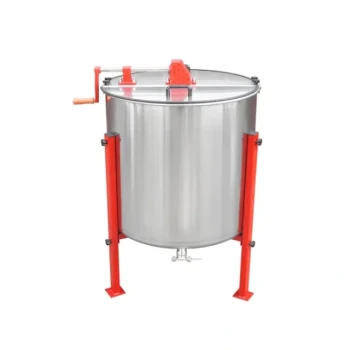
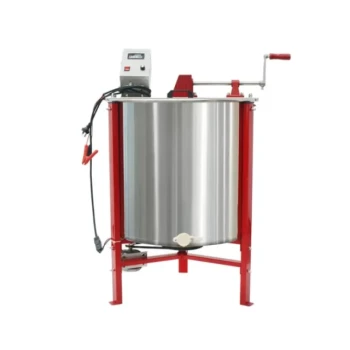
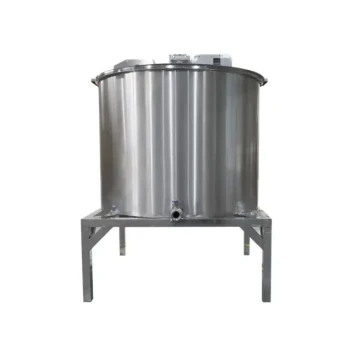
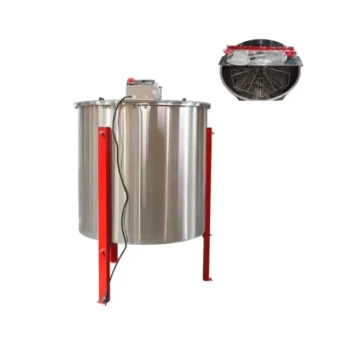
The manual stainless steel centrifugal honey extractor serves as the primary instrument for quantifying the economic success of mite control treatments. It allows researchers to harvest and weigh honey yields from treated colonies without destroying the honeycomb structure, providing a direct metric of colony productivity.
By isolating and weighing the honey yield using this non-destructive equipment, researchers can objectively verify if specific mite control processes translate into tangible economic gains.
Preserving the Asset for Accurate Measurement
Non-Destructive Extraction
The core value of a centrifugal extractor lies in its ability to separate honey from the comb using high-speed rotation.
Unlike crushing methods, this technique leaves the wax honeycomb structure intact. This allows the colony to reuse the comb immediately, ensuring that future productivity is not hampered by the need to rebuild wax.
consistent Data Collection
To evaluate mite treatments effectively, you must compare "apples to apples."
By using a standardized mechanical extraction method, you ensure that the yield collected from both treated and untreated groups is harvested under identical conditions.
Ensuring Data Integrity and Hygiene
The Role of Stainless Steel
The material construction of the extractor is critical for maintaining food-grade hygiene.
Stainless steel offers high resistance to corrosion and is easy to clean between batches. This ensures that the honey samples remain pure and that the equipment does not degrade over the course of the experiment.
Measuring Economic Benefits
The ultimate goal of mite control is often to secure the colony's ability to produce honey.
Researchers use this extractor to collect the total yield from experimental groups. By weighing this yield, they generate hard data proving the contribution of mite control processes to the enhancement of colony productivity.
Understanding the Trade-offs
Manual Labor vs. Control
A manual extractor requires physical effort to operate the side or top crank.
While this allows the operator to have precise control over the speed—preventing damage to fragile experimental frames—it is labor-intensive. It is best suited for assessing smaller experimental groups rather than massive commercial operations.
Capacity Limitations
Manual extractors typically have a lower frame capacity compared to industrial electric models.
This limitation makes them cost-effective and simple for smaller studies or beginning beekeepers, but potentially inefficient for processing hundreds of colonies simultaneously.
Making the Right Choice for Your Goal
To select the right equipment for your evaluation, consider the scale of your study:
- If your primary focus is precise data on a budget: A manual stainless steel extractor provides the necessary hygiene and comb preservation without the high cost of electric machinery.
- If your primary focus is assessing colony health: Prioritize the centrifugal mechanism, as it protects the drawn comb, allowing the bees to focus energy on honey production rather than wax rebuilding.
The manual centrifugal extractor bridges the gap between biological treatment and economic reality, turning colony health into measurable yield.
Summary Table:
| Feature | Benefit for Mite Treatment Evaluation | Impact on Data Integrity |
|---|---|---|
| Centrifugal Action | Non-destructive extraction preserves wax combs | Ensures bees focus on production, not rebuilding |
| Manual Control | Precision speed adjustment for fragile frames | Prevents frame damage during experimental sampling |
| Stainless Steel | Corrosion-resistant and easy to sanitize | Maintains sample purity and food-grade hygiene |
| Standardized Method | Consistent harvesting across all study groups | Enables objective 'apples-to-apples' comparisons |
Scale Your Honey Production with HONESTBEE Precision Tools
At HONESTBEE, we understand that every drop of honey is a testament to your colony's health and management efficiency. Whether you are a commercial apiary or a specialized distributor, we provide the industrial-grade machinery and consumables you need to turn bee health into measurable profit.
From high-capacity honey-filling machines to durable centrifugal extractors and professional beekeeping hardware, our comprehensive wholesale portfolio is designed to optimize your operations. Contact us today to discover how our tailored equipment solutions can enhance your productivity and streamline your honey processing workflow.
References
- Noor Ul Islam, Ghulam Sarwar. Evaluation of different controlling agents alone and in combination against Tropilaelaps clareae in relation to honey production in Apis mellifera colonies. DOI: 10.12692/ijb/21.6.41-52
This article is also based on technical information from HonestBee Knowledge Base .
Related Products
- 6 Frame Manual Stainless Steel Honey Extractor Beekeeping Equipment
- Stainless Steel 3 Frame Manual Honey Extractor Spinner for Bee Honey Extraction
- Stainless Steel Manual 8 Frame Radial Honey Extractor Machine for Beehives
- 2 Frame Stainless Steel Manual Honey Spinner Extractor for Beekeeping
- HONESTBEE 4 Frame Manual Self Reversing Honey Extractor for Beekeeping
People Also Ask
- How do you manually extract honey? Choose the Best Method for Your Hive
- What is a manual honey extractor? The Essential Guide to Cost-Effective Beekeeping for Beginners
- Why are manual extractors popular among beginner beekeepers? A Guide to Starting Simple & Saving Money
- What are the disadvantages of a manual honey extractor? Overcome Efficiency Bottlenecks in Your Apiary
- Which type of honey extractor is generally more durable? Focus on Material & Build Quality for Longevity