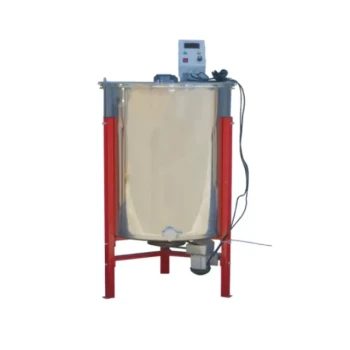
The primary role of a variable frequency fan is to precisely regulate air velocity to stabilize the drying process. By maintaining a constant wind speed, the fan ensures a consistent mass transfer coefficient on the honey's surface, preventing the localized airflow variations that lead to uneven drying.
Precise moisture control is critical for preserving honey's pharmaceutical and curative properties. A variable frequency fan serves as the stabilizing force in this process, eliminating airflow fluctuations that lead to uneven drying and compromised product quality.
The Mechanics of Moisture Migration
To optimize honey drying, you must control how air interacts with the product surface. The variable frequency fan is the engine behind this control.
Stabilizing the Mass Transfer Coefficient
The rate at which moisture leaves honey is governed by the mass transfer coefficient. This coefficient fluctuates if the air speed varies.
By delivering a constant wind speed, a variable frequency fan locks this coefficient in place. This ensures that the rate of moisture migration remains predictable and steady throughout the drying cycle.
Eliminating Localized Variations
Standard fans can create turbulent or dead zones within a drying chamber. This results in some sections of the batch drying too quickly while others remain wet.
A variable frequency system ensures drying air moves uniformly through the chamber. This guarantees that moisture content is consistent across the entire batch, regardless of where the honey is positioned.
The Impact on Honey Quality
Controlling the mechanics of airflow is necessary because of honey's biological sensitivity.
Preserving Curative Qualities
Honey is highly sensitive to moisture in the surrounding atmosphere. If moisture migration is inefficient or uneven, the honey's internal state can degrade.
Proper airflow regulation prevents the high moisture content that negatively affects honey's properties. This preserves the specific curative qualities that make honey valuable.
Ensuring Industrial Compliance
Industries such as pharmaceuticals have strict standards for raw materials. Honey that retains excess moisture due to poor drying is often rejected.
Using a variable frequency fan is an effective method to ensure the product meets these rigorous standards. It protects the honey's integrity, ensuring it remains suitable for high-value applications.
Understanding the Trade-offs
While variable frequency fans offer superior control, there are operational considerations to keep in mind.
System Complexity
Implementing variable frequency technology adds a layer of complexity to your drying infrastructure. Unlike a simple on/off switch, these fans require a control loop to monitor and adjust speed effectively.
Calibration Requirements
To achieve the "constant wind speed" mentioned in the primary reference, the system must be calibrated to the chamber size and batch volume. Improper settings can negate the benefits of the technology.
Making the Right Choice for Your Goal
The decision to implement variable frequency airflow depends on your specific production standards.
- If your primary focus is Pharmaceutical Compliance: You must use variable frequency fans to guarantee the absolute uniformity required to prevent batch rejection.
- If your primary focus is Batch Efficiency: Utilize this technology to eliminate "wet spots" that prolong the drying time for the entire batch.
Optimizing airflow velocity is not just about drying faster; it is about drying with the precision required to protect the value of your product.
Summary Table:
| Feature | Impact on Honey Drying | Key Benefit |
|---|---|---|
| Variable Air Velocity | Stabilizes the mass transfer coefficient | Predictable and steady moisture migration |
| Uniform Airflow | Eliminates localized turbulence or dead zones | Consistent moisture levels across the entire batch |
| Precise Speed Control | Prevents localized airflow variations | Protects curative properties and biological integrity |
| System Calibration | Matches airflow to chamber and batch size | Maximizes efficiency and prevents batch rejection |
Elevate Your Honey Production with HONESTBEE Precision Solutions
Maintaining the delicate biological integrity of honey requires professional-grade equipment. At HONESTBEE, we empower commercial apiaries and global distributors with the advanced machinery needed to meet rigorous pharmaceutical standards.
Our comprehensive wholesale portfolio includes:
- High-Precision Honey Drying & Processing Machinery (featuring variable frequency technology)
- Automated Honey-Filling & Packaging Systems
- Industrial-Scale Hive-Making Equipment
- Complete Range of Beekeeping Tools & Consumables
Don't let inefficient airflow compromise your product's curative value and market price. Partner with HONESTBEE to access the specialized hardware and industry expertise you need to scale your operations.
Ready to optimize your yield? Contact us today to discuss your wholesale equipment needs!
References
- Gülşah Karaca Dolgun, Mustafa Aktaş. Balın Kurutulması için Enerji Verimli ve Hijyenik Yeni Bir Sistem Tasarımı. DOI: 10.2339/politeknik.526639
This article is also based on technical information from HonestBee Knowledge Base .
Related Products
- 0.5T Capacity Honey Dehumidifier Dryer with Vacuum Heating and Thickening Filtering Machine
- High Quality Honey Dehumidifier Dryer Thickening Machine for Beekeeping
- Economy Small Scale Honey Dryer Dehumidifier Thickening Machine
- Honey Concentrating Vacuum Heating Thickening Machine Dehumidifier for Honey
- HONESTBEE 6 Frame Self Reversing Electric Honey Extractor for Beekeeping
People Also Ask
- What is the primary function of professional dehumidification equipment in honey processing? Stability & Quality
- How to dry up honey? The Safe Guide to Stabilizing Honey and Preventing Fermentation
- What is the process for using a dehumidifier to lower honey's moisture content? Expert Drying Techniques
- How to decrease moisture in honey? Prevent Fermentation and Ensure Long-Term Quality
- How to remove humidity from honey? Protect Your Harvest from Fermentation