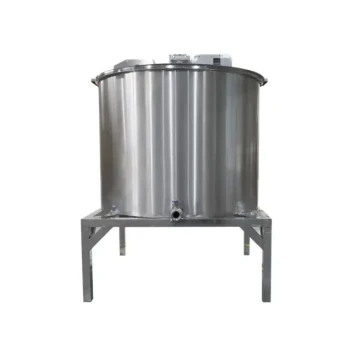
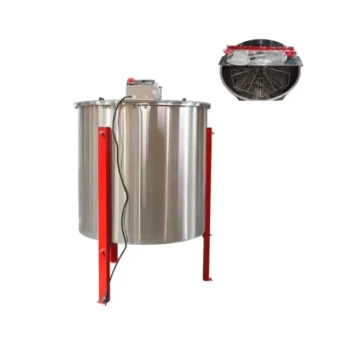
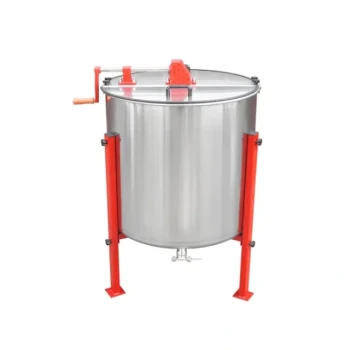
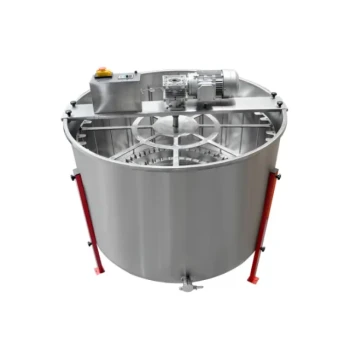
The industrial-grade honey extractor serves as the central engine for high-efficiency, large-scale apiary production. By spinning uncapped frames at high speeds, this machine utilizes centrifugal force to eject mature honey from the cells while leaving the delicate wax honeycomb structure completely intact and ready for immediate reuse.
Core Takeaway While manual methods destroy the comb to release the honey, an industrial extractor separates the two non-destructively. Its primary value lies in frame recyclability: because the wax structure is preserved, bees can focus their energy on producing more honey rather than rebuilding the hive, significantly shortening production cycles.
The Mechanics of Efficient Extraction
Utilizing Centrifugal Force
The fundamental operating principle of an industrial extractor is high-frequency rotation.
Frames are loaded into a drum that spins rapidly, generating precise physical centrifugal force.
Separation Without Destruction
This force pulls the honey out of the uncapped cells, projecting it against the drum walls for collection.
Crucially, this process separates the liquid without damaging the physical structure of the honeycomb frames.
The Economic Impact on Beekeeping
Enabling Frame Recycling
The most significant advantage of using an industrial extractor is the ability to recycle honeycombs.
Once the honey is spun out and the frames are cleaned, they can be immediately returned to the hive.
Reducing Bee Energy Expenditure
Bees consume a vast amount of energy and time to secrete wax and build new combs.
By providing bees with intact frames, the extractor eliminates the need for reconstruction.
Increasing Seasonal Yields
Because the bees do not need to rebuild, they can immediately begin filling the recycled combs with nectar.
This shortens the production cycle, potentially allowing for increased total honey yield during a single flowering period.
Hygiene and Quality Control
Preventing Secondary Contamination
Manual methods, such as squeezing or crushing combs, often introduce impurities and debris into the final product.
Industrial extraction occurs in a mechanized, controlled environment, preventing this type of contamination.
Ensuring Purity and Clarity
The centrifugal process maximizes the extraction of residual honey while maintaining high clarity.
This results in a hygienic product that meets strict food safety standards required for commercial sale.
Operational Considerations
Energy Consumption
While efficient in terms of yield, industrial extractors are often the primary energy-consuming equipment in the extraction phase.
Operators must account for the power requirements needed to sustain high-speed rotation for large batches.
Capital vs. Scale
This equipment is specifically engineered for large-scale, high-efficiency output.
For small hobbyists, the volume of honey produced may not justify the investment compared to the increased throughput the machine provides.
Making the Right Choice for Your Goal
To determine if an industrial-grade extractor fits your operation, consider your production targets:
- If your primary focus is commercial volume: You need this machine to maximize throughput and ensure consistent compliance with food safety hygiene standards.
- If your primary focus is colony health and speed: You should use this method to preserve beeswax combs, reducing the biological stress on your bees to rebuild between harvests.
The industrial extractor transforms honey harvesting from a destructive, manual chore into a sustainable cycle that benefits both the producer and the colony.
Summary Table:
| Feature | Industrial-Grade Honey Extractor | Manual/Traditional Methods |
|---|---|---|
| Extraction Method | Centrifugal Force (Non-destructive) | Crushing or Squeezing (Destructive) |
| Comb Preservation | High - Frames are fully reusable | None - Comb must be rebuilt |
| Production Cycle | Fast - Immediate reuse of frames | Slow - Bees must recreate wax |
| Hygiene Level | High - Controlled, food-safe environment | Moderate - High risk of contamination |
| Ideal Scale | Commercial Apiaries & Wholesalers | Small Hobbyists |
Scale Your Honey Production with HONESTBEE
Maximize your apiary's efficiency and ensure premium product quality with HONESTBEE’s professional-grade solutions. As a leading partner for commercial apiaries and distributors, we provide a comprehensive wholesale range, including high-performance honey-filling machines, hive-making equipment, and industrial extractors designed for durability and speed.
By preserving your honeycombs and streamlining your workflow, our tools help you shorten production cycles and increase seasonal yields. From essential industry consumables to specialized machinery and honey-themed cultural merchandise, HONESTBEE is your one-stop source for beekeeping excellence.
Ready to elevate your wholesale operations? Contact us today to explore our full equipment catalog!
References
- Nancy Diana Panța. Applying Value Chain Analysis through the Lens of Sustainability to Enterprises in the Beekeeping Sector. DOI: 10.18662/lumproc/gekos2020/12
This article is also based on technical information from HonestBee Knowledge Base .
Related Products
- HONESTBEE 72 Frame Industrial Electric Honey Extractor for Beekeeping
- 32 Frame Commercial Electric Honey Extractor for Beekeeping and Honey Production
- Commercial Electric 12 Frame Honey Extractor Spinner Motorized Honey Extractor
- 8-Frame Electric Self-Reversing Honey Extractor Spinner for Commercial Honey Extraction Equipment
- Commercial 48-Frame Stainless Steel Honey Extractor
People Also Ask
- What is the importance of balancing honeycomb frames within a honey extractor? Ensure Stability and Protect Machinery
- How is honey separated from the frames after they are uncapped? Efficient Extraction Methods for High Yields
- What are the main benefits of using a honey extractor? Maximize Yields and Protect Your Honeycomb
- What are the recommended methods for removing honey from the honeycomb? Top Extraction Techniques for Maximum Efficiency
- How do manual honey extractors compare to electric honey extractors? Choosing the Right Tool for Your Apiary Growth