For high-yield royal jelly production, commercial apiaries need specialized queen-rearing equipment, precise harvest timing, and an uninterrupted cold chain. The core setup includes movable-comb hives, queen cell cups, grafting or larval-transfer tools, queen excluders, and hygienic suction or collection devices. Larvae are generally harvested about three days after grafting, before they consume the jelly or the worker bees cap the cells.
The equipment creates production capacity, but timing determines yield. A well-managed operation must insert suitable larvae into prepared queen cups, remove the cups within the planned 24–72-hour window—typically around three days—and refrigerate or freeze the extracted royal jelly immediately.
Build the Right Production System
Use movable-comb hives for repeatable cycles
Movable-comb hives allow operators to insert, inspect, and remove dedicated queen-cell frames without dismantling the colony. This modular arrangement is essential for routine commercial production.
The cell-rearing section should be separated from the queen’s chamber with a queen excluder or equivalent queen-rearing arrangement. This helps maintain controlled production conditions and prevents the queen from interfering with the artificial cell program.
Choose artificial queen cups suited to scale
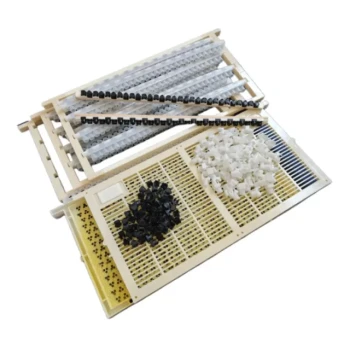
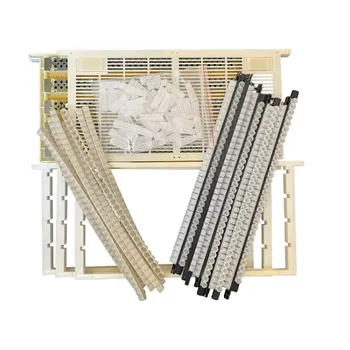
Royal jelly can be produced in plastic queen cups or wax queen cells. Plastic cups mounted on wooden bars are generally better suited to repeated commercial handling because they standardize cell placement and simplify frame loading and removal.
Using pre-molded plastic cups can reduce preparation time and make production more compatible with mechanized grafting, withdrawal, and collection systems.
Use accurate larval-transfer equipment
Traditional operations use grafting needles, transfer tools, or fine forceps to place one-day-old worker larvae into queen cups. Accurate placement is important because acceptance by nurse bees directly affects the number of productive cells.
For larger operations, non-grafting larval depositor systems can reduce the labor associated with manually transferring thousands of larvae. These systems are appropriate when labor availability and throughput are major constraints.
Match Tools to the Production Volume
Basic commercial equipment
A practical equipment package includes:
- Movable-comb hives or dedicated queen-rearing hives
- Queen excluders
- Plastic queen cups or prepared wax queen cells
- Queen-cell frame bars
- Grafting needles, larval-transfer tools, or forceps
- Harvesting spatulas or spoons
- Hygienic suction extraction equipment
- Fine strainers for removing wax and larval residues
- Dark glass storage vials
- Refrigeration or freezing capacity
This configuration supports controlled production while retaining manual oversight.
Higher-throughput equipment
Large apiaries can add double-frame queen-cup assemblies to increase the number of cells handled per cycle. These assemblies are useful when colony capacity, labor, and downstream extraction can support the additional volume.
Automated or semi-automated systems may also include:
- Bionic non-grafting larval depositors
- Automated larval withdrawal machines
- Mechanical royal jelly collectors
- Vacuum extraction systems
- Integrated cold-storage and packaging workflows
Automation improves throughput, but it does not remove the need for strong colonies, accurate scheduling, and quality control.
Select hygienic extraction tools
Royal jelly can be removed with a targeted vacuum or suction device, harvesting spoon, or plastic spatula. Suction equipment is particularly useful for commercial operations because it can accelerate removal and reduce direct handling.
After extraction, the product should be finely strained to remove residual wax and larval skins before it enters storage or final packaging.
Control the Operational Timing
Start with one-day-old larvae
The production cycle begins by transferring one-day-old worker larvae into artificial queen cups. Nurse bees then treat the cells as queen-rearing cells and deposit royal jelly around the developing larvae.
This step must be synchronized with the availability of suitable larvae, prepared cell bars, trained operators, and ready extraction equipment.
Harvest within the 24–72-hour window
The cups are typically left in the colony for 24 to 72 hours, with the optimal harvest point commonly identified as approximately three days after grafting, when the larvae are fully developed for the intended collection cycle.
The precise operating schedule should be standardized for the apiary and validated against cell acceptance, jelly volume, and product quality.
Avoid late collection
Delays create two direct risks. The larvae may consume more of the deposited jelly, reducing recoverable volume, or worker bees may cap the cells, making extraction more difficult and lowering yield.
Harvesting therefore requires scheduled frame removal rather than occasional inspection. A commercial team should know in advance when each frame enters the hive, when it must be removed, and how quickly it will be processed.
Prepare colonies before loading cells
Colony condition affects acceptance and output. The supplementary reference identifies 1:1 sugar-to-water syrup feeding as a management practice that can improve cell acceptance when used within an appropriate colony-management program.
Low yields may indicate underconditioned colonies or too many cell cups assigned to a finisher colony. Adding more cups without adequate nurse-bee capacity can spread colony resources too thinly.
Protect Yield and Product Quality After Extraction
Transfer the product immediately
Royal jelly should be moved into cold storage immediately after extraction. Refrigeration or freezing is mandatory for preserving its biological activity and limiting degradation.
Leaving the product at room temperature for extended periods can compromise its protein quality, so extraction, straining, filling, and cooling should be organized as one continuous workflow.
Use suitable storage containers
Dark glass vials are suitable for protecting the product during storage and handling. Containers should be clean, closed promptly, and compatible with the apiary’s filling and distribution process.
For wholesale or B2B supply, storage capacity should be planned around production peaks so that harvesting does not outpace cooling, filling, labeling, or order fulfillment.
Design the cold chain before expanding
A larger number of queen cups is only useful if the operation has enough extraction capacity, storage space, and rapid transport capability. Cold storage should therefore be treated as production equipment, not as an afterthought.
Distributors and resellers should confirm the supplier’s refrigeration or frozen-shipping capability, packaging format, batch handling, and response time before committing to large-volume purchasing.
Use Yield Metrics to Manage the Operation
Monitor yield per queen cell
The supplementary reference gives an expected benchmark of at least 200 mg of royal jelly per individual queen cell under modified Doolittle-style production. Lower results should trigger an investigation rather than simply increasing the number of cups.
Useful checks include:
- Colony strength and nurse-bee population
- Larval age and transfer accuracy
- Cell acceptance rate
- Time between grafting and removal
- Number of cups assigned to each finisher colony
- Extraction losses during suction, straining, or filling
Plan seasonal output realistically
A well-managed hive is described as capable of producing approximately 500 g over a five- to six-month season, subject to colony condition, management quality, and production design.
These figures should be treated as planning benchmarks rather than guaranteed output. Actual results depend on the number of productive cells, acceptance rates, harvest timing, and the ability to maintain colony health.
Connect production data to purchasing
For commercial sourcing, equipment should be selected as a complete system. Queen cups, frame bars, transfer tools, collectors, strainers, storage vials, and cold-chain supplies must be available in compatible quantities.
A one-stop supplier can reduce downtime by coordinating consumables, extraction equipment, replacement parts, and delivery schedules rather than treating each item as an isolated purchase.
Understanding the Trade-offs
Manual systems cost less to start
Manual grafting and spatula collection require lower initial capital investment and allow experienced beekeepers to control each cell. They are suitable for smaller operations or for validating a production method before investing in automation.
The disadvantage is labor intensity. Handling thousands of larvae and cells increases dependence on operator skill, scheduling discipline, and labor availability.
Automation increases capacity but raises complexity
Non-grafting depositors, automated withdrawal machines, and mechanical collectors can increase throughput and reduce repetitive labor. However, they require capital, maintenance, operator training, and sufficient colony output to justify their use.
Automation cannot correct poor larval selection, weak colonies, excessive cell loading, or delayed harvesting.
More cell cups do not always mean more jelly
Increasing the number of cups can exceed the capacity of the finisher colony. When nurse bees cannot adequately support the cells, acceptance and per-cell yield may decline.
The correct objective is balanced throughput: enough cups to use available colony and processing capacity, but not so many that biological or operational bottlenecks reduce output.
Cold storage can become the bottleneck
Extraction may be fast while cooling, straining, packaging, or shipping remains slow. This creates a quality risk because royal jelly must be chilled promptly after collection.
Before expanding production, verify that the cold room, freezer, containers, transport packaging, and order-fulfillment process can handle the planned harvest volume.
Making the Right Choice for Your Goal
The best equipment package depends on whether the priority is flexibility, labor reduction, or wholesale-scale throughput.
- If your primary focus is controlled small-to-medium production: Use movable-comb hives, plastic queen cups, grafting tools, manual collectors, fine strainers, and immediate refrigeration or freezing.
- If your primary focus is reducing manual labor: Add non-grafting larval depositors, automated larval withdrawal equipment, and mechanical royal jelly collectors.
- If your primary focus is maximum seasonal output: Coordinate double-frame cup assemblies, strong finisher colonies, scheduled three-day harvests, sufficient extraction capacity, and expanded cold storage.
- If your primary focus is wholesale distribution: Standardize cup and container formats, maintain batch-level handling records, and source equipment and consumables through a supplier able to provide rapid response and dependable delivery.
- If your primary focus is product quality: Prioritize hygienic extraction, fine filtration, dark storage containers, and immediate cold-chain transfer over simply increasing the number of queen cells.
High-yield royal jelly production comes from integrating the right tools with disciplined biological timing, balanced colony loading, and immediate cold preservation.
Summary Table:
| Aspect | Key Points |
|---|---|
| Equipment | Movable-comb hives, queen excluders, artificial queen cups, grafting/larval-transfer tools, suction collectors |
| Timing | Harvest larvae after 24-72 hours (optimal ~3 days post-grafting); prepare colonies with syrup feeding |
| Yield | Minimum 200 mg per queen cell; seasonal output up to 500 g per hive over 5-6 months |
| Storage | Immediate refrigeration/freezing; use dark glass vials; maintain cold chain |
| Scaling | Balance cell cups with colony capacity; expand cold storage before increasing production |
Ready to Boost Your Royal Jelly Yield?
Partner with HONESTBEE for a complete range of high-quality beekeeping tools and equipment tailored for commercial apiaries. From specialized queen-rearing kits to advanced extraction systems, we supply everything you need—backed by rapid response, dedicated support, and ultra-fast delivery. Whether you're a producer aiming to maximize output or a distributor seeking a reliable one-stop source, contact us today to discuss your requirements and get a customized solution.
Related Products
- No Grafting Queen Rearing Kit: System for Royal Jelly Production and Queen Rearing
- HONESTBEE Improved No Grafting Queen Rearing Kit For Queen Rearing and Royal Jelly Production
- Plastic Chinese Queen Grafting Tool for Bee Queen Rearing
- Double Nozzle Small Honey Filling Machine Honey Sachet Packing Packaging Equipment
- Commercial Rotary Honey Filling Machine for Production
People Also Ask
- What is the primary function of a queen rearing kit? Eliminate Manual Grafting for Superior Bee Breeding
- How do specialized queen rearing kits and queen management tools improve the success rate of bee colony expansion?
- What are some alternative methods to grafting for queen cell production? Discover Graft-Free Queen Rearing Systems
- Are queen rearing systems generally suitable for all honeybee species? Master Efficient Breeding Methods
- Are queen rearing systems suitable for all beekeepers? Modern Tools for Every Experience Level