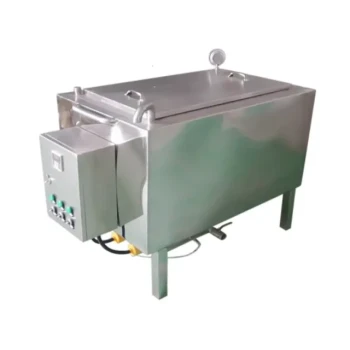
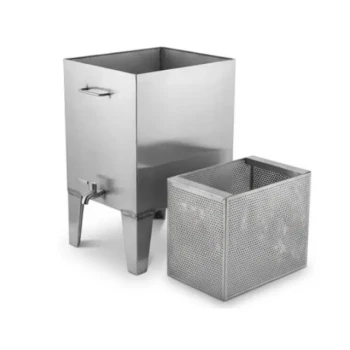
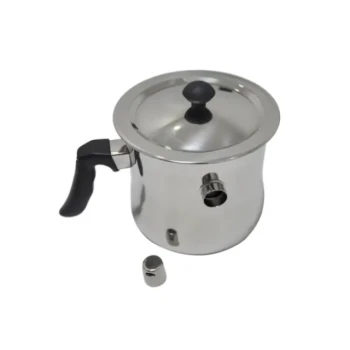
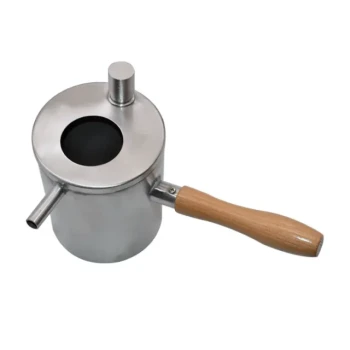
Industrial thermal filtration systems specifically address the removal of stubborn contaminants that traditional sedimentation methods cannot eliminate. By utilizing forced filtration while the beeswax is in a molten state, these systems extract micro-particles, larval remains, and fine debris. This process is essential for transforming raw apiary by-products into clear, high-quality wax suitable for premium applications.
The Core Insight Sedimentation alone is insufficient for modern industrial standards, as it leaves behind biological residues and microscopic solids. Thermal filtration solves this by mechanically trapping these fine impurities, ensuring the physical and chemical purity required for foundation combs and cosmetic-grade products.
The Limitation of Sedimentation
Why Gravity Isn't Enough
Traditional beeswax processing often relies on sedimentation, where heavy dirt sinks to the bottom of a melting tank.
However, this method fails to address light-weight or microscopic contaminants.
Industrial thermal filtration bridges this gap by applying "forced filtration," pushing molten wax through high-precision elements to trap what gravity misses.
Removing Biological Residue
One of the most persistent issues in raw beeswax is the presence of larval remains.
These biological materials can linger in the wax even after basic melting.
Thermal filtration systems explicitly target these organic residues, ensuring the final product is hygienically sound and visually clear.
Contaminants and Quality Control
Eliminating Micro-Particles
Beyond visible debris, raw wax contains micro-particles that cause cloudiness and structural weakness.
High-precision filter elements capture these minute impurities.
This results in a translucent, clean product that is critical for manufacturing high-quality beeswax foundation combs.
Preventing Burnt Impurities
Traditional heating methods often apply uneven heat, leading to carbonized or "burnt" impurities within the wax.
Industrial systems utilize constant-temperature heating processes to melt the wax evenly.
This precise thermal control prevents the creation of new impurities caused by overheating, preserving the wax's inherent physical and chemical properties.
Understanding the Trade-offs
Equipment Complexity
Moving from simple gravity settling to thermal filtration introduces mechanical complexity.
Operators must manage pump pressures and temperature zones rather than simply melting and pouring.
Consumable Dependencies
Unlike static settling tanks, these systems rely on high-density filtration consumables.
To maintain efficiency, filter elements must be monitored and replaced regularly, which adds a recurring operational cost to the refining process.
Making the Right Choice for Your Goal
The level of filtration you require depends heavily on the intended application of your beeswax.
- If your primary focus is Beekeeping Supplies (Foundation Combs): You need thermal filtration to remove larval remains and micro-particles to ensure the physical strength and clarity of the embossed sheets.
- If your primary focus is Cosmetics or Pharmaceuticals: You must prioritize systems with multi-stage filtration and precise temperature control to meet food-grade safety standards and prevent chemical degradation.
Ultimately, industrial thermal filtration is the only reliable method to guarantee the purity required for high-value commercial beeswax products.
Summary Table:
| Issue Addressed | Limitation of Traditional Methods | Thermal Filtration Solution | Resulting Quality |
|---|---|---|---|
| Micro-Particles | Gravity fails to settle light/tiny solids | High-precision forced filtration elements | Translucent, cloud-free wax |
| Biological Residues | Larval remains often float or stay suspended | Mechanical trapping in molten state | Hygienically sound, pure wax |
| Burnt Impurities | Uneven heating causes carbonization | Constant-temperature thermal control | Preserved chemical/physical properties |
| Structural Weakness | Micro-impurities degrade wax integrity | Removal of fine debris | High-strength foundation combs |
Elevate Your Wax Processing with HONESTBEE
Are you struggling to meet the purity standards required for premium foundation combs or cosmetic-grade beeswax? HONESTBEE specializes in empowering commercial apiaries and distributors with professional-grade machinery designed for excellence.
Our industrial thermal filtration systems are engineered to eliminate the micro-contaminants that traditional methods miss, ensuring your products stand out in the competitive wholesale market. Beyond filtration, we offer a comprehensive portfolio ranging from hive-making and honey-filling machines to a full spectrum of beekeeping tools and essential consumables.
Partner with HONESTBEE to transform your raw apiary by-products into high-value assets.
Contact our experts today to optimize your production line!
References
- Stefan Bogdanov. Beeswax: quality issues today. DOI: 10.1080/0005772x.2004.11099623
This article is also based on technical information from HonestBee Knowledge Base .
Related Products
- Electric Commercial Beeswax Melter for Factory Use
- Professional Stainless Steel Honey Filtering Machine with Water Bath Heating for Beekeeping
- Stainless Steel Triangle Support Honey Strainer and Filters
- Steam Beeswax Melter Wax Warmer for Wax Processing
- Solar Beeswax Melter Easy Solar Wax Melter for Beeswax
People Also Ask
- Why might a commercial beekeeper prefer an electric beeswax melter? Maximize Profit with Speed & Scale
- What safety precautions should be taken when melting beeswax? A Guide to Flammable Wax Handling
- What types of beeswax melters are available for different scales of beekeeping? Solar vs. Electric Melters Compared
- What are the three popular methods for melting beeswax? Safely Process Your Wax with Ease
- How do you melt beeswax without making a mess? Master Safe & Clean Techniques