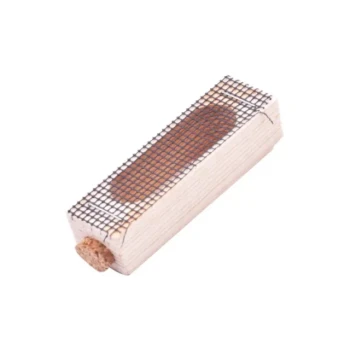
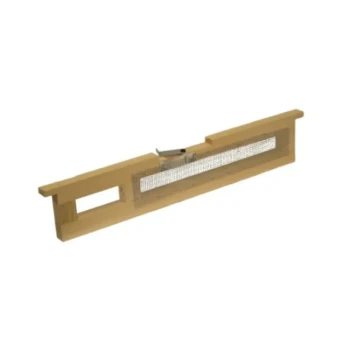
In the nascent era of commercial beekeeping, specifically during the 1860s, shippers relied on placing small pieces of comb honey directly into containers to sustain queen bees during transit. This primitive method caused significant logistical issues, as the honey frequently leaked, soiling other mail and leading postal authorities to enact a ban on queen shipments in 1872.
The use of raw comb honey for shipping was a failure of containment, not nutrition. While it provided the necessary food source, its physical instability during transit caused leaks that threatened the viability of mail-order beekeeping.
The Mechanics of the Failure
The Original Food Source
When queen shipping began in the 1860s, beekeepers attempted to mimic the hive environment as closely as possible.
They placed actual chunks of comb honey inside the shipping cages. This was intended to provide a natural, high-energy food source for the queen and her attendants during the journey.
The Leakage Problem
The structural integrity of honeycomb is compromised by the vibrations and handling inherent in postal transit.
The comb often broke or melted, causing sticky honey to leak out of the queen cages. This did not just harm the bees; it contaminated the surrounding mail, creating a mess that the postal service found unacceptable.
Regulatory Consequences
The 1872 Postal Ban
The widespread issue of leaky packages forced a regulatory response. In 1872, postal authorities officially banned the shipment of queen bees.
This ruling threatened to halt the expansion of the apiary industry by cutting off the primary distribution channel for genetic stock.
Inconsistent Enforcement
Despite the official ban, the ruling was not consistently enforced across all regions.
However, the existence of the ban highlighted the urgent need for innovation in shipping containers and food stability to ensure the industry's survival.
Understanding the Trade-offs
Natural Diet vs. Transport Stability
The primary trade-off in this historical context was between providing a natural food source and ensuring safe transport.
Comb honey is the ideal food for bees biologically, but it is mechanically unsuitable for shipping. It lacks the viscosity and containment required to remain stable when a package is tossed or inverted.
The Shift Toward Containment
The failure of comb honey dictated that future feeding methods had to prioritize containment over using raw, natural structures.
As noted in modern beekeeping practices, successful feeding—whether in the yard or during winter—relies on keeping the food source safely contained. The industry had to move away from loose comb toward methods that could be sealed or stabilized to prevent leakage.
Learning from Historical Logistics
To understand the evolution of beekeeping logistics, consider how the industry adapted to these early failures.
- If your focus is Historical Context: Recognize that the 1872 ban was a pivotal moment that forced the invention of specialized shipping cages and more stable food sources (like fondant or sugar candy).
- If your focus is Modern Application: Prioritize "containment" above all else; whether using yard feeders or shipping cages, liquid or semi-liquid food must be mechanically secured to prevent environmental contamination.
The history of shipping queen bees proves that a solution is only viable if it survives the logistics of delivery.
Summary Table:
| Era | Feeding Method | Key Problem | Industry Impact |
|---|---|---|---|
| 1860s | Raw Comb Honey | Structural failure & honey leakage | Postal contamination and mess |
| 1872 | N/A | Regulatory Ban | Queen shipments officially prohibited |
| Post-1872 | Fondant/Sugar Candy | N/A (Innovation phase) | Transition to stable containment & modern cages |
Elevate Your Apiary with Professional-Grade Equipment
From historical lessons in containment to modern-day precision, HONESTBEE understands that the success of your beekeeping operation depends on the quality of your tools. We provide commercial apiaries and distributors with a comprehensive range of high-performance solutions, including:
- Advanced Machinery: Hive-making and honey-filling machines for seamless production.
- Wholesale Equipment: A full spectrum of specialized beekeeping tools and essential consumables.
- Industry Merchandise: Unique honey-themed cultural goods for retail.
Don't let logistical failures hold back your growth. Partner with a supplier that prioritizes durability and efficiency. Contact HONESTBEE today to discuss our wholesale offerings and how we can support your business expansion.
Related Products
- JZBZ Style Professional Battery Box with 20 Shipping Cages
- Professional Queen Bee Introduction and Transport Cage
- Professional Multi-Compartment Queen Cage with Sliding Lid
- Professional Queen Cage with Sliding Gate and Feeder Plug
- Portable Queen Bee Incubator with 12V Car Adapter for Safe Transport
People Also Ask
- Why are specialized queen bee cages used for the banking of mated queen bees? Maximize Commercial Apiary Storage Efficiency
- How do different materials in queen bee shipping boxes affect temperature? Optimize Bee Health During Transit
- What is the mechanism of action for using temporary queen bee cages? Master Successful Queen Introduction
- What protective role do independent attendant bee partition compartments play? Ensure Safe Queen Bee Transit
- How do specialized logistics consumables like queen bee transport boxes affect biodiversity? Trade-offs & Trends