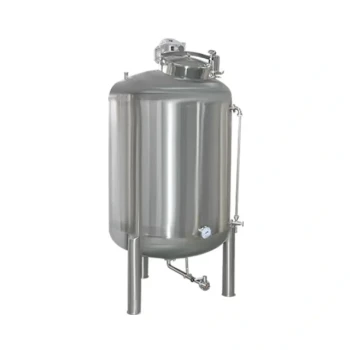
The shift toward 1000-liter large-capacity containers is driven fundamentally by the need for logistical efficiency and cost reduction in industrial honey operations. Unlike traditional small steel drums, these large-volume units are engineered specifically to integrate with mechanical loading systems and industrial filling lines, significantly reducing manual labor and packaging overhead.
The adoption of 1000-liter containers represents a move from simple storage to supply chain optimization. By reducing packaging costs per unit of volume and enabling automated handling, these containers serve as a critical logistics asset for modern, large-scale beekeeping.
Optimizing Logistics and Efficiency
Reducing Packaging Costs
The primary economic driver for choosing 1000-liter containers is the reduction in packaging costs.
Consolidating storage into a single large vessel uses less material per liter of honey compared to utilizing multiple small steel drums. This efficiency scales significantly for high-volume commercial operations.
Simplifying Mechanical Handling
Traditional steel drums often require labor-intensive manual manipulation or specific drum-handling attachments.
In contrast, 1000-liter containers are designed for seamless mechanical loading and unloading. They allow for rapid movement via standard industrial forklifts, streamlining the workflow in warehouses and transit centers.
Compatibility with Industrial Lines
Modern processing facilities rely on automation. Large-capacity containers are specifically designed to interface directly with industrial filling and extraction lines.
This compatibility removes bottlenecks associated with connecting and disconnecting multiple smaller vessels, ensuring a continuous flow of product.
Product Preservation and Yield
Minimizing Product Loss
Every time honey is transferred between containers, a small amount of residue remains on the container walls.
By increasing the volume-to-surface-area ratio, 1000-liter containers significantly minimize this residual product loss during transport and processing.
Addressing Chemical Stability
While the primary advantage of these containers is logistical, they must still adhere to the strict preservation standards required for honey.
Honey is naturally weak-acidic and can corrode unprotected metal substrates. Whether the 1000-liter container is plastic or lined metal, it must provide a chemical barrier to prevent the development of metallic off-flavors or color degradation.
Preventing Moisture Absorption
Honey is highly hygroscopic, meaning it readily absorbs moisture and odors from the environment.
Large containers must utilize tight-sealing lids to create a physical barrier against air and humidity. This prevents fermentation and ensures the honey maintains its original flavor profile and low moisture content during long-term storage.
Understanding the Trade-offs
Equipment Dependency
The shift to 1000-liter containers creates a dependency on heavy machinery.
Unlike small drums, which can be manipulated with basic tools if necessary, these large units cannot be moved without a forklift or pallet jack. This makes them unsuitable for facilities lacking industrial infrastructure.
Batch Flexibility
Using a single 1000-liter vessel reduces the granularity of your inventory.
If contamination occurs, you risk losing a larger volume of product compared to a single isolated steel drum. Furthermore, opening a large container exposes a massive quantity of honey to the atmosphere simultaneously, requiring rapid processing to prevent moisture uptake.
Making the Right Choice for Your Goal
When deciding between traditional drums and large-capacity containers, consider your operational scale and capabilities.
- If your primary focus is Industrial Efficiency: Choose 1000-liter containers to minimize packaging costs and integrate seamlessly with automated filling lines.
- If your primary focus is Small-Batch Flexibility: Stick to smaller drums or buckets to maintain easier manual handling and isolate distinct harvest batches.
- If your primary focus is Long-Term Quality: Ensure whichever size you choose features food-grade linings or inert materials to prevent acidic corrosion and moisture absorption.
For large-scale operations, the 1000-liter container is not just a storage vessel; it is a strategic tool that maximizes throughput and profitability.
Summary Table:
| Feature | 1000-Liter Containers | Traditional Steel Drums |
|---|---|---|
| Logistics Efficiency | High (Forklift-ready) | Low (Manual/Special Attachments) |
| Packaging Cost | Lower (Per unit volume) | Higher (Multiple units needed) |
| Automation | Highly compatible with filling lines | Difficult to automate |
| Product Loss | Minimal (Low surface-to-volume ratio) | Higher (Residue in multiple drums) |
| Handling Needs | Requires heavy machinery | Maneuverable with basic tools |
| Inventory Risk | High (Large batch contamination) | Low (Isolated batch control) |
Maximize Your Beekeeping Efficiency with HONESTBEE
At HONESTBEE, we understand the logistical challenges faced by commercial apiaries and distributors. Whether you need to transition to large-scale industrial storage or upgrade your honey-filling machines, we provide the full spectrum of professional beekeeping tools and machinery designed to boost your profitability.
Our value to you:
- Comprehensive Wholesale: Full access to beekeeping equipment, hardware, and industry consumables.
- Specialized Machinery: High-efficiency hive-making and honey-filling solutions for industrial lines.
- Scalable Solutions: Expert support for both expanding commercial operations and cultural merchandise retail.
Ready to optimize your honey supply chain? Contact us today to explore our wholesale solutions!
References
- Don Keith. The decline of melliferous native flora for European honey bees in Queensland – some reflections. DOI: 10.5962/p.357816
This article is also based on technical information from HonestBee Knowledge Base .
Related Products
- Stainless Steel Honey Storage Tank with Lid for Honey
- Premium Stainless Steel Honey Tank Bucket Pail with Reinforced Handle and Polished Finish
- Hexagonal Glass Honey Jar with Wooden Lid Integrated Dipper Elegant Functional Storage
- Classic Honey Bear Jars with Flip Top Dispensing Cap for Liquid Sweeteners
- Stainless Steel Honey Storage and Settling Tank with Double Strainer
People Also Ask
- What economic role do honey storage tanks play? Boost Your Revenue Through Strategic Inventory Management
- What roles do industrial honey storage tanks and filtration meshes play in processing? Ensure Purity & Consistency
- What is the purpose of a honey storage tank? Streamline Your Honey Processing for Quality & Efficiency
- What are honey storage tanks used for? Essential Features for Quality Preservation and Profit
- How do large honey storage tanks and gravity fall filling systems improve honey packaging efficiency and safety?