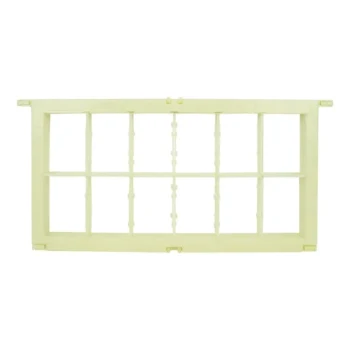
Five-frame compact beehives represent the optimal balance between colony viability and spatial constraints for controlled pollination experiments. They are preferred because they fit easily within the limited volume of isolation cages while providing sufficient internal space for brood and food stores to maintain colony health. This configuration preserves high foraging pressure and ensures consistent pollinator behavior, which is critical for gathering accurate experimental data.
By utilizing compact hives, researchers can eliminate nutritional stress and spatial disruption as variables, ensuring that observed pollination results are derived from healthy, active, and natural-behaving colonies.
Optimizing for Restricted Environments
Fitting Within Isolation Cages
The primary logistical challenge in controlled pollination is the limited volume of the isolation cage.
Standard hives are often too bulky to position effectively without obstructing the cage or the plants.
Five-frame hives offer the necessary portability to fit within these tight spaces without compromising the physical setup of the experiment.
Facilitating Rapid Transport
Field experiments often require moving colonies between different sites or treatment areas.
The compact design of the five-frame nucleus hive facilitates rapid transfer, reducing the physical strain on researchers and the disturbance to the bees.
This portability is essential for studies involving simulated transport durations, such as 8-hour or 32-hour confinement periods.
Maintaining Scientific Validity
Preserving Foraging Pressure
To get useful data, the bees inside the cage must actively visit flowers.
These compact hives maintain a population density that ensures high foraging pressure.
If the hive were too large or the colony too weak, foraging activity might drop, leading to inconclusive pollination results.
Removing Nutritional Stress as a Variable
A major risk in isolation studies is that the bees might behave differently simply because they are hungry.
Five-frame hives are equipped with internal feeders that allow for the delivery of precise ratios of sucrose solution to honey.
This ensures the colony maintains sufficient energy levels even when cut off from external resources, removing nutritional stress as a confounding factor in your study.
Ensuring Consistent Behavior
Scientific rigor demands that the subject of the study behaves consistently.
By providing adequate brood space and food stores, the five-frame configuration keeps the colony in a state of normalcy.
This stabilizes the health and activity levels of the bees, ensuring that their behavior in the cage reflects their natural pollination patterns.
Understanding the Trade-offs
Managing Resource Depletion
While compact hives are efficient, they hold fewer resources than full-sized hives.
Researchers must monitor food stores closely, as the colony can deplete its limited reserves faster than a standard hive would.
Population Density Risks
The "compact" nature that makes these hives useful also creates a risk of overcrowding.
If the population grows too large for the five frames during a long experiment, the colony may attempt to swarm or experience stress from lack of space.
Making the Right Choice for Your Experiment
Selecting the correct hive configuration is about aligning your equipment with your data requirements.
- If your primary focus is strictly limiting variables: Choose five-frame hives to utilize internal feeders, effectively eliminating nutritional stress as a confounding factor.
- If your primary focus is logistical efficiency: rely on the compact design to facilitate rapid transport and easy positioning within small isolation cages.
Success in controlled pollination relies on maintaining a healthy, stress-free colony that fits the physical constraints of your research environment.
Summary Table:
| Feature | Five-Frame Compact Hive Benefit | Impact on Research |
|---|---|---|
| Spatial Footprint | Fits easily within small isolation cages | Prevents plant obstruction & logistical issues |
| Portability | Lightweight & designed for rapid transport | Enables easy movement between test sites |
| Colony Density | Maintains high foraging pressure | Ensures consistent pollination activity for data |
| Resource Mgmt | Accommodates internal feeders | Eliminates nutritional stress as a variable |
| Brood Space | Sufficient for normal colony behavior | Stabilizes colony health during confinement |
Elevate Your Commercial Beekeeping Operations with HONESTBEE
At HONESTBEE, we specialize in supporting commercial apiaries, researchers, and global distributors with high-performance beekeeping solutions. Whether you are conducting controlled pollination studies or scaling a commercial honey production facility, we provide the specialized hardware you need to succeed.
Our comprehensive wholesale portfolio includes:
- Precision Machinery: Hive-making and honey-filling machines designed for efficiency.
- Professional Equipment: A full spectrum of specialized beekeeping tools and essential consumables.
- Unique Merchandise: Honey-themed cultural products to diversify your brand.
Ready to optimize your apiary or restock your distribution inventory? Contact us today to discover how our high-quality equipment and wholesale expertise can drive your business forward.
References
- Vagner de Alencar Arnaut de Toledo, Tais De Sousa Lopes. Polinização por <em>Apis mellifera</em> em soja transgênica [<em>Glycine max</em> (L.) Merrill] Roundup Ready™ cv. BRS 245 RR e convencional cv. BRS 133. DOI: 10.4025/actasciagron.v30i2.1787
This article is also based on technical information from HonestBee Knowledge Base .
Related Products
- 5 Frame Wooden Nuc Box for Beekeeping
- Automatic Heat Preservation 6 Frame Pro Nuc Box for Honey Bee Queen Mating
- In-Hive Dual Compartment Frame Bee Feeder for Targeted Colony Nutrition
- 5 Frame Langstroth Poly Nuc Corrugated Plastic Nuc Boxes
- Wooden Bee Hive Frames for Beekeeping and Wholesale
People Also Ask
- What are the options for adding frames to a nuc after taking two frames from the parent colony?
- What frames should be moved into the queenless hive when requeening with a nuc? Ensure a Successful Queen Introduction
- What roles do five-frame nucleus boxes and ten-frame Langstroth hive boxes play in colony standardization?
- What is the primary function of five-frame nuclei boxes? Master Early Colony Establishment for Stronger Hives
- What is the typical composition of frames in a nuc? A 5-Frame Blueprint for a Thriving Hive