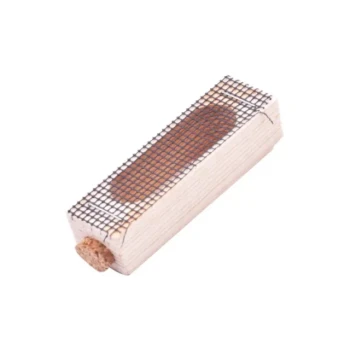
Laboratory cages are the standard method for isolating biological variables in honeybee research. They allow scientists to create a highly controlled micro-environment where external factors—such as weather fluctuations or inconsistent foraging—are completely eliminated. By confining bees of the exact same age in these settings, researchers can attribute changes in survival rates directly to the biological agent being tested, rather than random environmental noise.
The core value of the laboratory cage method is variable isolation. By standardizing age, nutrition, and environment, researchers ensure that mortality data reflects the true toxicity or benefit of a specific dosage, serving as a critical filter before moving to expensive and complex field trials.
Achieving Scientific Precision
Eliminating Environmental Noise
In a natural hive setting, countless uncontrolled variables affect bee health. Temperature shifts, predators, and varying food sources can skew survival data.
Laboratory cages create a "micro-environment." This isolation ensures that the only significant variable changing during the experiment is the introduction of the biological agent.
Standardizing the Test Subjects
To get accurate lifespan data, you must start with a level playing field. Laboratory cages allow researchers to select and house honeybees of the same age.
This standardization prevents results from being contaminated by natural age-related mortality. It ensures that observed deaths are a result of the agent being tested, not the natural life cycle of older bees.
Dosage and Delivery Control
Exact Dosage Administration
Field trials make it difficult to know exactly how much of a substance a specific bee has consumed. Cages solve this by utilizing feeders with precise concentrations.
Researchers can mix biological agents (such as Bifidobacterium extracts) into syrups at specific ratios. This allows for the determination of optimal concentrations and toxicity thresholds with high accuracy.
Eliminating Nutritional Stress
A major risk in survival testing is that bees might die from starvation or dehydration rather than the agent itself. This would ruin the data validity.
To prevent this, custom cages are equipped with automatic feeders that supply continuous sugar syrup. This simulates a natural feeding abundance, ensuring that any reduction in lifespan is due to the test agent, not a lack of energy.
Real-Time Dynamic Monitoring
Survival analysis requires knowing exactly when a subject dies. In a field hive, dead bees are often removed by other bees or lost in the grass.
Cages allow for "real-time dynamic monitoring." Researchers can instantly record mortality events, allowing for the precise calculation of average lifespans and mortality rates over time.
The Role of Physical Design
Balancing Containment and Ventilation
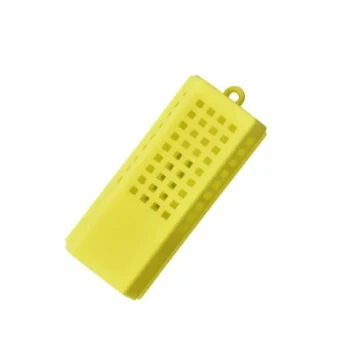
The physical structure of the cage is critical to the success of the experiment. It is typically constructed with a metal mesh.
This mesh serves two purposes: it prevents the bees from escaping and ensures proper air exchange. Good ventilation prevents humidity buildup and respiratory issues that could artificially lower survival rates.
Understanding the Trade-offs
While laboratory cages are essential for establishing baseline data, they are inherently artificial environments. They strip away the complex social structures and division of labor found in a full colony.
Consequently, data derived from cages should be viewed as a preliminary screening tool. They are excellent for determining toxicity and dosage safety, but they cannot perfectly predict how a biological agent will interact with the complex ecosystem of a full-scale apiary.
Making the Right Choice for Your Research
Using laboratory cages is a strategic step in the research pipeline, not necessarily the end destination.
- If your primary focus is establishing toxicity thresholds: Use laboratory cages to test various ratios and concentrations without the noise of environmental variables.
- If your primary focus is behavioral analysis: Recognize that cages limit social interaction; this method is better for physiological survival data than behavioral study.
- If your primary focus is cost-efficiency: Use cages to validate the safety of a biological agent before investing in large-scale, high-risk field trials.
Laboratory cages provide the clean, undeniable data needed to justify moving a biological agent from the lab bench to the field.
Summary Table:
| Feature | Research Benefit | Impact on Survival Data |
|---|---|---|
| Variable Isolation | Eliminates weather and foraging noise | Higher statistical accuracy |
| Age Standardization | Uses bees of identical cohorts | Prevents age-related mortality bias |
| Dosage Control | Precise syrup-to-agent ratios | Identifies exact toxicity thresholds |
| Real-time Monitoring | Immediate recording of mortality | Accurate average lifespan calculation |
| Metal Mesh Design | Ensures high-quality ventilation | Prevents humidity-induced stress |
Elevate Your Apiary Research and Productivity with HONESTBEE
At HONESTBEE, we understand that scientific precision in the lab translates to commercial success in the field. Whether you are a distributor looking to supply the latest beekeeping tools or a commercial apiary seeking advanced honey-filling and hive-making machinery, we offer the comprehensive wholesale solutions you need.
Our extensive portfolio ranges from high-durability hardware and essential industry consumables to unique honey-themed cultural merchandise. Partner with us to access professional-grade equipment designed for the modern beekeeping industry.
Ready to scale your operations? Contact us today to explore our wholesale catalog!
References
- С.Л. Воробьева, A. S. Fedorova. ОПЫТ ПРИМЕНЕНИЯ ФЕРМЕНТНОГО ПРЕПАРАТА С УСИЛЕННЫМ АНТИОКИСЛИТЕЛЬНЫМ ЭФФЕКТОМ ПРИ НОЗЕМАТОЗЕ МЕДОНОСНЫХ ПЧЕЛ. DOI: 10.48012/1817-5457_2025_2_117-124
This article is also based on technical information from HonestBee Knowledge Base .
Related Products
- Automatic Heat Preservation 6 Frame Pro Nuc Box for Honey Bee Queen Mating
- Twin Queen Styrofoam Honey Bee Nucs Mating and Breeding Box
- Langstroth Honey Bee Box Hive Boxes for Different Depths
- Hexagonal Direct Comb Introduction Queen Bee Cage
- Professional Queen Bee Introduction and Transport Cage
People Also Ask
- What are the options for adding frames to a nuc after taking two frames from the parent colony?
- How are nuc boxes used in queen rearing? The Essential Tool for Reliable Queen Mating
- What steps are involved in transferring frames from the nuc box to the hive? A Guide for a Smooth, Low-Stress Colony Move
- What is the process for managing a new bee colony started in a nuc box? Expert Tips for Hive Success
- How long can bees be kept in a nuc box? Expert Timeline for Hive Transfer