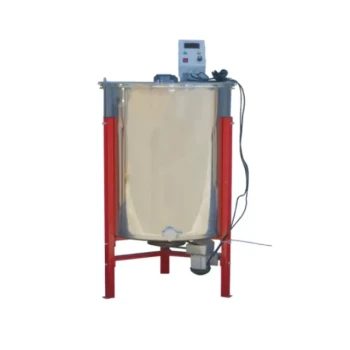
To ensure the integrity of your analysis and the efficiency of your equipment, a centrifuge is an indispensable tool in propolis processing. It utilizes high-speed rotation to generate powerful centrifugal forces, which separate solid propolis residues from the liquid phase containing active ingredients. This mechanical separation is significantly faster and more thorough than natural sedimentation, producing a clear liquid that is free of insoluble microparticles.
Core Insight: The centrifuge acts as a critical quality control gate, removing microscopic suspended solids that would otherwise compromise chemical analysis results or physically damage downstream filtration systems.
The Mechanics of Purification
Overcoming Natural Limitations
Propolis extraction liquid is naturally laden with fine impurities. These often include residual resins, waxes, and microscopic bee debris.
Because these particles are fine and often have densities similar to the liquid, they are difficult to separate via natural sedimentation (gravity alone). A high-speed centrifuge generates a force field that rapidly drives these suspended particles into a dense sediment at the bottom of the container.
achieving True Solid-Liquid Separation
The primary physical goal is obtaining a "mother liquor" that is highly transparent. By forcing the solids out of suspension, the centrifuge ensures that the remaining liquid contains only the desired dissolved active ingredients.
Ensuring Analytical Accuracy
Protecting Chromatographic Integrity
For professionals analyzing the chemical composition of propolis, clarity is non-negotiable. The primary reference emphasizes that centrifugation is critical for chromatographic fingerprint analysis.
If insoluble microparticles remain in the sample, they generate "noise" or false peaks in the data. By removing these residues, the centrifuge ensures that the analysis reflects the true active ingredients rather than contaminants.
Standardizing Samples
Consistency is key in scientific analysis. Centrifugation provides a repeatable method for sample preparation, ensuring that every batch is processed to the same standard of clarity before it reaches the analytical stage.
Operational Efficiency and Equipment Protection
Pre-treatment for Nanofiltration
Beyond analysis, centrifugation plays a vital role in production workflows. It serves as a necessary pre-treatment step for downstream processing equipment.
Specifically, if you utilize nanofiltration to further refine the extract, suspended solids are a major hazard. Without prior centrifugation, these particles will rapidly clog membrane pores, leading to equipment failure and increased maintenance costs.
Understanding the Process Limitations
Physical vs. Chemical Separation
It is important to recognize what a centrifuge cannot do. It provides physical separation based on density and particle size, but it does not remove dissolved impurities or concentrate the solution.
For example, removing dissolved ethanol requires a rotary evaporator, and removing larger debris like wood chips might be better suited for a vacuum filtration system. The centrifuge is a precision tool for suspended microparticles, not a universal filter.
Making the Right Choice for Your Goal
To maximize the value of your propolis extraction process, apply the centrifuge based on your specific downstream requirements:
- If your primary focus is analytical testing: Ensure high rotational speeds to remove all microparticles that could interfere with chromatographic baselines.
- If your primary focus is large-scale production: Prioritize centrifugation as a protective measure to extend the lifespan of your sensitive nanofiltration membranes.
By effectively isolating solid residues from the active liquid phase, centrifugation safeguards both the accuracy of your data and the longevity of your processing equipment.
Summary Table:
| Feature | Benefit of Centrifugation in Propolis Processing |
|---|---|
| Separation Type | Rapidly removes microscopic suspended solids and bee debris |
| Analytical Value | Prevents "noise" in chromatographic fingerprint analysis |
| Equipment Protection | Prevents clogging of expensive nanofiltration membranes |
| Physical Goal | Produces a transparent "mother liquor" free of microparticles |
| Process Efficiency | Significantly faster and more thorough than natural sedimentation |
Elevate Your Beekeeping Operation with HONESTBEE
At HONESTBEE, we specialize in empowering commercial apiaries and distributors with the professional-grade tools needed for high-quality propolis and honey production. From specialized centrifuges and honey-filling machines to advanced beekeeping hardware and consumables, we provide a comprehensive wholesale offering designed for industry-leading efficiency.
Whether you are refining your propolis extraction process or scaling your apiary’s production capacity, our expert team is ready to supply the machinery and cultural merchandise that drive success. Contact us today to explore our full product portfolio and wholesale solutions!
References
- Dušanka Milojković‐Opsenica, Živoslav Tešić. TLC Fingerprinting and Pattern Recognition Methods in the Assessment of Authenticity of Poplar-Type Propolis. DOI: 10.1093/chromsci/bmw024
This article is also based on technical information from HonestBee Knowledge Base .
Related Products
- Manual Hand Crank 4 Frame Honey Extractor Centrifuge for Beekeeping
- electric honey extractor honey centrifuge 3 frame honey extractor stainless steel honey frame extractor
- Professional 4 Frame Self Reversing Electric Honey Extractor for Beekeeping
People Also Ask
- What are some tips for achieving efficient honey extraction with a centrifuge extractor? Maximize Your Yield & Efficiency
- What is the proper procedure for maintaining a centrifuge honey extractor? Expert Tips for Longevity and Hygiene
- What are the advantages of using a centrifuge honey extractor? Maximize Yields and Protect Your Honeycombs
- Which type of honey extractor is generally more durable? Focus on Material & Build Quality for Longevity
- What is a manual honey extractor? The Essential Guide to Cost-Effective Beekeeping for Beginners