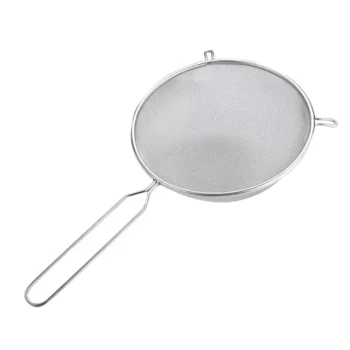
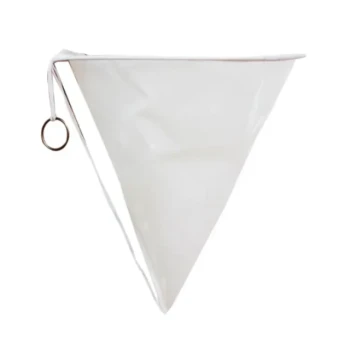
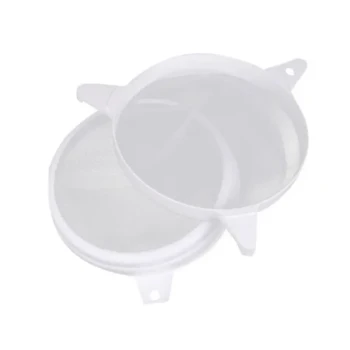
The requirement for a dual-layer filtration system stems from the need to execute a "gradient filtration" process that balances purity with processing efficiency. The 2mm primary mesh acts as a coarse barrier to capture bulk debris like wax and bee parts, protecting the system from clogging. The secondary 0.5mm mesh refines the product by intercepting minute impurities, ensuring visual clarity and texture without stripping the honey of its nutritional value.
By staging filtration from coarse to fine using chemically inert materials, you maximize visual appeal and shelf stability while preventing the chemical contamination that occurs when acidic honey interacts with non-standard metals.
The Mechanics of Gradient Filtration
The Role of the 2mm Primary Filter
The first stage of the system is strictly mechanical protection. A 2mm mesh is specifically sized to target "macroscopic" contaminants.
Its primary function is to catch large wax cappings, bee larvae debris, and other physical foreign objects introduced during the uncapping process. By removing these large solids first, you prevent the finer downstream filter from becoming immediately saturated and blocked.
The Role of the 0.5mm Fine Filter
Once bulk debris is removed, the honey passes through the 0.5mm mesh. This stage is critical for the sensory quality of the final product.
It effectively intercepts minute suspended particles, fine plant fibers, and micro-impurities. This step transforms the honey from a raw state into a polished product with the uniform texture and clear color expected in the high-end market.
Why Stainless Steel is Non-Negotiable
Chemical Stability Against Acidity
Honey is naturally acidic. Standard metals or lower-grade plastics can degrade when in prolonged contact with high-sugar, acidic environments.
Stainless steel provides the necessary chemical stability to prevent corrosion. This ensures that no metallic tastes or chemical contaminants leach into the honey, preserving its natural flavor profile.
Hygiene and Biological Safety
Honey processing equipment must meet rigorous food safety standards. Stainless steel offers a smooth, non-porous surface that resists biofilm formation.
It allows for thorough chemical disinfection and cleaning, eliminating pathogen residues in crevices. This prevents cross-contamination between batches and ensures the biological safety of the edible product.
Impact on Product Stability
Controlling Crystallization
One of the deep needs addressed by this system is shelf life. Minute impurities often act as nucleation sites.
These microscopic particles provide a surface for glucose crystals to begin forming. By filtering down to 0.5mm, you significantly reduce the number of these nucleation sites, thereby slowing down the natural crystallization process and keeping the honey liquid for longer.
Nutrient Retention
Despite the filtration, the 0.5mm size is strategic. It is fine enough to remove dirt but generally large enough to allow natural components to pass through.
The goal is to maintain the honey’s nutritional integrity. A properly calibrated system clarifies the liquid without stripping away all the beneficial enzymes and micro-nutrients that define raw honey.
Understanding the Trade-offs
Flow Rate vs. Clarity
While the dual-layer system improves quality, it introduces resistance. The 0.5mm filter creates a bottleneck that significantly reduces flow rate compared to a single coarse filter.
Operators must account for this pressure drop. Attempting to force honey through the 0.5mm mesh too quickly (high pressure) can compress soft debris through the mesh or damage the filter integrity.
The Risk of Over-Filtration
There is a delicate balance between clarity and authenticity. If you were to filter significantly finer than 0.5mm (e.g., into the micron range), you risk ultra-filtration.
Ultra-filtration removes pollen grains, which are essential for identifying the botanical source of the honey. The 2mm/0.5mm combination is a standard specifically chosen to avoid this "sterile" state, maintaining the product's identity as natural honey rather than simple syrup.
Making the Right Choice for Your Goal
When configuring your filtration line, your priorities dictate how strictly you adhere to these mesh standards.
- If your primary focus is Market Grade Aesthetics: Prioritize the 0.5mm secondary stage to ensure the high clarity and uniform texture required for premium retail shelving.
- If your primary focus is Botanical Identification: Ensure you do not decrease the mesh size below 0.5mm, as this preserves the pollen grains necessary to prove the honey's origin (e.g., Forest Honey).
- If your primary focus is Equipment Longevity: Invest strictly in food-grade stainless steel, as avoiding corrosion from acidic honey is cheaper than replacing degraded equipment.
The 2mm/0.5mm stainless steel system is the industry standard because it effectively removes the bad (wax, debris) while protecting the good (nutrients, pollen) in a durable, sanitary package.
Summary Table:
| Filter Stage | Mesh Size | Primary Function | Key Contaminants Removed |
|---|---|---|---|
| Primary | 2.0mm | Mechanical protection & coarse filtration | Wax cappings, bee parts, large debris |
| Secondary | 0.5mm | Polishing & quality refinement | Fine fibers, micro-impurities, nucleation sites |
| Material | Stainless Steel | Chemical stability & hygiene | Prevents corrosion and metallic contamination |
Elevate Your Honey Quality with Professional Filtration
At HONESTBEE, we understand that commercial apiaries and distributors require equipment that balances high-end aesthetics with nutritional integrity. Our food-grade stainless steel filtration systems are engineered to resist acidity, ensure biological safety, and maximize the shelf stability of your honey.
From specialized honey-filling machines to a comprehensive range of beekeeping tools and machinery, we provide everything needed to scale your operations. Partner with us to access professional-grade hardware and essential industry consumables tailored for the wholesale market.
Ready to refine your production? Contact us today to discuss our wholesale equipment solutions!
References
- Charline Obone, Alexis Nicaise Lepengué. Physico-Chemical Characterization of Some Honeys from the Savannah-Gallery Forest Complex and Primary Forest in Gabon. DOI: 10.4236/ojapps.2024.147124
This article is also based on technical information from HonestBee Knowledge Base .
Related Products
- Stainless Steel Double Layer Honey Strainer Sieve Filters
- Professional Stainless Steel Honey Filter with Support Handle
- Stainless Steel Triangle Support Honey Strainer and Filters
- Professional Stainless Steel Honey Filtering Machine with Water Bath Heating for Beekeeping
- Electric Double Wall Honey Filtering Machine Purifier Equipment for Honey Processing Plant
People Also Ask
- What are some typical mesh size combinations found in double sieve honey strainers? Expert Guide to Honey Filtration
- How is a double-layer honey filter used for monitoring Varroa mite infestation? Achieve Precise Pest Control Data
- How do double-layer honey filters and white blotting paper function together in Varroa mite detection? Expert Guide
- What is the function of honey sieves, strainers, and filters in processing? Master the 3 Stages of Honey Purity
- What mesh sizes are commonly used in double sieve honey strainers? Achieve Clean, Raw Honey Efficiently