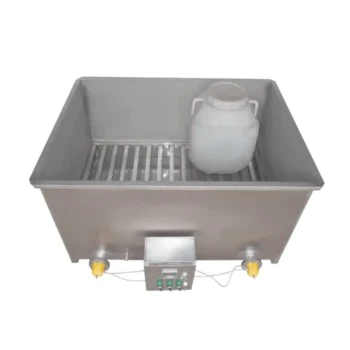
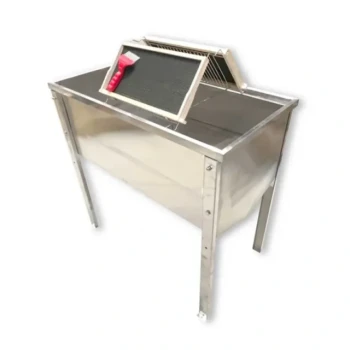
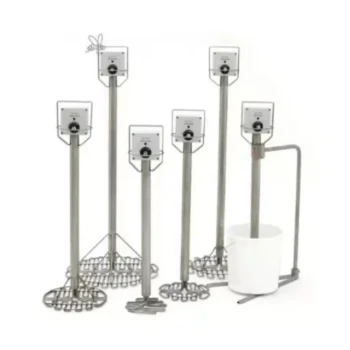
Decanting is a passive purification method that relies on gravity and time rather than mechanical force to clarify honey. By allowing raw honey to rest in a settling tank, usually for a period of roughly two weeks, impurities separate naturally based on density, effectively removing air bubbles and fine wax without the physical stress of direct filtration.
The core distinction lies in the method of separation: decanting utilizes static sedimentation to achieve high clarity and purity naturally, enhancing commercial value by preserving the honey’s physical state.
The Mechanics of Static Sedimentation
Gravity as a Separator
Unlike direct filtration, which forces honey through a mesh barrier, decanting uses the principle of density. Heavier components sink, while lighter impurities naturally rise to the surface.
Targeting Specific Impurities
This process is particularly effective for removing air bubbles and fine wax particles. These elements are lighter than the honey itself and migrate upward to form a "foam" or scum layer that can be easily skimmed off.
The Time Requirement
Achieving high purity through decanting is not immediate. The honey typically requires a resting period of approximately two weeks to fully clarify.
Why Decanting Enhances Sensory Quality
Clarification Without Agitation
Direct filtration can sometimes aerate the honey or break down particles due to pressure. Decanting is a static process, meaning the honey remains at rest.
Visual Appeal and Market Value
The primary output of the settling tank is a product with high clarity and no visible residues. This visual purity directly correlates to a higher commercial value and improved market perception.
Understanding the Trade-offs
Production Velocity
The most significant limitation of decanting is speed. While filtration systems can process honey continuously, decanting creates a bottleneck where inventory must sit idle for weeks.
Space Requirements
Because the process relies on retention time, producers need sufficient tank capacity to hold the harvest while it settles. This requires more physical floor space compared to inline filtration systems.
Making the Right Choice for Your Goal
To decide between decanting and filtration, you must balance your need for throughput against your desire for a natural presentation.
- If your primary focus is sensory quality: Prioritize decanting to produce a crystal-clear, high-purity product that retains its natural character without mechanical stress.
- If your primary focus is processing speed: Recognize that the two-week static sedimentation period of decanting will significantly slow your production cycle compared to direct filtration.
Ultimately, decanting is the superior choice for producers who view clarity and natural handling as the primary drivers of their honey's commercial worth.
Summary Table:
| Feature | Decanting (Settling Tanks) | Direct Filtration |
|---|---|---|
| Mechanism | Static Sedimentation (Gravity) | Mechanical Pressure/Mesh Barrier |
| Primary Targets | Fine wax particles & air bubbles | Large debris & coarse impurities |
| Processing Time | ~2 weeks (Slow) | Immediate (Fast) |
| Product Quality | High clarity, minimal aeration | High speed, potential for aeration |
| Physical Stress | None (Passive) | High (Mechanical Force) |
Elevate Your Honey Quality with HONESTBEE Professional Equipment
Are you ready to optimize your purification process for maximum market value? HONESTBEE provides commercial apiaries and distributors with the high-capacity settling tanks and specialized machinery needed to achieve superior honey clarity.
Whether you are scaling up your production line with honey-filling machines or sourcing essential beekeeping tools, we offer a comprehensive wholesale portfolio designed to enhance your efficiency. Contact us today to discover how our industry-leading hardware and consumables can help you deliver a premium, crystal-clear product to your customers.
References
- Kleber Solera, Leandro Dênis Battirola. Perspectives of honey production in Mato Grosso: an evaluation from the point of view of beekeepers. DOI: 10.1590/1809-4422asoc01971vu28l4oa
This article is also based on technical information from HonestBee Knowledge Base .
Related Products
- Stainless Steel Honey Storage and Settling Tank with Double Strainer
- Stainless Steel Honey Storage Tank with Lid for Honey
- Heavy Duty Stainless Steel Honey Processing Machine Decrystallizing Tank
- Professional Honey Storage Tank with Agitation System
- Stainless Steel Heated Honey Tank Warming Heating Tank
People Also Ask
- What economic role do honey storage tanks play? Boost Your Revenue Through Strategic Inventory Management
- What roles do industrial honey storage tanks and filtration meshes play in processing? Ensure Purity & Consistency
- What is the purpose of a honey storage tank? Streamline Your Honey Processing for Quality & Efficiency
- What role do settling tanks play in honey production? Achieve Pure, High-Clarity Honey Naturally
- Why are large settling tanks used in the honey clarification process? Achieve Natural Purity & Batch Consistency