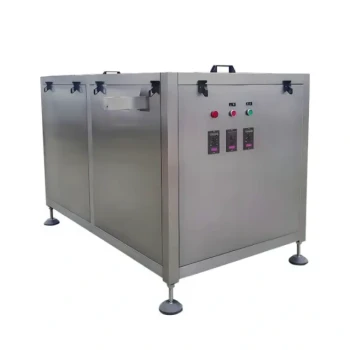
A high-precision rotational viscometer is the fundamental instrument for quantifying the flow behavior and internal structure of honey. It provides critical measurements of viscosity (mPa.S) under strictly controlled temperatures and speeds, directly influencing the efficiency of industrial filling equipment. Beyond processing, this data serves as a vital, non-destructive metric for verifying honey purity, freshness, and detecting economic adulteration through water dilution.
Core Takeaway While visual inspection can estimate thickness, only a rotational viscometer provides the precise rheological data required to engineer industrial transport systems and scientifically validate botanical authenticity. It bridges the gap between raw physical properties and efficient, standardized production.
Optimizing Industrial Processing
Designing Efficient Transport Systems
Accurate viscosity data is indispensable for the engineering of industrial fluid pipelines and transport pumps. A rotational coaxial cylinder viscometer provides the data necessary to calculate flow resistance.
Engineers rely on this specific technical data to verify the linear relationship between shear stress and shear rate. This confirms the fluid characteristics of the honey, ensuring pumps are sized correctly to prevent equipment failure or flow stagnation.
Simulating Real-World Handling
Honey behaves differently when sitting in a jar versus being pumped through a high-speed filler. A high-precision viscometer measures torque at defined speeds to simulate these conditions.
By analyzing the resulting data, manufacturers can model how honey will react during stirring and pumping. This allows for the calculation of activation energy and ensures the handling efficiency of filling lines is optimized to prevent bottlenecks.
Defining the Fluid Model
Understanding whether honey acts as a Newtonian fluid or exhibits pseudoplastic (shear-thinning) behavior is critical for processing. A concentric cylinder rheometer creates a uniform shear field to make this distinction.
Accurate shear stress and shear rate data allow processors to fit power-law models to their product. This ensures that the machinery used is appropriate for the specific physical state of the honey being processed.
Ensuring Quality and Authenticity
Detecting Adulteration and Freshness
Viscosity is a direct indicator of honey's internal composition. A rotational viscometer serves as a non-destructive testing tool to judge the quality of the product without altering it.
Significant deviations in viscosity often signal potential adulteration, specifically water addition. Furthermore, viscosity profiles change as honey ages, making this tool essential for assessing freshness and maturity.
Identifying Botanical Origin
Different floral sources produce honey with distinct rheological signatures. A digital viscometer can capture the fluid's resistance to rotation to distinguish between these varieties.
By measuring torque at a constant temperature (e.g., 25 °C), producers can obtain physical parameters that differentiate, for example, wildflower honey from orange blossom honey. This validates labeling claims and ensures consumer trust.
Understanding the Trade-offs
Temperature Sensitivity
Viscosity measurements are meaningless without strict temperature control. Honey is highly sensitive to thermal changes; a fluctuation of even a few degrees can drastically alter the mPa.S reading.
The trade-off: High-precision equipment requires rigorous environmental controls. If the temperature is not maintained constant (e.g., at exactly 25 °C) during testing, the data cannot be used for comparative analysis or quality control.
Complexity of Interpretation
While a simple viscometer gives a single viscosity number, true rheological analysis requires understanding the relationship between shear stress and shear rate.
The trade-off: A single-point measurement may oversimplify the fluid's behavior. To fully understand how honey will flow under industrial stress, technicians must perform multipoint tests to verify if the fluid is behaving linearly (Newtonian) or thinning under pressure.
Making the Right Choice for Your Goal
To maximize the utility of a rotational viscometer, tailor your testing approach to your specific objective:
- If your primary focus is Industrial Engineering: Prioritize a coaxial cylinder configuration to generate precise shear rate sweeps for pump and pipeline calculations.
- If your primary focus is Quality Control: Prioritize standardized single-point viscosity tests at constant temperatures to quickly flag adulteration or verify botanical origin.
Precise rheological analysis transforms honey from a variable natural product into a predictable, manageable industrial ingredient.
Summary Table:
| Key Feature | Benefit for Honey Industry | Industrial Application |
|---|---|---|
| Viscosity Quantification | Verifies purity and detects water dilution/adulteration | Quality Control & Lab Testing |
| Shear Stress Analysis | Defines flow models (Newtonian vs. Pseudoplastic) | Equipment Calibration |
| Torque Measurement | Simulates flow behavior during high-speed filling | Bottling Line Optimization |
| Temperature Control | Ensures data accuracy across different floral origins | Botanical Authentication |
| Coaxial Geometry | Provides precise data for pipeline & pump engineering | Infrastructure Design |
Elevate Your Honey Production with HONESTBEE
Precise rheological data is the backbone of efficient honey processing and global distribution. At HONESTBEE, we empower commercial apiaries and distributors by providing the professional-grade tools needed to transform raw honey into a standardized, high-quality industrial product.
How we add value to your business:
- Comprehensive Equipment Supply: From high-precision testing tools to advanced honey-filling machines and specialized hive-making hardware.
- Wholesale Solutions: A full spectrum of beekeeping machinery and essential industry consumables tailored for large-scale operations.
- Industry Expertise: We help you optimize transport systems and ensure botanical authenticity through our premium machinery portfolio.
Ready to scale your operation and ensure the highest product standards? Contact HONESTBEE today to explore our wholesale equipment solutions!
References
- L Cedillo, Daniel Trujillo‐Ramírez. EVALUATION OF THE QUALITY OF BEE HONEY (Apis mellifera) FROM CENTRAL-SOUTH REGION OF TAMAULIPAS, MEXICO. DOI: 10.55908/sdgs.v12i12.4205
This article is also based on technical information from HonestBee Knowledge Base .
Related Products
- Commercial Rotary Honey Filling Machine for Production
- Precision Durable Efficient HONESTBEE Rotary Honey Filling Machine
- Precision Honey Refractometer Instrument for Quality Assessment
- Fully Automatic High Speed Centrifugal Bottle Unscrambler
- Digital Honey Refractometer for Precision Measurement of Optimal Honey Quality
People Also Ask
- What role do commercial honey filling machines play in honey distribution? Scaling Efficiency and Quality Control
- What technical support do commercial-grade filling machines provide? Convert Honey NTFPs into Marketable Commodities
- What is the significance of specialized honey filling equipment? Scaling from Beekeeping to Commercial Success
- Why is professional honey filling machinery critical for honey production? Scale Your Apiary's Profit & Efficiency
- Why is high-capacity honey filling machinery necessary for Giant Honey Bees? Solve the Apis dorsata Volume Crisis