Performing honey extraction in warmer ambient temperatures is advantageous primarily because heat significantly reduces the viscosity of the honey. When honey is warm, it transitions from a thick, sluggish substance to a fluid that flows effortlessly out of honeycomb cells and passes through filtration mesh with minimal resistance. This simple thermal adjustment directly correlates to higher efficiency and reduced processing time.
Core Takeaway By maintaining a warmer environment, you lower the honey's resistance to flow, ensuring it exits the comb completely and moves through processing equipment without creating bottlenecks or causing unnecessary mechanical strain.
The Mechanics of Viscosity
Reducing Fluid Resistance
Viscosity is the measure of a fluid's internal resistance to flow. Cold honey has high viscosity, meaning it resists movement and clings to surfaces.
Heat lowers this resistance, allowing the honey to behave more like a liquid and less like a semi-solid.
Increasing Flowability
Because the honey is less viscous, it flows smoothly rather than dragging. This is critical when gravity or centrifugal force is attempting to pull the honey out of the deep cells of the honeycomb.
Impact on Extraction Equipment
Optimizing Centrifugal Extraction
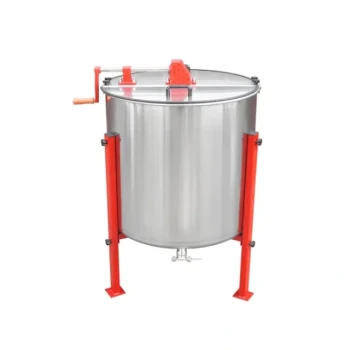
Most modern extraction relies on centrifugal extractors that spin frames to throw honey out.
If the honey is cold, it clings to the wax, requiring higher speeds or longer spin times to dislodge. Warmer honey releases easily, significantly increasing the extraction rate.
Facilitating Automated Uncapping
Before extraction, the wax caps must be removed from the cells.
In automated uncapping machines, warm honey allows the frames to move through the mechanism smoothly. This prevents the honey from dragging on the blades or chains, ensuring a clean cut and continuous operation.
Extending Equipment Lifespan
Processing cold, thick honey places a heavy load on motors and gears.
By warming the environment, you reduce the torque required to spin or pump the honey. This directly reduces mechanical wear, protecting your investment in expensive machinery.
Enhancing Filtration Efficiency
Preventing Bottlenecks at the Mesh
Once extracted, honey must be filtered to remove wax and debris.
Cold honey often sits on top of the filtration mesh, creating a backlog. Warm honey passes through the fine mesh quickly, preventing overflows and keeping the production line moving.
Understanding the Trade-offs
The Requirement for Consistency
The advantage of heat is lost if the temperature fluctuates.
To achieve the benefits of reduced wear and high flow rates, you must utilize constant heating. "Warm rooms" are often used to maintain a stable environment, ensuring the honey remains at optimal viscosity throughout the entire process, from uncapping to filtration.
Making the Right Choice for Your Goal
To apply this to your extraction workflow, consider your specific operational needs:
- If your primary focus is Speed: Maintain a consistently warm ambient temperature to ensure rapid flow through filtration mesh and centrifugal extractors.
- If your primary focus is Equipment Longevity: Use warmth to lower viscosity, thereby reducing the mechanical load and wear on your uncapping and spinning machinery.
Managing ambient temperature is the single most effective variable for transforming a sluggish extraction process into a smooth, efficient operation.
Summary Table:
| Factor | Cold Extraction | Warm Extraction (Advantageous) |
|---|---|---|
| Viscosity | High (Thick & Sluggish) | Low (Fluid & Easy Flow) |
| Extraction Rate | Slow; Honey clings to wax | Fast; Honey releases easily |
| Equipment Strain | High torque; Heavy motor wear | Low torque; Reduced mechanical wear |
| Filtration Speed | Slow; Potential for overflows | Rapid; Passes through mesh easily |
| Uncapping | Difficult; Honey drags on blades | Smooth; Clean cuts and continuous flow |
Maximize Your Harvest Efficiency with HONESTBEE
Optimizing your honey extraction process requires more than just the right temperature—it requires professional-grade equipment built for performance. HONESTBEE specializes in supporting commercial apiaries and distributors with a comprehensive range of wholesale beekeeping solutions.
From high-efficiency honey-filling machines and automated uncapping systems to specialized hardware and essential consumables, we provide the tools you need to reduce mechanical wear and accelerate your production line. Whether you are scaling a commercial operation or supplying the industry, our portfolio of beekeeping machinery and honey-themed cultural merchandise ensures you stay competitive.
Ready to upgrade your extraction workflow? Contact us today to discover how HONESTBEE can deliver precision and durability to your business.
Related Products
- Electric 8 Frame Honey Spinner Extractor Equipment for Beekeeping
- 6 Frame Manual Stainless Steel Honey Extractor Beekeeping Equipment
- HONESTBEE 2 Frame Manual Acrylic Honey Extractor Beekeeping Equipment
- 32 Frame Commercial Electric Honey Extractor for Beekeeping and Honey Production
- HONESTBEE 72 Frame Industrial Electric Honey Extractor for Beekeeping
People Also Ask
- What are the advantages of an electric honey extractor? Boost Efficiency and Scale Your Honey Production
- What are the characteristics of electric honey extractors? Boost Your Apiary Efficiency with Automated Technology
- What are the disadvantages of using an electric honey extractor? Weighing Cost, Power, and Comb Safety
- What are the features of an electric honey extractor? Boost Your Apiary's Productivity with Motorized Efficiency
- What are the technical advantages of electric honey extractors? Maximize Yield and Protect Your Bee Colony