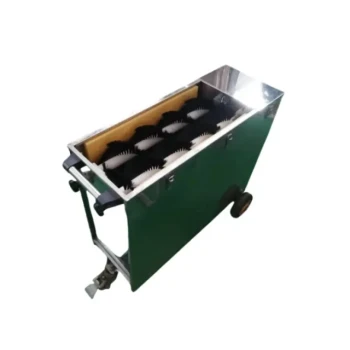
Implementing improved beekeeping equipment is the most effective way to align economic prosperity with environmental preservation. By increasing the economic yield per unit of land, modern tools provide forest-adjacent communities with a high-margin alternative to destructive practices like logging or land clearing. This shift transforms the local population into active guardians of the forest, as their livelihood depends directly on a healthy, standing ecosystem.
Core Takeaway: Improved beekeeping equipment creates a symbiotic relationship between profit and protection; it maximizes financial returns for local communities while removing the logistical and economic drivers of deforestation and habitat loss.
Driving Conservation Through Economic Alignment
Higher Yields per Hectare
Modern hives and specialized extraction tools significantly increase the volume and quality of honey produced compared to traditional methods. This efficiency creates a strong financial incentive for communities to prioritize beekeeping over resource-heavy agriculture.
Reducing Resource Dependency
By providing high financial returns through non-destructive means, improved equipment reduces the local population's reliance on over-exploiting forest resources. When beekeeping becomes a primary income source, the economic pressure to engage in illegal logging or charcoal production is drastically minimized.
Sustaining the Pollination Cycle
Beekeeping is inherently forest-compatible because honey production relies on the health of the surrounding flora. This creates a direct feedback loop where beekeepers actively protect floral diversity to ensure the continued productivity of their colonies.
Mitigating Physical Habitat Destruction
Eliminating the Need for Tree Felling
Traditional "honey hunting" often involves felling entire trees to access wild nests, leading to significant forest degradation. Standardized beekeeping machinery allows for the creation of permanent apiary sites, making the destructive practice of tree felling obsolete.
Reducing Deforestation via Standardized Materials
Modern beehives are manufactured from standardized lumber, often utilizing sustainable or waste materials. This shift alleviates the pressure on primary forests, as traditional methods frequently require the use of large, old-growth logs to create hollowed-out hives.
Preventing Wildfires through Modern Harvesting
Traditional harvesting often relies on heavy smoke and open fire to subdue bees, which poses a massive risk of accidental forest fires. Professional equipment and modern harvesting techniques eliminate these fire hazards, ensuring the safety of both the apiary and the broader forest canopy.
Enhancing Ecosystem Resilience Through Professionalism
Scientific Colony Management
Professional hive designs and specialized tools enable beekeepers to follow scientific management protocols. This includes regular health checks and disease monitoring, which are essential for maintaining the stability of local bee populations.
Managing Biological Risks
Standardized tools allow for better identification of colony health issues and help prevent the spread of diseases between populations. By maintaining healthy colonies, beekeepers minimize the risk of biological invasions that could disrupt the local ecological balance.
Reliable Sourcing for Scalable Impact
For distributors, providing a full-spectrum product portfolio is critical to ensuring that these conservation efforts can be scaled. Rapid response times and efficient order fulfillment allow local projects to implement these technologies quickly, maximizing their environmental impact.
Understanding the Trade-offs
The Barrier of Initial Investment
While improved equipment offers superior long-term returns, the upfront cost can be prohibitive for subsistence communities. Success often depends on distributors who can offer competitive pricing and reliable bulk supply chains to bridge this gap.
The Requirement for Technical Training
Simply providing equipment is rarely enough; users must understand scientific management to see the full environmental benefits. Without proper guidance, even modern equipment can be underutilized or mismanaged, leading to colony loss.
Dependence on Market Access
The conservation incentive only holds if the increased honey production can be sold. Communities require a stable supply chain and access to markets, which underscores the importance of working with experienced B2B partners who understand the global honey trade.
How to Apply This to Your Portfolio
Making the Right Choice for Your Goal
As a technical advisor in the trading space, I recommend tailoring your sourcing strategy based on the specific needs of your target market or conservation project:
- If your primary focus is rapid environmental impact: Source standardized, easy-to-assemble hive kits and modern smokers to immediately reduce the risks of tree felling and forest fires.
- If your primary focus is maximizing community income: Prioritize premium extraction tools and honey processing equipment that ensure the final product meets international export standards.
- If your primary focus is long-term ecological stability: Focus on professional monitoring tools and specialized queen-rearing equipment to promote colony health and genetic diversity.
By bridging the gap between advanced technology and forest-adjacent communities, you are not just selling equipment—you are providing the essential tools for sustainable global development.
Summary Table:
| Feature | Conservation Impact | Business Benefit |
|---|---|---|
| Modern Hives | Eliminates tree felling & habitat loss | Higher honey volume and land efficiency |
| Advanced Smokers | Prevents accidental forest fires | Safeguards apiary and forest assets |
| Extraction Machinery | Reduces resource dependency | Ensures export-grade honey quality |
| Monitoring Tools | Protects colony and ecosystem health | Long-term stability for commercial yields |
Scale Your Impact with HONESTBEE’s One-Stop Sourcing
As a distributor or B2B reseller, your success depends on a reliable supply of professional-grade equipment. HONESTBEE caters to commercial apiaries and wholesalers with a comprehensive, full-spectrum portfolio. From specialized hive-making and honey-filling machines to essential industry consumables and cultural merchandise, we provide the tools needed to align profit with sustainability.
Why Partner with HONESTBEE?
- Comprehensive Portfolio: One-stop access to specialized hardware, machinery, and beekeeping essentials.
- Rapid Fulfillment: Ultra-fast delivery and efficient order processing to meet market demands.
- Industry Expertise: Deep professional knowledge to support your OEM/ODM requirements and drive high margins.
- Exceptional Service: Dedicated support focused on the unique needs of B2B resellers and large-scale apiaries.
Ready to elevate your supply chain? Contact us today to access our premium wholesale offerings and expert trading services.
References
- Wanjiku Mwangi. Adoption, Livelihoods, and Returns: A Survey of Improved Beekeeping Technologies in Kakamega Forest-adjacent Communities, Kenya. DOI: 10.5281/zenodo.18944093
This article is also based on technical information from HonestBee Knowledge Base .
Related Products
- Queen Bee Artificial Insemination Instrument Equipment for Instrumental Insemination
- Stainless Steel J Hook Hive Tool for Beekeeping
- HONESTBEE Professional Mini J-Hook Hive Tool for Beekeeping
- Professional Bee Smoker with Elongated Spout and Durable Bellows for Beekeeping
- Durable Galvanized Steel Frame Grip
People Also Ask
- Why is maintaining sanitary conditions important during artificial insemination? Protect Your Queen from Fatal Infections
- Why are artificial insemination instruments critical in bee hybridization? Master Genetic Control & Pure Breeding
- What is the core value of bee artificial insemination instruments in breed improvement? Achieve Precise Genetic Control
- Why is professional bee artificial insemination equipment considered a core tool for genetic control in honeybee breeding? Ensure 100% Purity
- Why is high-purity CO2 used for queen bee artificial insemination? Unlock Precision Breeding & Faster Egg-Laying