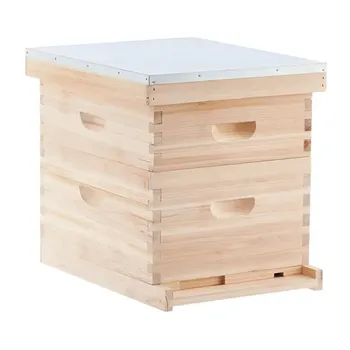
The internal population capacity of a beehive is the primary metric for calculating spatial pollination energy and operational efficiency. A high-volume beehive, which typically supports approximately 70,000 bees and 20,000 active foragers, serves as the definitive hardware specification for servicing farmland. By understanding these capacities, distributors can provide clients with precise unit-per-acreage recommendations that align biological output with agricultural demand.
Core Takeaway: Internal capacity determines the "pollination power" of a single unit, allowing for scientific asset allocation. Accurate density planning prevents the common pitfalls of equipment underutilization or colony overextension, ensuring maximum ROI for large-scale operations.
Maximizing Agricultural ROI Through Precision Density
The Forager-to-Acreage Ratio
High-volume hives function as the primary physical production units in professional beekeeping. With a capacity of 20,000 foragers, each hive provides a measurable "pollination energy output" that dictates how many units are required to cover a specific geographic area.
Strategic Asset Allocation
Quantifying beehive numbers based on internal capacity allows operators to evaluate if they are achieving optimal returns to scale. This scientific approach helps B2B resellers identify whether a client's project requires a broader deployment of units or a more concentrated density of high-capacity hardware.
Algorithmic Spatial Node Alignment
Professional deployment relies on algorithmically generated spatial nodes that correspond to the hive's forager output. By matching hive hardware to the specific acreage, distributors can ensure that pollination is uniform and that no area of the farmland is underserved.
Biological Stability and Spatial Management
Reducing Colony Splitting Triggers
The volume of the hive compartment directly influences the trigger mechanism for colony splitting. High-volume units (exceeding 2 liters in specific expansion zones) alleviate spatial pressure, providing sufficient room for brood chambers and honey pots.
Facilitating Colony Expansion
Larger internal volumes ensure the queen bee’s egg-laying area is not restricted, which is vital for maintaining a robust population of 70,000 bees. Small containers often fail because they limit expansion, resulting in incomplete colonies that cannot meet the high-volume forager requirements.
Managing Public Safety in Dense Areas
In high-density or urban deployments, spatial management is critical for mitigating human-bee conflicts. Using specific layout techniques and physical shielding boards, beekeepers can guide flight paths away from pedestrians while maintaining high-capacity production.
Understanding the Trade-offs and Pitfalls
Overextension and Competition
Increasing deployment density without considering local forage availability can lead to resource competition. If too many high-volume hives are placed in a limited area, the foragers may struggle to find sufficient nectar, leading to a decline in colony health and honey production.
Logistical Fulfillment Requirements
High-volume hardware requires efficient order fulfillment and specialized handling to maintain colony integrity during transport. Rapid response times are essential when colonies reach peak capacity, as spatial pressure can lead to sudden swarming if not managed with additional equipment.
Equipment Underutilization
Deploying high-capacity hives in areas with low pollination demand results in capital inefficiency. Wholesalers must help clients balance the cost of premium, high-volume hardware against the actual biological requirements of the crop to avoid "over-tooling" a project.
Strategic Selection for Your Beekeeping Portfolio
How to Apply This to Your Project
To ensure your clients receive the most effective pollination and honey production solutions, consider the specific goals of their deployment.
- If your primary focus is maximum agricultural yield: Prioritize high-volume hives with a proven 70,000-bee capacity to maximize the forager-to-acreage ratio across large land tracts.
- If your primary focus is operational scaling and ROI: Use standardized hive units to simplify asset allocation and ensure your equipment inventory matches the scale of the target farmland.
- If your primary focus is urban or sensitive area deployment: Invest in a full-spectrum portfolio that includes shielding boards and flight-path management tools to ensure safety alongside high-capacity production.
Mastering the relationship between internal hive capacity and deployment density is the key to delivering professional-grade agricultural results.
Summary Table:
| Key Metric | High-Volume Specification | Operational Impact |
|---|---|---|
| Total Population | ~70,000 Bees | Ensures biological stability & queen productivity |
| Active Foragers | ~20,000 Foragers | Dictates the unit-per-acreage pollination ratio |
| Spatial Volume | 2L+ Expansion Zones | Prevents colony splitting & swarming triggers |
| Deployment Goal | Precision Spatial Nodes | Maximizes agricultural yield & asset allocation |
Scale Your Beekeeping Business with HONESTBEE
As a premier partner for distributors, wholesalers, and B2B resellers, HONESTBEE understands that precision in hardware leads to excellence in the field. We offer a one-stop sourcing solution and premium trading services designed to maximize your profit margins and supply reliability.
Why Choose HONESTBEE?
- Full-Spectrum Portfolio: From high-capacity hives and specialized hive-making machinery to honey-filling equipment and essential industry consumables.
- Rapid Fulfillment: Ultra-fast delivery and efficient order processing to keep your inventory moving.
- Professional Expertise: Deep industry insights to help you provide expert recommendations to your commercial clients.
- OEM/ODM Support: Tailored manufacturing solutions with full certification compliance.
Ready to elevate your wholesale offering with high-performance beekeeping technology?
Contact Our Export Team Today to discuss bulk pricing and specialized equipment solutions.
References
- Jiaming Zhu, Jun Zhang. Optimal Placement Algorithm for Beehives with Pollination Probability Model. DOI: 10.54097/6rfc4997
This article is also based on technical information from HonestBee Knowledge Base .
Related Products
- Professional Large-Format Hive Number Set for Beekeeping
- HONESTBEE Professional Hive Top Bee Feeder Feeding Solution
- Professional Insulated Plastic Bee Hives
- Wholesales Dadant Size Wooden Bee Hives for Beekeeping
- Professional Hive Top Bee Feeder for Beekeeping
People Also Ask
- What are the structural advantages of bee hives with high-efficiency ventilation? Prevent Honeycomb Thermal Collapse
- How do different beekeeping hive structures influence productivity? Optimize Designs for Maximum Honey Yield
- Why Increase Hive Installation Quantity in Commercial Apiaries? Offset Climate Risks with Scalable Infrastructure
- How does the design of improved beekeeping hives contribute to maintaining honey quality and purity? Enhancing Purity
- What factors determine the necessary hive configuration for an apiary? Optimize Hive Setup for Better Colony Survival