The physical structure of wax combs and frames acts as a fundamental thermodynamic barrier, not merely a biological feature. If you attempt to model a hive as a simple hollow enclosure, your calculations regarding internal heat convection will be critically flawed. These structures physically divide the hive's internal volume into narrow, isolated gaps, preventing the free flow of air that drives standard heat transfer.
The presence of wax combs effectively suppresses large-scale natural convection by compartmentalizing air volume. This structural segmentation drastically alters the "equivalent thermal conductivity" of the hive, requiring Computational Fluid Dynamics (CFD) models to account for these physical partitions to achieve accuracy.
The Physics of Hive Aerodynamics
Suppression of Natural Convection
In an open space, warm air rises and cool air falls, creating large circulation loops known as natural convection.
Wax combs disrupt this process by acting as thermodynamic partitions.
They divide what would be continuous air layers into narrow, restricted gaps, physically blocking the formation of large-scale air currents.
Localized Air Movement
Because the combs segment the hive, air movement is confined to localized areas between the frames.
Instead of a single, hive-wide thermal loop, you have many small, independent pockets of air.
This localization prevents the rapid mixing of internal temperatures, helping the colony maintain a stable microclimate.
Impact on Thermal Conductivity
When convection is suppressed, heat cannot travel via moving air currents as easily.
This significantly alters the overall equivalent thermal conductivity of the hive interior.
The hive behaves less like a fluid-filled container and more like a solid insulator, changing how energy loss must be calculated.
The Role of Geometry in CFD Simulations
Modeling the Infrastructure
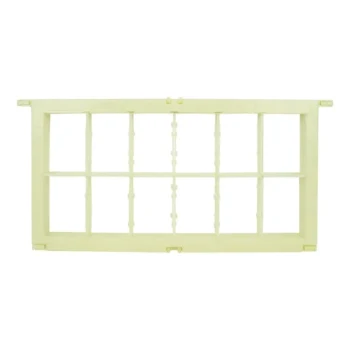
According to standard Computational Fluid Dynamics (CFD) simulations, the geometry of the frames cannot be ignored.
Frames provide the standardized structural support that enables bees to build the wax cells used for storage and reproduction.
This dense infrastructure creates the physical boundaries that define the simulation's mesh and boundary conditions.
The Density of the Barrier
The wax cells serve as storage units for pollen and honey, as well as the site for larval development.
This means the partitions are not just thin sheets; they are significant masses that occupy volume.
Accurate models must recognize these cells as solid obstacles that dictate the path of airflow.
Understanding the Trade-offs
Complexity vs. Computational Cost
Including the detailed geometry of wax combs and frames increases the complexity of a CFD model.
This requires a finer mesh and higher computational power to resolve the fluid dynamics within the narrow gaps.
However, simplifying the geometry to save processing time often results in overestimating heat loss, as the model will falsely predict high levels of convection.
Static Structure vs. Dynamic Contents
While the frames provide stable support, the contents of the wax cells change over time.
A frame filled with honey has different thermal properties than one filled with brood or air.
While the convection suppression (aerodynamics) remains constant due to the physical structure, the thermal mass may fluctuate, introducing a variable that geometric modeling alone may not fully capture.
Making the Right Choice for Your Goal
To ensure your thermal model serves your specific engineering or biological objectives, apply these principles:
- If your primary focus is high-fidelity thermal accuracy: You must explicitly model the geometry of the combs and frames to capture the suppression of natural convection.
- If your primary focus is simplified, rapid estimation: You may approximate the hive interior as a solid block with a modified (lower) thermal conductivity value to represent the lack of airflow.
Ignoring the physical structure of the combs implies an airflow reality that does not exist within the hive.
Summary Table:
| Factor | Impact on Heat Convection | Modeling Requirement |
|---|---|---|
| Wax Combs | Suppress natural convection by compartmentalizing air volume. | Must be modeled as physical partitions or barriers. |
| Frame Spacing | Creates narrow, isolated gaps that restrict large-scale airflow. | Defines the CFD mesh and boundary conditions. |
| Structural Density | Acts as a solid obstacle, altering equivalent thermal conductivity. | Requires high-resolution geometry for fluid dynamics. |
| Cell Contents | Changes the thermal mass (honey vs. brood vs. air). | Needs variable thermal properties based on contents. |
Maximize Your Colony’s Efficiency with HONESTBEE
Precise thermal management is the difference between a thriving commercial apiary and a struggling one. At HONESTBEE, we understand the complex physics of the hive. As a premier provider for commercial apiaries and global distributors, we offer a comprehensive wholesale range of:
- Precision Machinery: Advanced honey-filling and hive-making machines to streamline your production.
- Quality Infrastructure: Durable frames and hive components designed for optimal thermal stability.
- Essential Consumables: A full spectrum of beekeeping tools and industry-standard supplies.
Whether you are scaling a commercial operation or supplying the industry, our expertise ensures you have the right tools for the job. Contact HONESTBEE today to discuss your wholesale needs and see how our hardware and equipment can elevate your beekeeping success.
References
- Derek Mitchell. Honeybee cluster—not insulation but stressful heat sink. DOI: 10.1098/rsif.2023.0488
This article is also based on technical information from HonestBee Knowledge Base .
Related Products
- Assembled Wooden Bee Frames with Beeswax Foundation Ready to Use by HONESTBEE
- Wooden Bee Hive Frames for Beekeeping and Wholesale
- Professional Frame Comb Fork and Lifter for Efficient Handling
- Plastic Bee Frame Beekeeping Hive Frames for Wholesale
- Assembled Wooden Bee Frames with Plastic Foundation for Durability and Convenience by HONESTBEE
People Also Ask
- Under what circumstances should bee frames be destroyed? Protect Your Apiary from American Foulbrood
- How should frames be rearranged as a bee colony grows? Master Hive Expansion and Nest Management
- Do bee frames need foundation? Choose the Right Approach for Your Apiary
- Do you have to wire bee frames? Essential Guide to Frame Strength & Honey Harvesting
- How do you re-wax bee frames? A Simple Guide to Faster Comb Building