The Illusion of a Simple Procedure
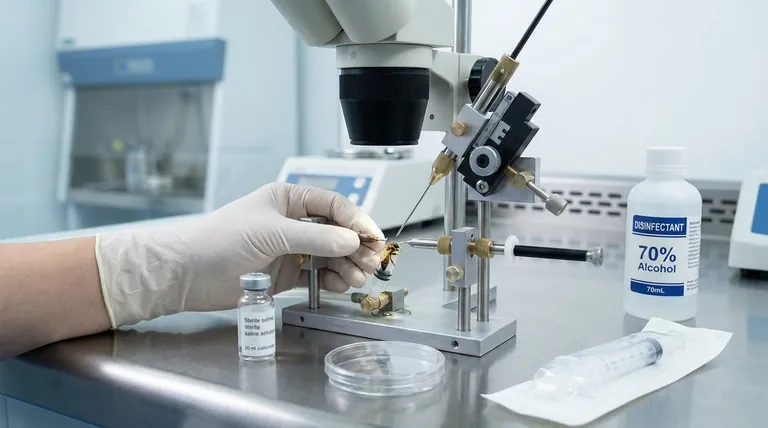
At a glance, the artificial insemination of a queen bee appears to be a feat of mechanical precision. A delicate instrument, a steady hand, a valuable queen. The focus is on the physical action—the visible, tangible steps.
This is a dangerous illusion.
The greatest risk in this procedure isn't a shaky hand or a misaligned instrument. It's the operator who sees the task as merely mechanical and forgets the millions of invisible passengers—bacteria, fungi, and viruses—present on every non-sterile surface.
Success in artificial insemination is not a mechanical skill. It is a surgical discipline.
The Queen's Defenseless Interior
To understand the stakes, you must appreciate the profound vulnerability of the queen. Her reproductive tract—the median and lateral oviducts—is an internal, pristine environment, sealed off from the outside world. It has no army of immune cells waiting to fight off a sudden invasion.
The insemination instrument bypasses every single one of her natural, external defenses.
It is a direct portal into her most sensitive internal system. Approaching this as anything less than a minor surgical operation is to invite catastrophic failure.
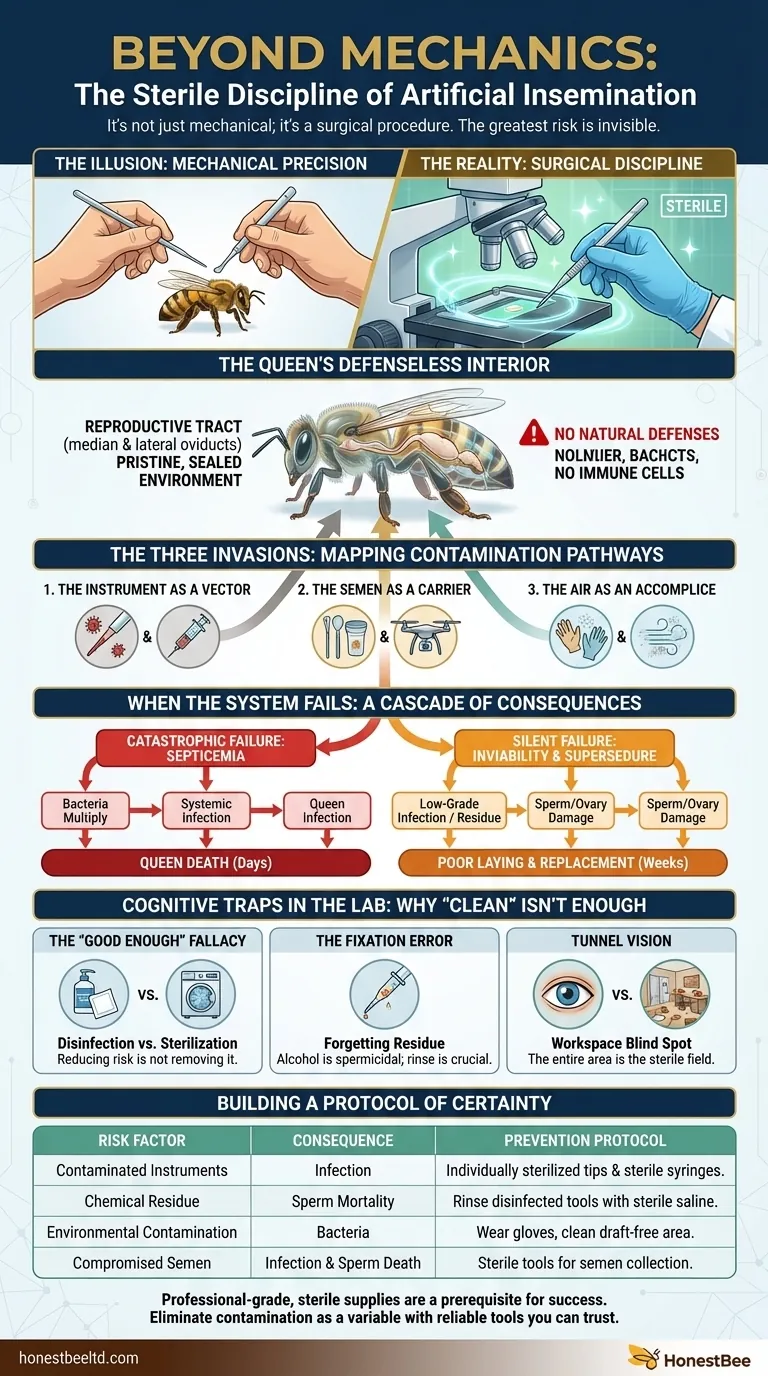
The Three Invasions: Mapping Contamination Pathways
Contamination isn't random; it follows predictable paths. Understanding these vectors is the first step toward building a sterile protocol.
- The Instrument as a Vector: The insemination tip, syringe, and handling hooks are the most direct routes for infection. A single microbe on the tip will be placed directly into the queen's oviduct.
- The Semen as a Carrier: Semen can be contaminated during collection if the drone or the collection tools are not clean. The payload itself becomes the poison.
- The Air as an Accomplice: The operator's hands, breath, or even dust motes drifting through the workspace can settle on sterile equipment in a moment of inattention, compromising the entire procedure.
When the System Fails: A Cascade of Consequences
A breach in sanitary protocol triggers a cascade of failures, ranging from the immediate and obvious to the subtle and delayed.
The Catastrophic Failure: Septicemia
This is the most severe outcome. Bacteria introduced into the oviducts find a warm, nutrient-rich environment. They multiply uncontrollably, spilling into the hemolymph (insect blood) and causing a systemic infection called septicemia.
For the queen, this is almost always a death sentence, usually within a few days.
The Silent Failure: Inviability and Supersedure
Sometimes the queen survives the initial infection, but the mission still fails. A low-grade bacterial presence can create a hostile environment in the reproductive tract.
This can damage or kill sperm before it reaches the spermatheca for storage. Or, it can damage the queen's ovaries, leading to a poor laying pattern. The colony, with its brutal efficiency, will detect a failing queen and replace her—an act called supersedure.
All the time, effort, and resources invested in her are lost.
Cognitive Traps in the Lab: Why "Clean" Isn't Enough
The most persistent failures in sanitation stem from psychological blind spots, not a lack of effort.
The "Good Enough" Fallacy: Clean vs. Sterile
Wiping an instrument with 70% alcohol feels effective. It’s an action with a visible result. But this is disinfection, which only reduces the microbial load. It is not sterilization, which eliminates all microbial life. This distinction is the difference between reducing risk and removing it.
The Fixation Error: Forgetting the Residue
A common mistake is focusing so intently on killing microbes that the consequences of the "weapon" itself are forgotten. Alcohol is spermicidal. If a tip is disinfected with alcohol but not thoroughly rinsed with a sterile saline solution, the residual chemical will kill the sperm on contact. The procedure is doomed before it even begins.
Tunnel Vision: The Workspace Blind Spot
An operator can become so focused on the microscopic point of the insemination tip that they lose awareness of the surrounding environment. A sterile tip means nothing if it passes through a draft from an open window or brushes against a non-sterile surface. The entire workspace is part of the sterile field.
Building a Protocol of Certainty
For commercial apiaries and equipment distributors, where outcomes are measured at scale, a reliable and repeatable system is non-negotiable. The foundation of that system is an unwavering commitment to sterile technique, which begins with the quality of your tools.
| Risk Factor | Consequence | Prevention Protocol |
|---|---|---|
| Contaminated Instruments | Direct introduction of bacteria | Use individually sterilized insemination tips and sterile syringes for each queen. |
| Chemical Residue | Sperm mortality | Always rinse disinfected instruments with a guaranteed sterile saline solution. |
| Environmental Contamination | Introduction of bacteria from hands, dust | Wear gloves and work in a clean, draft-free, dedicated area. |
| Compromised Semen | Infection and sperm death | Utilize sterile tools and best practices during semen collection. |
You cannot build a system of certainty on a foundation of uncertainty. Professional-grade, sterile supplies are not a luxury; they are a prerequisite for success. HONESTBEE provides the high-quality, reliable instruments and solutions that commercial operations need to eliminate contamination as a variable.
Building a truly sterile protocol removes uncertainty, and it starts with tools you can trust. Contact Our Experts
Visual Guide
Related Products
- Queen Bee Artificial Insemination Instrument Equipment for Instrumental Insemination
- Plastic Chinese Queen Grafting Tool for Bee Queen Rearing
- Double Head Beekeeping Grafting Tools for Beekeepers
- Stainless Steel Beekeeping Queen Grafting Tool for Honey Bee Rearing
- Retractable Chinese Queen Rearing Grafting Tools Equipment