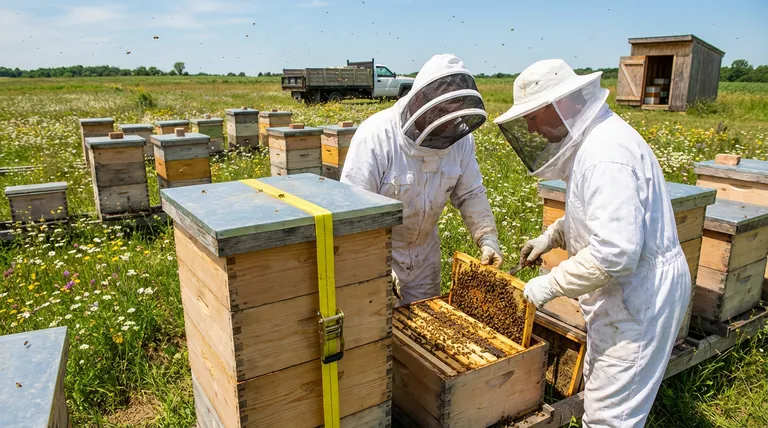
It’s a scenario played out in apiaries everywhere: after months of investment and anticipation, you open a hive to find only silence. The colony that was meant to be the foundation of your operation has failed to survive its first winter. You're left with empty equipment, a wasted season, and the nagging question: "What went wrong?"
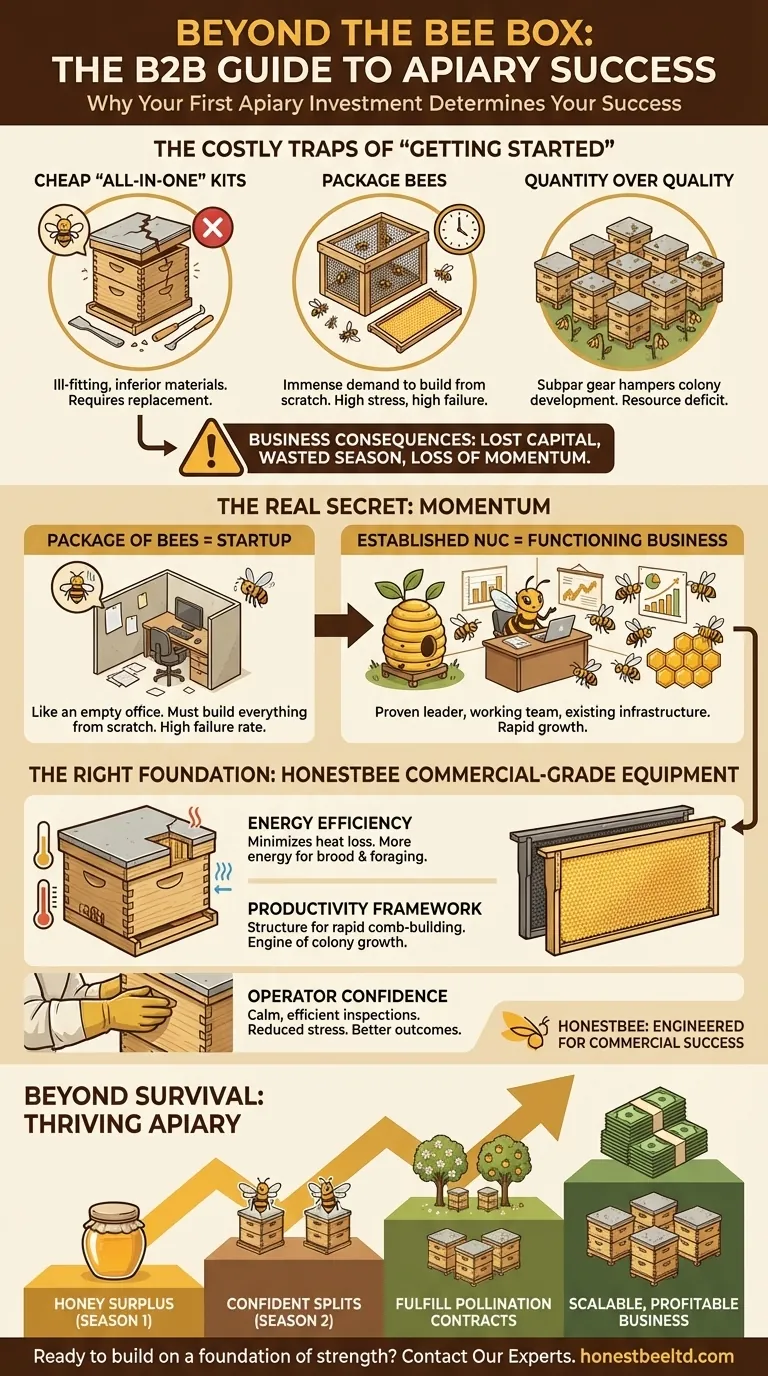
The Costly Traps of "Getting Started"
For aspiring commercial beekeepers, this first-year failure is more than a disappointment; it's a significant financial setback. The common path for new entrants is littered with well-intentioned advice that, unfortunately, is often a recipe for struggle.
Many new operators, in an effort to manage initial costs, will:
- Opt for the cheapest "all-in-one" beginner kit, often finding the components are ill-fitting, made from inferior materials, and require replacement within a season.
- Start with "package bees" because it's the most widely advertised method, without realizing the immense and immediate demand this places on the bees to build a home, raise brood, and store food from a dead start.
- Focus on quantity over quality, aiming to start with several hives but equipping them all with subpar gear that hampers colony development across the board.
These decisions aren't made from negligence, but from a fundamental misunderstanding of what a new colony truly needs to succeed. The business consequences are severe: lost capital on bees and equipment, a full year of lost production and pollination revenue, and a critical blow to operational momentum. You’re not just back to square one; you're starting from a deficit.
The Real Secret to Success: It's Not the Bees, It's the Momentum
Here is the critical turning point in understanding: The single greatest predictor of a new colony's success is its initial momentum.
Think of it this way:
- A package of bees is like a startup business handed an empty office and a list of phone numbers. They have the potential, but they must build everything—their infrastructure, their workforce, their inventory—from absolute scratch while fighting against the clock. It's a high-stress, high-failure-rate scenario.
- An established nucleus colony ("nuc") is like acquiring a small but already-functioning business. It comes with a proven leader (the queen), a working team (the worker bees), existing infrastructure (drawn comb), and inventory (brood, honey, and pollen).
The common "solutions" fail because they ignore this principle of momentum. A flimsy, poorly constructed hive forces the colony to waste precious energy sealing gaps instead of raising brood. Starting with a package colony creates a massive resource deficit that many new beekeepers are unprepared to manage through intensive feeding and monitoring. These early-stage struggles are the root cause of most first-year failures.
The Right Foundation: Equipping Your Colony for Exponential Growth
To truly solve this problem, you must shift your focus from merely housing bees to powering their momentum. This requires a professional-grade system designed for efficiency, durability, and colony health from day one.
This is precisely why HONESTBEE focuses on supplying commercial-grade equipment. Our products are not just boxes; they are engineered tools designed to address the root causes of colony failure and accelerate their growth:
- Energy Efficiency: Our precision-milled hive bodies and components fit together securely, minimizing drafts and heat loss. This means the colony spends less energy on climate control and more energy on raising brood and foraging.
- Productivity Framework: Our durable frames and foundations provide the perfect structure for rapid, efficient comb-building, allowing the queen to establish a strong brood pattern immediately. This is the engine of your colony's growth.
- Operator Confidence: Our high-quality protective gear allows for calm, efficient hive inspections, reducing stress on both the beekeeper and the bees. Confident management leads to better outcomes.
By investing in equipment that's built for the demands of a productive apiary, you are directly investing in your colony's momentum and drastically increasing its odds of success.
Beyond Survival: Turning Your First Hive into a Thriving Apiary
When you solve the problem of initial momentum, the entire outlook for your operation changes. The goal is no longer mere survival; it's rapid, predictable growth.
With a strong, thriving first-year colony, you can:
- Achieve a harvestable honey surplus in your very first season.
- Confidently split your strong hives the following spring, doubling your operation with your own proven, locally adapted bee stock.
- Fulfill pollination contracts with healthy, populous colonies that meet and exceed required hive strength.
- Build a scalable, profitable business on a foundation of success, not a cycle of replacement and recovery.
This isn't just about buying better equipment; it's about adopting a professional strategy that de-risks your investment and sets your apiary on a path to long-term profitability. Your first decision shouldn't be how to start cheaply, but how to start correctly.
Ready to build your apiary on a foundation of strength and reliability? Our team understands the challenges of scaling a beekeeping operation because we are dedicated to serving commercial beekeepers and distributors. Let's discuss your project goals and how the right equipment can make all the difference in your first year and beyond. Contact Our Experts.
Visual Guide
Related Products
- Wholesales Dadant Size Wooden Bee Hives for Beekeeping
- Metal Bee Hive Stand Bee Box Stand for Beekeeping
- Wooden Bee Hive Frames for Beekeeping and Wholesale
- High-Performance Langstroth Bee Hives for Global Professional Beekeeping
- HONESTBEE Professional Hive Top Bee Feeder Feeding Solution
Related Articles
- The Silent Killer in the Hive: Why Moisture, Not Cold, Is Winter's Greatest Threat
- How to Assemble Wooden Beehives: A Beginner's Guide to Durable Joint Systems
- Why Wooden Beehives Outperform Modern Alternatives: A Science-Backed Guide for Beekeepers
- How Bee Space Dictates Hive Success: Science-Backed Management Strategies
- More Than a Number: Why the 8-Frame vs. 10-Frame Hive Debate Is About Psychology, Not Just Production
















