The Beekeeper's Unanswered Question
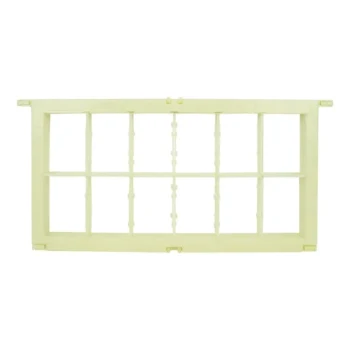
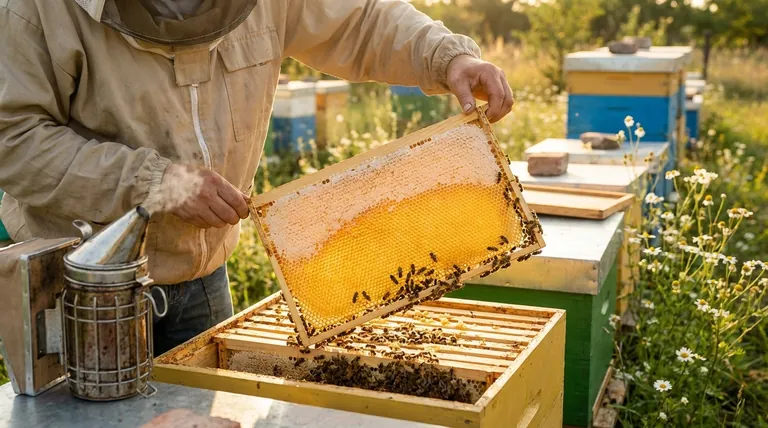
A beekeeper invests in a pristine frame and comb box, places it in a hive, and waits. Weeks later, they open it to find... nothing. The bees have completely ignored it, treating the expensive new equipment like an irrelevant obstacle.
This isn't a failure of equipment. It's a failure of communication.
Producing flawless comb honey is not a mechanical task of adding a box. It is a delicate negotiation with a complex, self-organizing system. Success hinges on understanding the colony's internal economy and creating an irresistible incentive. You don't just give them a task; you engineer the conditions that make building perfect comb the most logical, profitable action for them to take.
The Unspoken Contract with the Colony
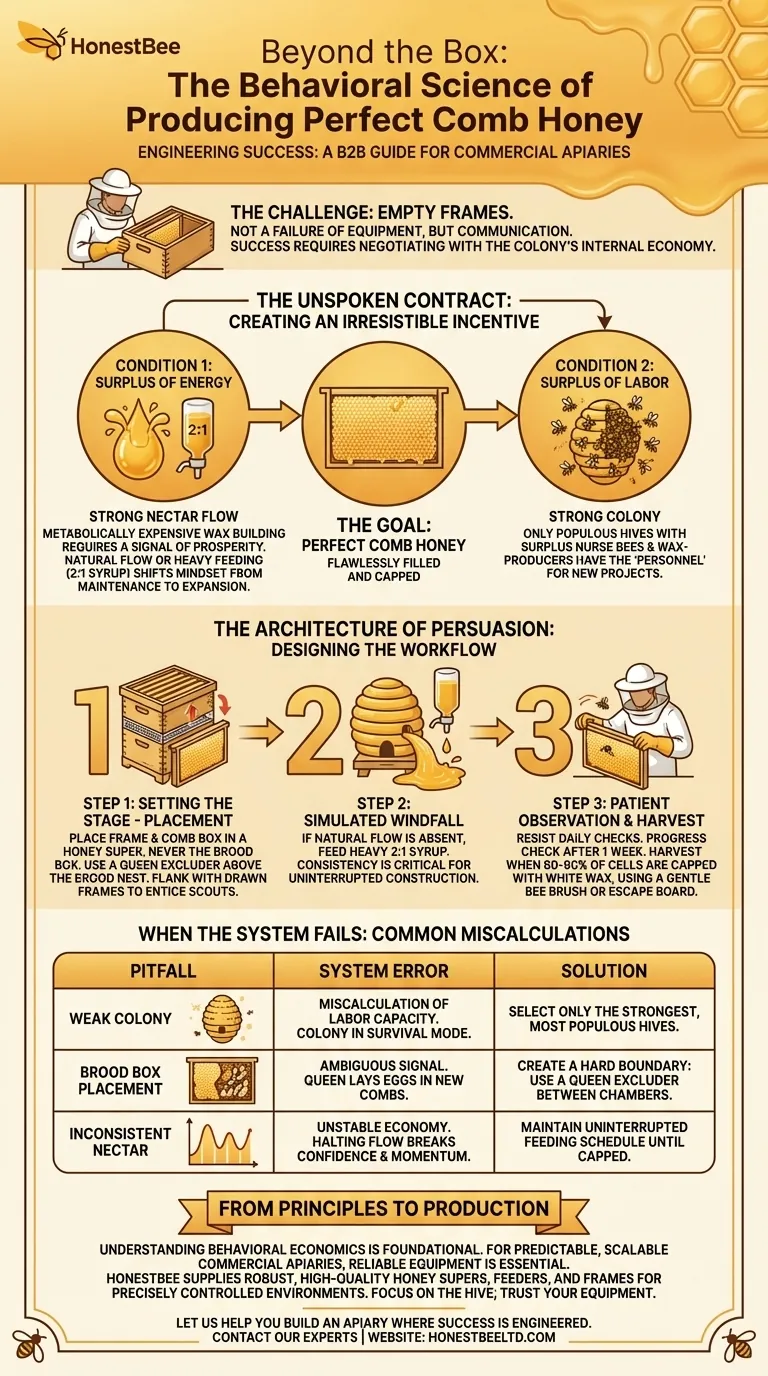
Before any equipment enters the hive, a contract must be met. The bees will only invest their most precious resources—energy and labor—into a new project if two conditions are overwhelmingly met.
The Psychology of Surplus
Building beeswax is one of the most metabolically expensive tasks a honeybee can perform. They will not engage in it frivolously.
This is why a strong nectar flow is non-negotiable. An abundance of incoming resources shifts the colony's collective mindset from maintenance to expansion. It's a psychological trigger. A powerful natural flow, or a simulated one via heavy feeding, signals a time of prosperity where investing in future storage (new comb) is a low-risk, high-reward endeavor. Without this signal of surplus, the colony remains fiscally conservative, hoarding resources for the existing brood nest.
The Engine of the Hive
The second condition is a surplus of labor. A "strong" colony is one bursting at the seams, with 80-90% of its brood frames covered in bees.
Think of it as an organization's capacity for new projects. A small or moderately-sized colony is running at full capacity just to manage core operations: raising brood, foraging for daily needs, and defending the hive. They have no "personnel" to spare. A powerful, populous colony has a surplus of nurse bees and wax-producers ready to be deployed. They are looking for the next project, and a new comb box becomes a welcome opportunity, not a burden.
The Architecture of Persuasion
With the right economic conditions in place, the beekeeper's job shifts to that of an architect, designing a workflow that guides the bees' efforts with precision.
Step 1: Setting the Stage
Placement is everything. The frame and comb box unit belongs in a honey super, never the brood box. This creates a clear zoning designation.
By placing this super directly above the brood nest, you make it the next logical frontier for expansion. To make the invitation even clearer, flank the new frame with a couple of drawn-out frames. This acts as a bridge, enticing scout bees upward and signaling that this new area is ready for development.
Step 2: The Simulated Windfall
If a strong natural nectar flow is absent, you must become the source. Feeding a heavy 2:1 sugar-to-water syrup creates a simulated resource boom.
Consistency here is critical. An intermittent food supply creates uncertainty and causes construction to halt. A steady, abundant flow provides the colony with the confidence and the raw materials to commit fully to drawing out and filling the new comb.
Step 3: Patient Observation and Harvest
Once the system is running, the best intervention is often no intervention. Resist the urge to check daily. A quick inspection after a week is sufficient to confirm progress.
The project is complete when 80-90% of the honey cells are capped with white wax. This is the bees' own quality seal, indicating the honey is cured and ready. Harvesting is done gently, using a soft bee brush or an escape board to clear the frame, respecting the workforce that built it.
When the System Fails: Common Points of Miscalculation
Failure is rarely random. It is almost always a result of misreading the state of the system or sending ambiguous signals.
| Pitfall | The underlying System Error | Solution |
|---|---|---|
| Weak Colony | A miscalculation of the hive's labor capacity. The system is in survival mode, not expansion mode. | Be ruthlessly selective. Only give the task to your absolute strongest, most populous hives. |
| Brood Box Placement | An ambiguous signal. The queen interprets the new, perfect cells as prime real estate for egg-laying, contaminating the product. | Create a hard boundary. Use a queen excluder between the brood chamber and the honey supers. |
| Inconsistent Nectar | An unstable economy. Halting the flow (natural or fed) breaks the colony's confidence and stops the project momentum cold. | If feeding, commit to an uninterrupted schedule until the combs are fully drawn, filled, and capped. |
From Principles to Production
Understanding the behavioral economics of the hive is the foundation. But for commercial apiaries where results must be predictable and scalable, the quality of your tools is what allows you to execute this strategy flawlessly. Inconsistent or poorly made equipment introduces variables that can undermine an otherwise perfect plan.
At HONESTBEE, we focus on supplying the robust, reliable beekeeping equipment that large-scale operations depend on. Our wholesale model is built to provide commercial apiaries and distributors with the high-quality honey supers, feeders, and frames needed to create precisely controlled environments. When you can trust your equipment to perform consistently, you can focus on managing the biological system of the hive.
Let us help you build an apiary where success is engineered, not hoped for. Contact Our Experts
Visual Guide
Related Products
- Stainless Steel Honey Bee Smoker Hive and Honeycomb Smoker for Beekeeping
- Professional Sectional Comb Honey Frame with 250g Cassette System for Beekeeping
- Heart-Shaped Comb Honey Frame and Honeycomb Cassette
- Plastic Honey Comb Frames Cassette Box for Honey
- Honey Bee Lifecycle Model: A Detailed Honeycomb Display of Bee Development
Related Articles
- The End of 'Hot Hives': Why Your Bee Smoker Is More Important Than Your Suit
- Why Your Bee Smoker Might Be Making Your Hives More Aggressive—And How to Fix It
- Why Your Bee Smoker Keeps Going Out—And the 3-Layer Fix
- How to Operate a Bee Smoker Safely: Expert Techniques for Calmer Hives
- How to Choose the Right Bee Smoker Size for Your Beekeeping Operation