The Anatomy of a Simple Mistake
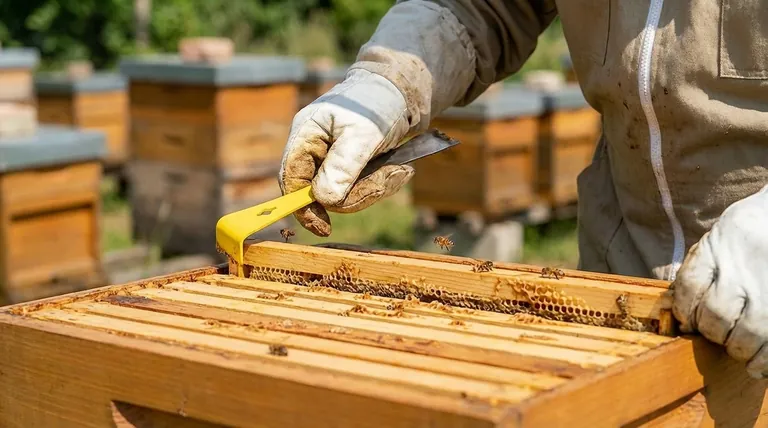
It often starts with a small, seemingly harmless decision. An experienced beekeeper, short on time, leaves their hive tool in the truck. A screwdriver is closer. A quick pry on a propolis-sealed hive body, and a faint crack echoes through the quiet apiary.
A splintered edge on a hive box seems trivial. But it's not. It's a new entrance for pests, a point of weakness against the elements, and a subtle signal of a larger cognitive error: underestimating the importance of a purpose-built tool.
This isn't a failure of knowledge, but of mindset. The beehive is a delicate, intricate system. Interacting with it requires more than brute force; it demands precision, respect, and the right interface.
A Study in Purpose-Driven Design
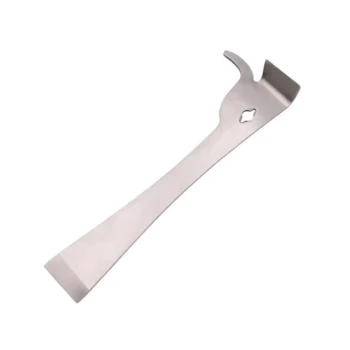
The standard hive tool is a masterpiece of functional simplicity. It's not just a bent piece of steel; it is the physical embodiment of lessons learned over centuries of beekeeping. Its design elegantly solves the specific, recurring problems encountered inside a hive.
The Lever and the Scraper
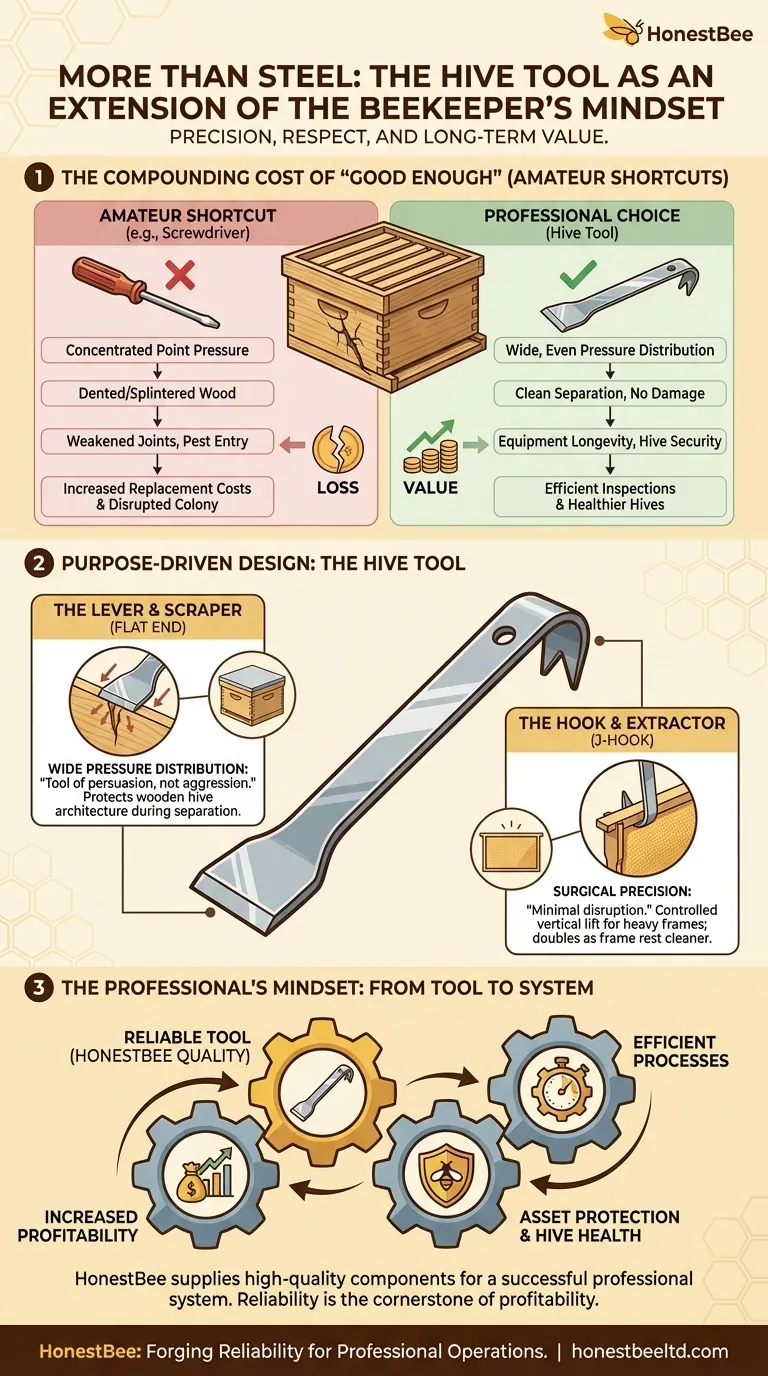
The tool's long, flat end has a sharp, beveled edge. Its genius lies not in its sharpness, but in its width.
When prying apart hive bodies sealed with propolis—a substance with the tensile strength of glue—a screwdriver concentrates all the force onto a single point, crushing wood fibers. The hive tool distributes this force, allowing the beekeeper to apply significant leverage without damaging the hive's wooden architecture. It becomes a tool of persuasion, not aggression.
The Hook and the Extractor
The "J" hook end is the surgical instrument of the pair. Frames of brood and honey are heavy and sealed tight. Lifting the first one without jarring the colony or rolling bees is a delicate operation.
The hook slips precisely under the frame's ear, providing a vertical lift that breaks the seal with minimal disruption. It’s the difference between a controlled inspection and an intrusion that triggers a defensive response from the colony. This end also doubles as a pull-scraper, perfect for clearing wax and propolis from the frame rests, ensuring frames seat properly every time.
The Compounding Cost of 'Good Enough'
The temptation to use a substitute tool is a classic cognitive trap. We choose the convenient option now, failing to calculate the accumulating cost of "good enough" over the long term.
A screwdriver splinters wood. A putty knife bends and fails. Each small act of damage creates a larger, future problem. This is the difference between a professional's tool and an amateur's shortcut.
| Tool | Force Distribution | Immediate Outcome | Long-Term Consequence |
|---|---|---|---|
| Hive Tool | Wide, even pressure | Clean separation, no damage | Equipment longevity, hive security |
| Screwdriver | Concentrated point pressure | Dented or splintered wood | Weakened joints, entry for pests |
| Putty Knife | Flexible, weak leverage | Bends, fails, wastes time | Frustration, potential for sudden slips |
The Professional's Mindset: From Tool to System
For a commercial apiary or a wholesale distributor, efficiency and asset protection are not abstract goals; they are economic necessities. Splintered boxes add up to replacement costs. Inefficient inspections add up to lost man-hours. Agitated hives produce less.
The choice to exclusively use a proper hive tool is the mark of a professional operation. It signals an understanding that success is built on a system of reliable, repeatable processes.
This is the principle that guides us at HONESTBEE. We supply beekeeping equipment not just as individual items, but as components of a successful, professional system. Our hive tools are forged from high-quality steel, built to withstand the rigors of thousands of hive inspections, because we know that reliability is the cornerstone of profitability in beekeeping.
The hive tool, in essence, is a physical extension of the beekeeper's professional mindset. It reflects a commitment to precision, a respect for the bees, and a shrewd understanding of long-term value.
For operations built on this principle of professional-grade reliability, using the right equipment isn't a choice; it's the foundation. Contact Our Experts
Visual Guide
Related Products
- HONESTBEE Professional Long Handled Hive Tool with Precision Cutting Blade
- Professional Multi-Function Stainless Steel Hive Tool
- HONESTBEE Premium Italian Style Hive Tool with Hardwood Handle
- Ergonomic Plastic Frame Spacer Tool for Rapid Hive Management Beekeeping
- Professional Grade Foldable Beehive Handles
Related Articles
- Force and Finesse: The Hive Tool as the Beekeeper's Critical Interface
- The Essential Guide to Hive Tools in Modern Beekeeping
- The Apiary as a System: Why Your Hive Tool is More Than Just Steel
- How to Choose Hive Tools That Match Your Beekeeping Workflow
- The Beekeeper's Scalpel: How a Simple Hive Tool Governs Apiary Health