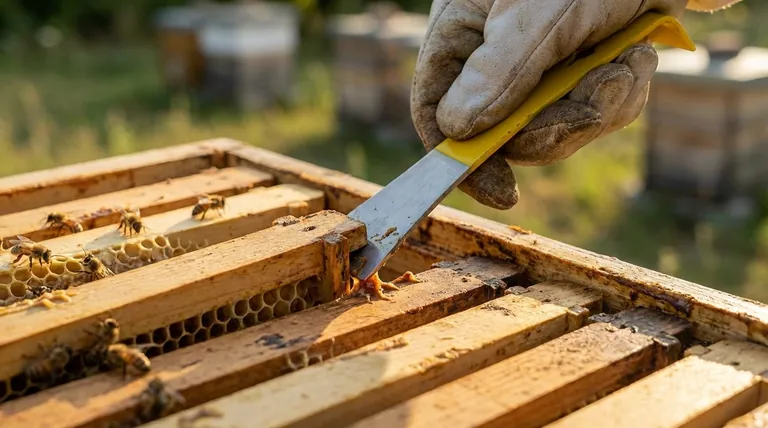
A hive tool is a simple object: a small, forged piece of steel. Yet, in the hands of a beekeeper, it becomes a complex instrument. It can be a key that grants quiet access, or a hammer that invites chaos.
The difference lies not in the tool, but in the mind controlling it. For a commercial beekeeper, mastering this interface is the foundation of efficient, safe, and productive work. It is an act of engineering and empathy, combined.
The Hive as a Nervous System
Think of a colony not as 50,000 individual bees, but as a single, distributed superorganism. It responds to stimuli with a collective consciousness. Sudden vibrations and sharp, jarring movements are interpreted as a singular event: a predator's attack.
This is a primal, hardwired response. The crack of a hastily pried lid is not just a sound; it is a shockwave that puts the entire system on high alert.
Speaking the Language of Safety
Your movements are your words. Slow, deliberate, and gentle actions communicate safety. They tell the colony you are not a bear tearing the hive apart, but a steward performing a necessary function.
Confidence is the key to this language. Hesitation leads to jerky, uncertain motions. The bees feel this indecision and interpret it as a threat. A calm, confident hand translates into smooth, predictable actions that maintain the peace. Your hive tool is an extension of your hands, but your demeanor is your most valuable asset.
The Grammar of Movement: Core Techniques
Every interaction with the hive is a conversation. Proper technique ensures this conversation is a productive one, minimizing stress and maximizing efficiency.
Prying Seals: Applying Force Without Shouting Alarm
Bees use propolis to seal every crack, gluing their world together. Your first job is to break these seals. Insert the flat end of your hive tool between hive bodies or frames and apply steady, firm, and progressive pressure. The goal is a gentle separation, not a sudden, explosive "pop" that jolts the colony.
Maintaining Order: The Art of Scraping
Burr comb and excess propolis disrupt the critical "bee space" that governs colony movement and organization. Use the chiseled edge of your tool to scrape these away. This is not just cleaning; it is architectural maintenance. Smooth, even strokes preserve the hive's internal logic and prevent the bees from having to perform rework.
The Gentle Lift: Precision Over Power
Once a frame is loosened, use the tool's hooked end to lift it. This technique provides a secure grip and, critically, avoids crushing bees between your fingers and the frame. A single crushed bee can release alarm pheromones, instantly changing the mood of the entire inspection from calm to defensive.
Unforced Errors: The Discipline of a Professional
In beekeeping, as in any complex system, small mistakes can have cascading consequences. A professional is defined not by the absence of challenges, but by the discipline to avoid unforced errors.
| Common Pitfall | Direct Consequence | The Professional's Discipline |
|---|---|---|
| Crushing Bees | Triggers alarm pheromones, agitating the colony. | Constant spatial awareness. Know where your tool is and what it might touch at all times. |
| Poor Hygiene | Spreads pathogens like American Foulbrood between hives. | Rigorous biosecurity. Clean your tool in a washing soda solution between inspecting different apiaries or suspect hives. |
| A Misplaced Tool | Disrupts workflow, causes frustration, and encourages haste. | Systematize your workspace. Paint your tool's handle a bright color and always place it in the same spot. |
The Non-Negotiable Quality of Equipment
All the technique and calm intent in the world can be undermined by a subpar tool. A tool that flexes under pressure creates unpredictable movements. A poorly sharpened edge crushes comb instead of scraping it cleanly.
For a hobbyist, this is an inconvenience. For a commercial apiary managing hundreds or thousands of colonies, it is a critical failure point. Inefficiencies multiply. Bee stress accumulates. The work becomes harder, slower, and more dangerous.
This is why the quality of your equipment is non-negotiable. HONESTBEE supplies professional-grade beekeeping equipment built for the demands of commercial operations. Our hive tools are forged for durability and designed for precision, providing the reliable, predictable performance you need to work efficiently and keep your colonies calm. They are not just pieces of steel; they are instruments engineered for a purpose.
Mastering the hive tool is about mastering the subtle conversation between beekeeper and bee. The right equipment makes that conversation much clearer. If you're ready to equip your operation with tools designed for professional demands, Contact Our Experts.
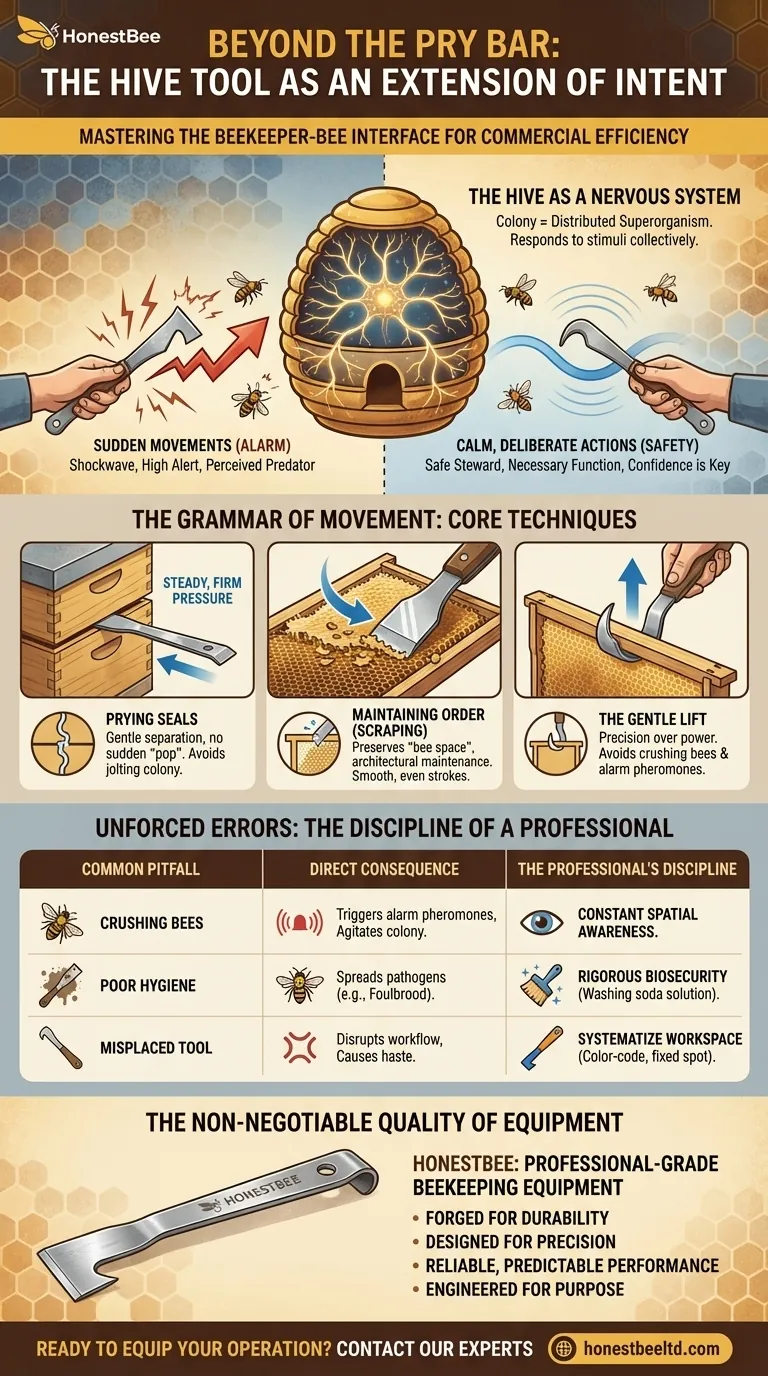
Visual Guide
Related Products
- HONESTBEE Professional Long Handled Hive Tool with Precision Cutting Blade
- Professional Multi-Function Stainless Steel Hive Tool
- HONESTBEE Premium Italian Style Hive Tool with Hardwood Handle
- Ergonomic Plastic Frame Spacer Tool for Rapid Hive Management Beekeeping
- Professional Grade Foldable Beehive Handles
Related Articles
- Force and Finesse: The Hive Tool as the Beekeeper's Critical Interface
- The Essential Guide to Hive Tools in Modern Beekeeping
- The Apiary as a System: Why Your Hive Tool is More Than Just Steel
- How to Choose Hive Tools That Match Your Beekeeping Workflow
- The Beekeeper's Scalpel: How a Simple Hive Tool Governs Apiary Health


















