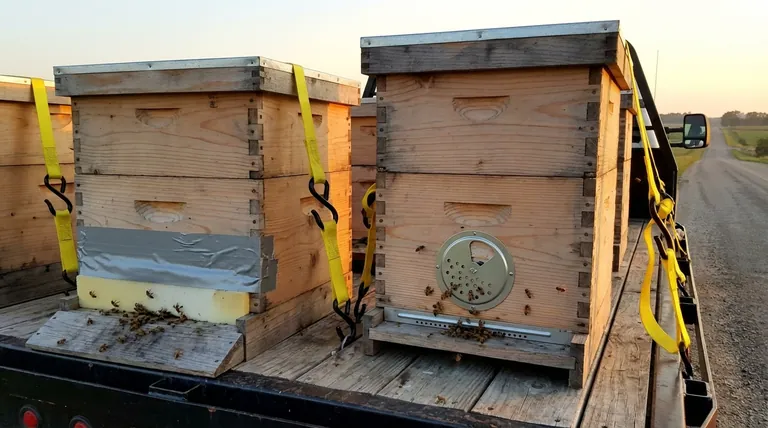
It’s a scenario familiar to every commercial beekeeper: pallets of hives are loaded, straps are tight, and a long night of driving to the next pollination contract lies ahead. But amidst the logistics, a single, persistent worry surfaces. Will all the colonies make it? Arriving at dawn to discover several "deadouts"—hives that didn't survive the journey—is a costly and demoralizing reality. You did everything right, you secured the entrances, so what went wrong?
The Cycle of Makeshift Fixes and Costly Failures
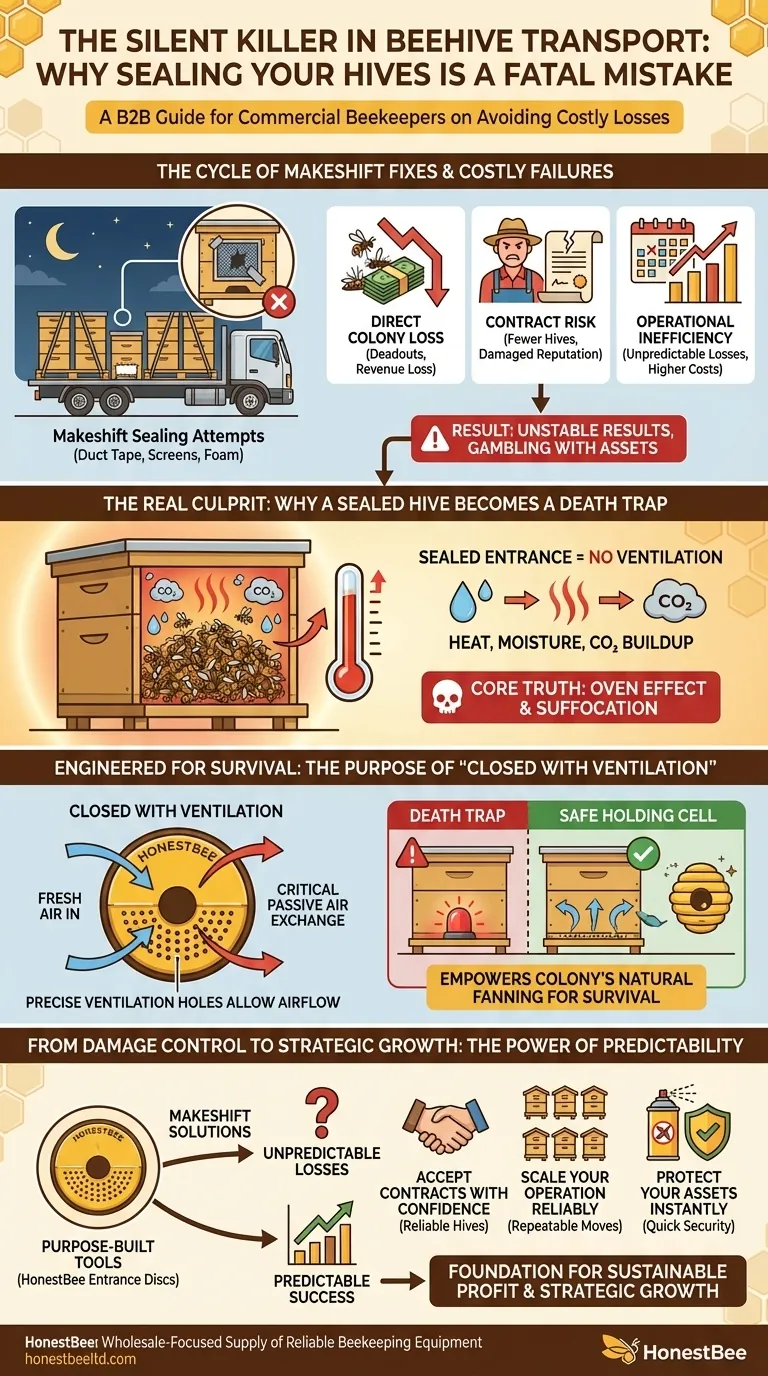
When faced with the need to move a hive or protect it from nearby pesticide spraying, the immediate impulse is to seal the entrance. It seems like the most logical step to prevent bees from escaping. Commercial apiaries, under pressure, often turn to quick, makeshift solutions: a piece of window screen stapled over the entrance, a strip of duct tape, or a plug of foam.
But these methods are a gamble. Screens can tear, tape can fail in the heat or damp, and a determined colony can chew through or dislodge a foam block.
The consequences of these gambles are measured in dollars and cents.
- Direct Colony Loss: A single deadout is a loss of hundreds of dollars in bees and future honey or pollination revenue. When moving dozens or hundreds of hives, these losses multiply quickly.
- Contract Risk: Arriving at an almond grove or blueberry field with fewer healthy hives than promised can jeopardize a valuable pollination contract and damage your reputation.
- Operational Inefficiency: Unpredictable losses mean you have to budget for failure, increasing your operational costs and eating into your profit margins.
You keep trying different methods, hoping to find one that works consistently, but the results remain frustratingly unstable. You're treating a symptom—escaping bees—while unknowingly triggering a much more dangerous problem.
The Real Culprit: Why a Sealed Hive Becomes a Death Trap
The reason so many confinement efforts fail isn't because of the escapees; it's a fundamental misunderstanding of hive biology. A beehive is not just a wooden box; it is a living, breathing superorganism.
Imagine 50,000 tiny, self-regulating engines packed into a well-insulated space. Through their collective metabolism, the bees generate an immense amount of heat, moisture, and carbon dioxide. To manage this, they are master engineers of ventilation, constantly fanning their wings to circulate air, control the temperature, and lower the humidity.
When you completely seal the entrance—even with a supposedly "breathable" material like dense foam—you cut off this vital airflow. The internal temperature can skyrocket to lethal levels in a surprisingly short time. The CO₂ builds up, and the colony suffocates.
This is the core truth: your attempts to secure the hive are inadvertently creating an oven. Makeshift solutions fail not only because they are flimsy, but because they fundamentally ignore the colony's most basic need to breathe.
Engineered for Survival: The Purpose of "Closed with Ventilation"
To safely confine a colony, you need to solve two problems at once: prevent their escape and ensure their survival. This requires a tool that was specifically designed for this very conflict.
Enter the "closed with ventilation" setting on a standard beehive entrance disc. It’s not just another option; it’s an elegant piece of engineering born from a deep understanding of the problem.
This setting works by providing a barrier perforated with holes. These holes are too small for a bee to pass through, but they are numerous and large enough to allow for critical passive air exchange. This is the crucial difference.
By allowing air to move, the ventilated setting empowers the colony to do what it does best: save itself. The bees can continue their fanning, pulling in fresh air and pushing out the dangerous buildup of heat and CO₂. It turns a potential death trap into a temporary, safe holding cell. This is why our HONESTBEE entrance discs are manufactured to precise, reliable specifications. We know that in a high-stakes moment like a cross-country hive move, the difference between a properly sized ventilation hole and a blocked one is the difference between profit and loss.
From Damage Control to Strategic Growth: The Power of Predictability
When you stop gambling with makeshift solutions and start using the correct, purpose-built tool, the impact on your operation is transformative. The conversation shifts from "How many hives will we lose this time?" to "Where is our next opportunity?"
Solving this fundamental transport and confinement problem unlocks new potential:
- Accept Contracts with Confidence: Take on that lucrative, long-distance pollination contract without worrying about arrival-day losses.
- Scale Your Operation Reliably: Expand your apiaries to new yards, knowing your method for moving bees is safe, repeatable, and scalable.
- Protect Your Assets Instantly: When a pesticide spray notification comes in, you can secure your colonies in minutes, protecting your foragers and your investment without putting the hive's health at risk.
Ultimately, mastering this one small detail introduces a powerful element into your business: predictability. And in the world of commercial beekeeping, predictability is the foundation for sustainable profit and strategic growth.
The success of your entire operation can hinge on the reliability of its smallest components. An incorrectly designed entrance disc is just one example of how equipment that is "good enough" can create catastrophic and unpredictable failures. From the durability of your hive bodies to the construction of your frames, every piece of hardware plays a critical role in the health of your colonies and the profitability of your business. Don't let equipment failure undermine your expertise and hard work. Our team understands the unique pressures of commercial beekeeping and the importance of tools that work, every time. Let's discuss the challenges your apiary is facing and how HONESTBEE's wholesale-focused supply of reliable, durable equipment can provide the stability you need to grow. Contact Our Experts.
Visual Guide
Related Products
- Durable Plastic Interlocking Hive Connector for Beekeeping
- Plastic Transporting Bee Packages and Nuc Boxes for Beekeeping
- Professional Multi-Function Stainless Steel Hive Tool
- Professional Grade Foldable Beehive Handles
- Ergonomic Plastic Frame Spacer Tool for Rapid Hive Management Beekeeping
Related Articles
- Gravity is Not Your Friend: The Simple Physics of Safe Beehive Transport
- The Physics of a Stacked Beehive: Why a Simple Connector is a Non-Negotiable Tool
- Plastic Bee Hives: A Smart Investment for Modern Beekeepers
- Stop Losing Bees in Transit: The Real Reason Your Hive Transport is Chaotic and How to Fix It for Good
- The Aerodynamics of Survival: Why Hive Transportation Is a Race Against Heat