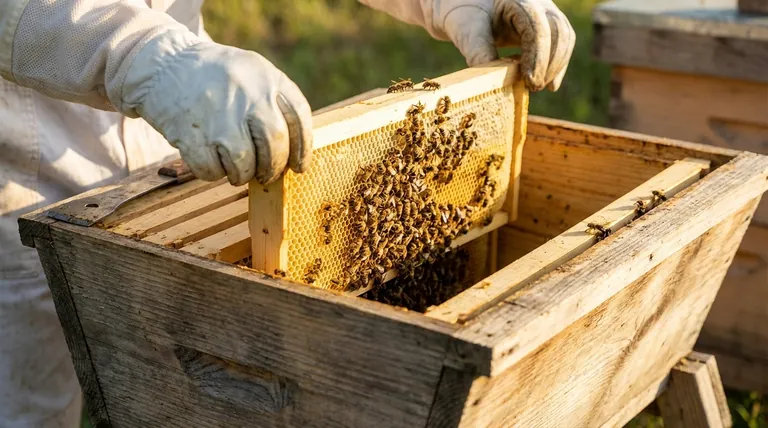
A Dialogue in Millimeters
Imagine lifting the lid of a beehive, expecting to find neat, parallel rows of honeycomb. Instead, you find a chaotic sculpture of wax. Combs are welded together, fused to the walls, and impossible to inspect without tearing the colony's world apart.
This isn't a failure of the bees. It's a failure of communication.
Successful beekeeping, especially with top-bar hives, isn't about imposing human will on a colony. It's about understanding their language—a language written not in sounds, but in space. The hive itself is a conversation, and its success hinges on getting the grammar right.
The Unseen Blueprint: Understanding Bee Space
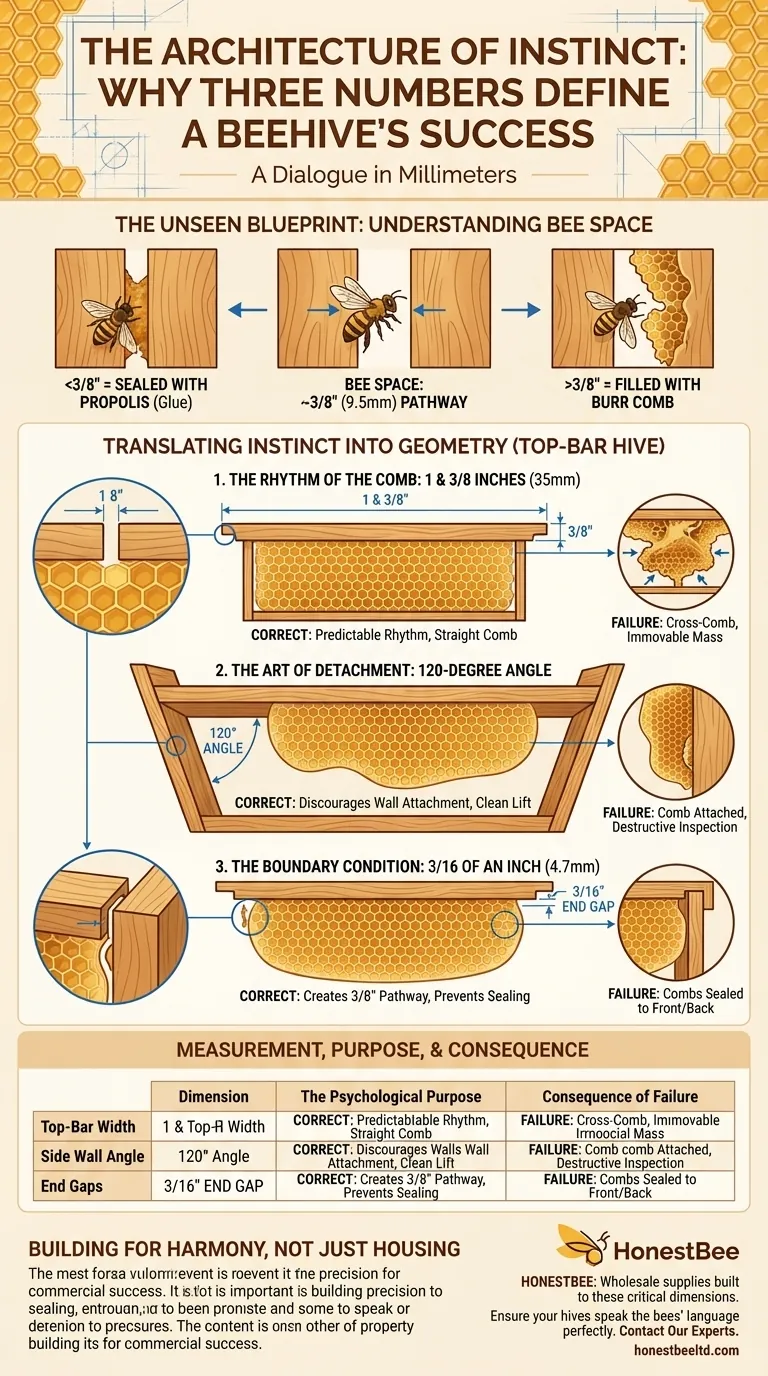
At the heart of all modern hive design is a single, powerful concept: "bee space."
It's a gap, roughly 3/8 of an inch (about 9.5mm), that bees instinctively leave open for passage and work. To a bee, this specific dimension means "pathway."
- Any space smaller than this, they seal with propolis, a resinous glue.
- Any space larger, they fill with burr comb.
This isn't a suggestion; it's a biological imperative. Getting this wrong is like building a house with hallways that are either too narrow to walk through or so wide people start putting furniture in them. The result is chaos.
The three critical measurements of a top-bar hive are not arbitrary rules. They are a precise geometric translation of this fundamental instinct.
Translating Instinct into Geometry
To build a hive that works with the bees, you must master the three dimensions that define their world.
1. The Rhythm of the Comb: 1 and 3/8 Inches
This is the most critical measurement. The width of each top-bar must be exactly 1 and 3/8 inches (35mm).
When placed side-by-side, this width forces a center-to-center spacing between combs that perfectly mimics what bees build in the wild. It sets a predictable rhythm. The bees read this spacing and instinctively build one straight, even comb down from the center of each bar. It's the foundation of order within the hive.
2. The Art of Detachment: The 120-Degree Angle
Why are the sides of a top-bar hive sloped? It's a clever bit of psychological manipulation.
Angling the side walls at 120 degrees from the bottom board creates a space that is wider at the top and narrower at the bottom. Since bees build their comb vertically, this angle means the comb never quite touches the wall.
This simple design choice "tells" the bees not to attach their comb to the sides. For the beekeeper, it means each bar can be lifted cleanly for inspection, without the destructive act of cutting the comb free from the hive body.
3. The Boundary Condition: 3/16 of an Inch
The final piece of the puzzle is a tiny gap of 3/16 of an inch (about 4.7mm) between the ends of the top-bars and the front and back walls of the hive.
Why this specific, small number?
Because this 3/16 inch gap on one end, combined with the space around the comb, creates the perfect 3/8 inch "bee space" pathway. It completes the envelope, preventing bees from welding the first and last combs to the hive walls and sealing the beekeeper out.
When the Geometry Fails
Violate these measurements, and the conversation with the colony breaks down.
- Incorrect Top-Bar Width: If bars are too wide or narrow, the bees' natural spacing is disrupted. They will build aberrant, wave-like combs that span across multiple bars, gluing them into an immovable mass.
- Straight Walls: A hive with 90-degree vertical walls is an open invitation for bees to attach their comb. Every inspection becomes a destructive, stressful event for both the colony and the beekeeper.
- Ignored End Gaps: Forgetting the 3/16 inch gap results in the entire block of combs being propolized and cemented to the hive's front and back walls, making management nearly impossible.
| Measurement | Dimension | The Psychological Purpose | Consequence of Failure |
|---|---|---|---|
| Top-Bar Width | 1 and 3/8 inches | Establishes a predictable rhythm for comb building. | Cross-comb, bars welded together. |
| Side Wall Angle | 120 degrees | Discourages attachment to hive walls. | Comb attached to walls, destructive inspections. |
| End Gaps | 3/16 of an inch | Creates a "bee space" boundary pathway. | Combs sealed to the front/back of the hive. |
Building for Harmony, Not Just Housing
Constructing a functional hive is an act of engineering empathy. It requires precision not for the sake of perfection, but for the sake of respecting the biological and social realities of the honeybee.
Achieving this level of precision consistently, especially for commercial apiaries or equipment distributors, is paramount. Success isn't just about having hives; it's about having hives that are models of efficiency and harmony. Sourcing components built to these exact, non-negotiable specifications is the first step.
HONESTBEE provides wholesale beekeeping supplies that adhere to these critical dimensions, ensuring that every hive you build or sell is designed for success from the start. To ensure your hives speak the bees' language perfectly, Contact Our Experts.
Visual Guide
Related Products
- Stainless Steel Round Beehive Air Vents for Ventilation
- Wholesales Dadant Size Wooden Bee Hives for Beekeeping
- Metal Hive Feet Bee Hive Stand for Ant Protection
- Metal Bee Hive Stand Bee Box Stand for Beekeeping
- Wooden Bee Hive Frames for Beekeeping and Wholesale
Related Articles
- How to Optimize Beehive Ventilation: Prevent Disease and Boost Colony Health
- The Silent Killer in the Hive: Why Moisture, Not Cold, Is Winter's Greatest Threat
- Beyond the Bee Box: Why Your First Apiary Investment Determines Your Success
- The Precision of Chaos: Navigating the Biological Risks of Commercial Beehive Transportation
- Beyond the Box: Why Hive Architecture Is Your Apiary's Core Operating System













