The Beekeeper's Paradox
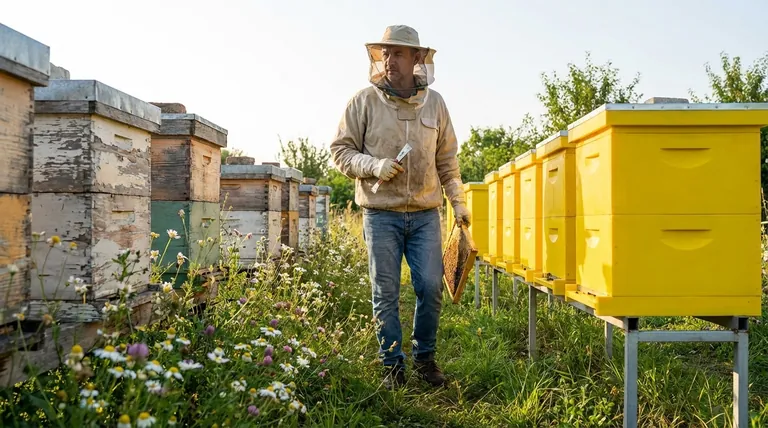
Imagine a commercial beekeeper at dawn, looking out over a field of a hundred hives. Each white box isn't just a home for bees; it's a unit of production, a capital asset. The silent question hanging in the cool morning air is not about honey, but about entropy. Which of these boxes will rot first? Which will warp under a heavy nectar flow? Which will survive the damp winter?
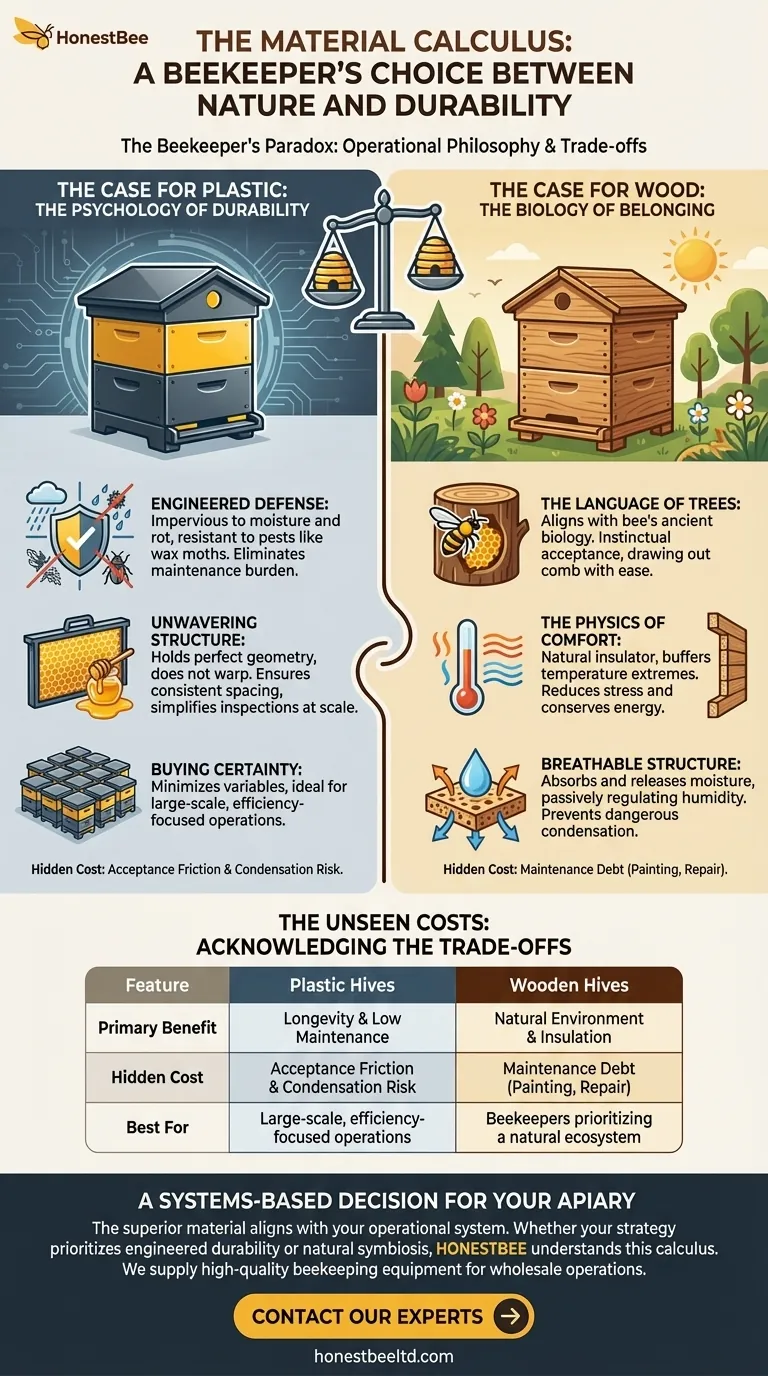
The choice between wood and plastic hives is not merely a preference. It is a fundamental decision about operational philosophy, a trade-off between biological harmony and engineered resilience. It reflects how a beekeeper weighs time, risk, and their relationship with the colony itself.
The Psychology of Durability: The Case for Plastic
Choosing plastic is an act of buying certainty. It is a decision to minimize variables in an environment where countless factors—weather, pests, disease—are beyond your control.
An Engineered Defense
Plastic is non-negotiable with nature. It is impervious to moisture, meaning the slow, destructive creep of rot that plagues wooden equipment is simply off the table. For an operator managing hundreds or thousands of hives, this isn't a small convenience; it's the elimination of a massive, recurring maintenance burden.
Its non-porous surface also offers a strategic advantage against pests like wax moths, which cannot easily burrow into it. The hive becomes a cleaner, more defensible fortress.
The Unwavering Structure
There's an engineering elegance to a plastic frame that holds its perfect geometry year after year. While a wooden frame can sag, twist, or break under the immense weight of honey, a plastic component remains rigid. This structural integrity ensures smooth inspections and consistent spacing, small details that compound into significant time savings at scale.
The Biology of Belonging: Wood's Natural Contract
Choosing wood is an acknowledgment of the bee's ancient biology. It is a decision to align the equipment with the organism, creating an environment that feels less like housing and more like a habitat.
The Language of Trees
For millions of years, bees have sought out hollow trees. Wood and beeswax are the materials of their world. They readily accept wooden components, drawing out comb with an instinctual ease. The material speaks a language they already understand.
The Physics of Comfort
Wood is a remarkable natural insulator, buffering the colony from the brutal heat of summer and the deep cold of winter. This reduces stress and conserves the bees' energy stores.
More importantly, wood breathes. Its porous structure allows it to absorb and release moisture, passively regulating the hive's internal humidity. This simple act prevents the dangerous buildup of condensation in winter, which can drip onto the cluster and chill the bees to death. It is a quiet, life-sustaining feature.
The Unseen Costs: Acknowledging the Trade-offs
Every choice carries a hidden tax. The key is knowing which tax you are willing to pay.
| Feature | Plastic Hives | Wooden Hives |
|---|---|---|
| Primary Benefit | Longevity & Low Maintenance | Natural Environment & Insulation |
| Hidden Cost | Acceptance Friction & Condensation Risk | Maintenance Debt (Painting, Repair) |
| Best For | Large-scale, efficiency-focused operations | Beekeepers prioritizing a natural ecosystem |
Wood's Tax on Time
The natural appeal of wood comes with a recurring cost: your time. It must be painted or sealed, and even then, its battle with the elements is a losing one. Every season, some components will need repair or replacement. This is the maintenance debt of wood.
Plastic's Barrier to Entry
The durability of plastic can come with initial resistance. Bees are sometimes hesitant to build on a foreign, artificial surface. This often requires adding a thick coat of fresh beeswax, an extra step that bridges the gap between the engineered and the natural. Furthermore, its non-porous nature means the beekeeper, not the material, is responsible for managing condensation through ventilation.
A Systems-Based Decision for Your Apiary
The superior material is the one that best aligns with your operational system.
Are you building an agricultural asset designed for maximum efficiency and minimum downtime? Or are you curating a collection of semi-wild ecosystems where the goal is to mimic nature as closely as possible?
For commercial apiaries and equipment distributors, this isn't an abstract debate; it's a decision that impacts labor costs, replacement cycles, and overall profitability. The right choice depends entirely on your business model.
HONESTBEE understands this calculus. We supply high-quality beekeeping equipment for wholesale operations, providing durable plastic components for those who prioritize longevity and traditional wooden hives for those who prioritize a natural environment. We don't just sell boxes; we provide the foundational assets for your beekeeping philosophy.
Whether your strategy prioritizes engineered durability or natural symbiosis, having a reliable supply chain is non-negotiable. To build a resilient and productive apiary based on your goals, Contact Our Experts.
Visual Guide
Related Products
- Wholesales Dadant Size Wooden Bee Hives for Beekeeping
- Stainless Steel Round Beehive Air Vents for Ventilation
- Metal Bee Hive Stand Bee Box Stand for Beekeeping
- Durable Plastic Hive Number Set for Beekeeping
- Wooden Bee Hive Frames for Beekeeping and Wholesale
Related Articles
- The Silent Killer in the Hive: Why Moisture, Not Cold, Is Winter's Greatest Threat
- Beyond the Bee Box: Why Your First Apiary Investment Determines Your Success
- How to Assemble Wooden Beehives: A Beginner's Guide to Durable Joint Systems
- Why Wooden Beehives Outperform Modern Alternatives: A Science-Backed Guide for Beekeepers
- How Wooden Beehives Naturally Regulate Temperature for Healthier Honeybee Colonies


















