The Observer's Paradox
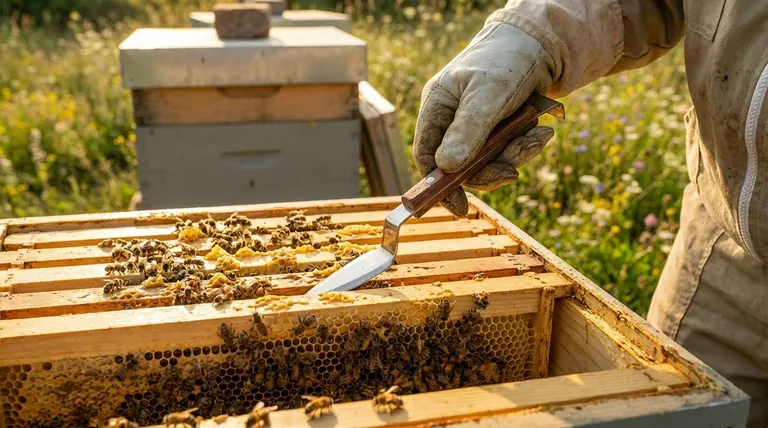
A beekeeper gently lifts a frame, heavy with bees, brood, and honey. To the untrained eye, it’s a chaotic scene. To the keeper, it’s a dashboard of vital signs. They are not just looking at bees; they are assessing the health of a complex, living system.
There is a powerful temptation in beekeeping to "let the bees be." It stems from a good place—a respect for nature's autonomy. But this view mistakes inaction for neutrality. In a system as dynamic as a beehive, choosing not to intervene is still a choice, one that allows small, correctable issues to cascade into colony failure.
The true art is not non-interference, but knowing precisely when and how to act. It's a proactive partnership.
The Three Pillars of Colony Stability
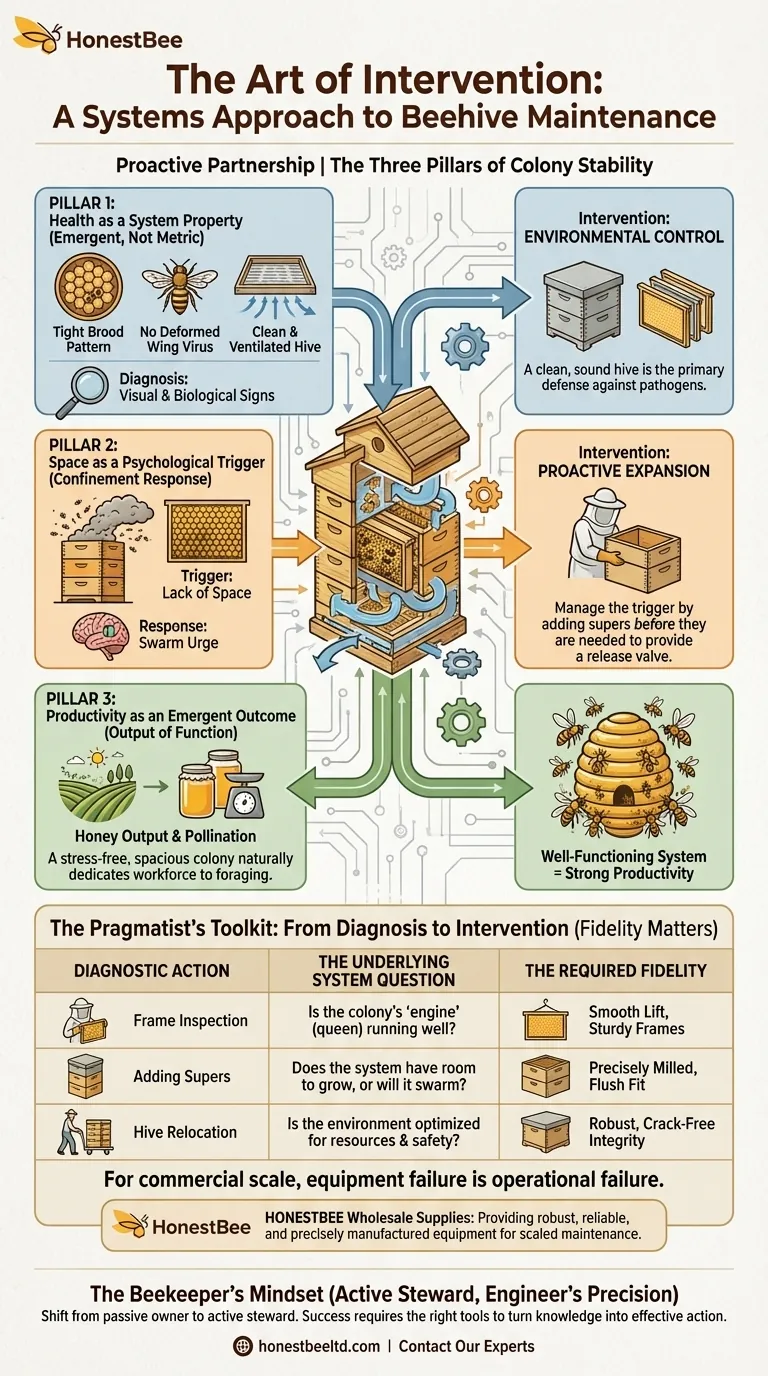
Effective maintenance isn't a random checklist. It's a systematic diagnosis focused on three core pillars that determine a colony's fate. Thinking of them as interconnected systems reveals why small adjustments can have an outsized impact.
Pillar 1: Health as a System Property
Colony health is an emergent property, not a single metric. It’s visible in the details.
A healthy queen lays in a tight, contiguous pattern, like a solid carpet of capped brood. A struggling colony reveals itself in a "shotgun" pattern, with empty cells scattered throughout. Varroa mites, the nearly invisible parasites, reveal their presence not just on adult bees, but in the subtle sign of deformed wing virus in newly hatched workers.
A beekeeper's intervention here is environmental control. A clean bottom board, good ventilation, and a structurally sound hive body are not just comforts; they are the colony's primary defense against the pathogens and pests that thrive in damp, poorly maintained conditions.
Pillar 2: Space as a Psychological Trigger
A colony’s urge to swarm is not a problem to be solved; it’s a predictable, biological response to a single stimulus: confinement.
As the population booms and nectar flows, the hive fills. Every available cell is packed with brood, pollen, or honey. This lack of space triggers a psychological switch in the colony. It is time to reproduce. The queen will leave with half the workforce, depleting the hive's strength just before the peak honey season.
The beekeeper's job is to manage this trigger. By regularly assessing the colony's density and adding supers before they are desperately needed, you provide a release valve for this pressure. You are managing the colony’s perception of its environment.
Pillar 3: Productivity as an Emergent Outcome
You cannot force a hive to be productive. Productivity—whether measured in pounds of honey or acres of pollinated crops—is simply the output of a well-functioning system.
A healthy, stress-free colony with ample space to expand will naturally dedicate its immense workforce to foraging and storage. The beekeeper doesn't create the honey; they create the optimal conditions for the bees to do what they have perfected over millions of years.
Strong productivity is the ultimate indicator that the underlying systems of health and space are properly managed.
The Pragmatist's Toolkit: From Diagnosis to Intervention
Understanding the system is one thing; acting on it is another. Every intervention, from a simple inspection to adding a super, is a physical act that depends on the quality and reliability of your equipment. For a commercial operation, this is not a detail—it is the foundation of efficiency and success.
| Diagnostic Action | The Underlying System Question | The Required Fidelity |
|---|---|---|
| Frame Inspection | Is the colony's 'engine' (the queen) running well? | Requires a smooth, controlled lift. A sturdy hive tool and well-built frames are non-negotiable. |
| Adding Supers | Does the system have room to grow, or will it swarm? | Boxes must be precisely milled and durable to stack perfectly, preventing drafts and pests. |
| Hive Relocation | Is the environment optimized for resources and safety? | The hive body must be robust enough to be moved without cracking or compromising its integrity. |
These are not just tasks; they are precise interventions. The fidelity of your actions is limited by the quality of your tools. A warped super that doesn't sit flush creates a vulnerability. A flimsy frame that breaks during an inspection can send a colony into chaos and set back its progress for weeks.
For commercial apiaries and distributors, where these interventions happen at scale, equipment failure is operational failure. This is the principle behind HONESTBEE's wholesale supplies—providing robust, reliable, and precisely manufactured equipment that enables effective maintenance across dozens or hundreds of hives.
The Beekeeper's Mindset
Ultimately, successful beekeeping is a function of mindset. It’s the shift from being a passive owner to an active steward. It's the engineer's satisfaction in understanding and tuning a complex system, and the biologist's awe at the living marvel within the box.
This stewardship requires more than just knowledge; it requires the right tools to turn that knowledge into effective action. To build a truly resilient and productive operation, your strategy must be supported by equipment designed for the task. Contact Our Experts
Visual Guide
Related Products
- Stainless Steel Round Beehive Air Vents for Ventilation
- Wholesales Dadant Size Wooden Bee Hives for Beekeeping
- Metal Hive Feet Bee Hive Stand for Ant Protection
- Metal Bee Hive Stand Bee Box Stand for Beekeeping
- Wooden Bee Hive Frames for Beekeeping and Wholesale
Related Articles
- How to Optimize Beehive Ventilation: Prevent Disease and Boost Colony Health
- Beyond the Bee Box: Why Your First Apiary Investment Determines Your Success
- The Silent Killer in the Hive: Why Moisture, Not Cold, Is Winter's Greatest Threat
- The Precision of Chaos: Navigating the Biological Risks of Commercial Beehive Transportation
- Beyond the Thermometer: The Hidden Thermodynamics of a Winter Beehive













