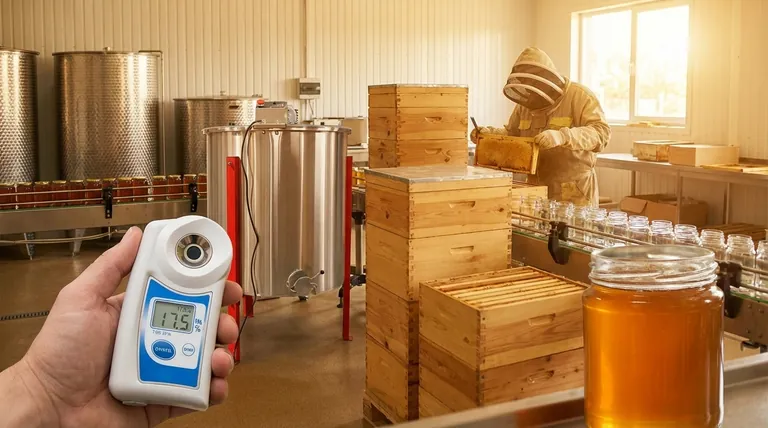
It’s a scenario every commercial beekeeper dreads. A full pallet of your finest honey—representing months of hard work—is returned by a distributor. The complaint: signs of fermentation. The honey you were so proud of is now a costly liability. You were sure it was ready; it looked, felt, and dripped perfectly from the spoon. But in the world of commercial honey production, what "feels right" can be dangerously wrong.
The Guessing Game: Why Traditional Methods Are a Risky Bet
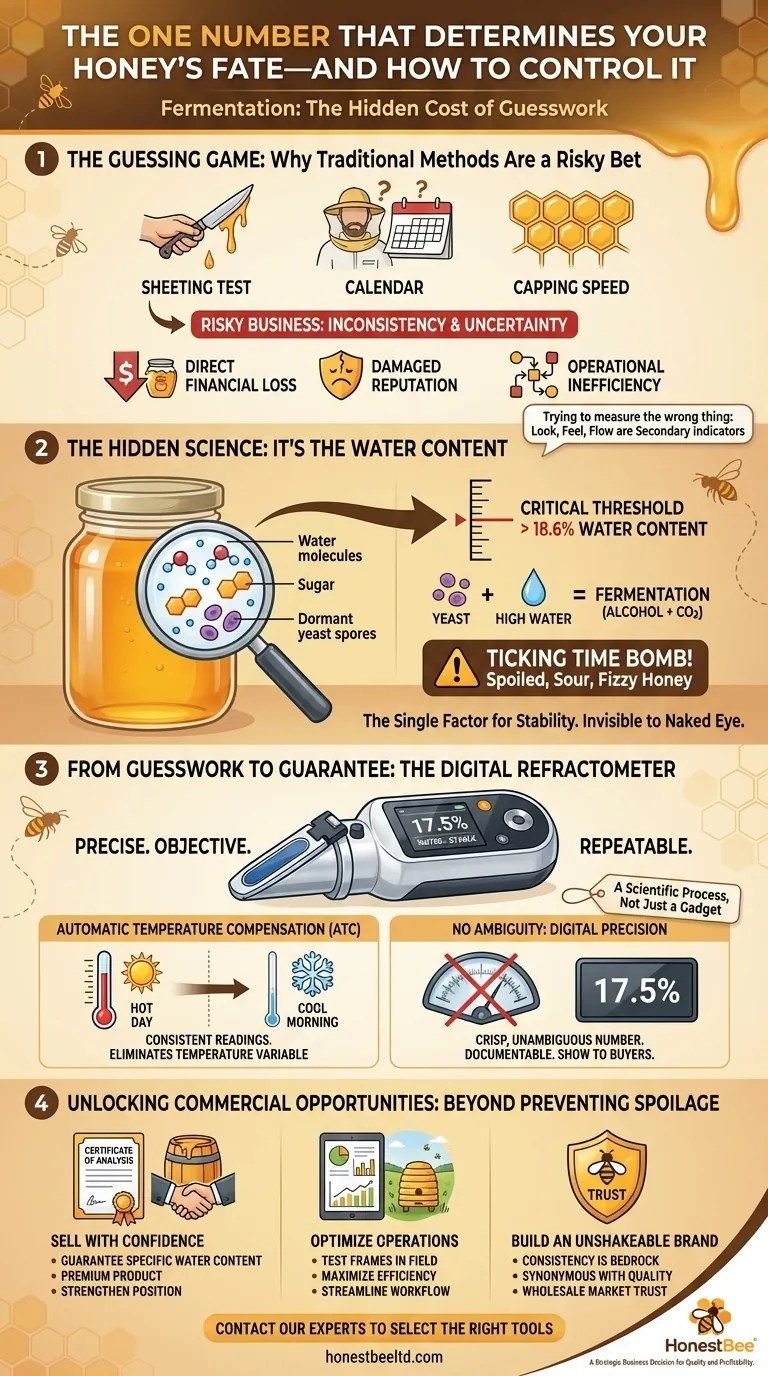
If you’ve ever found yourself anxiously second-guessing the perfect harvest time, you are not alone. For generations, beekeepers have relied on a collection of time-honored traditions: observing how quickly bees cap the cells, checking how honey "sheets" off a knife, or simply going by the calendar. These methods are a cherished part of the craft, but for a business, they are a high-stakes gamble.
Relying on guesswork and visual cues introduces massive inconsistency. A harvest that was stable last year might ferment this year due to subtle, invisible changes in humidity or nectar source.
The business consequences of this uncertainty are severe:
- Direct Financial Loss: A spoiled batch means lost revenue, wasted labor, and squandered resources.
- Damaged Reputation: A single return from a distributor or wholesaler can erode years of trust and lead to lost contracts.
- Operational Inefficiency: Indecision at harvest time slows down your entire operation, creating bottlenecks and delaying your path to market.
These "common solutions" fail because they are trying to measure the wrong thing. The look, feel, and flow of honey are all secondary indicators. The one factor that truly governs its stability is something you can't see, taste, or feel.
It's Not You, It's the Water: The Hidden Science of Honey Spoilage
The core issue isn't your experience or the health of your bees. It’s a simple matter of chemistry. The single most important factor determining if your honey will store safely or spoil is its water content.
Honey is a supersaturated sugar solution, and it naturally contains dormant, harmless yeast spores. When the water content in honey rises above a critical threshold—typically around 18.6%—these yeast spores can activate and begin to metabolize the sugars. The result is fermentation, which produces alcohol and carbon dioxide, giving the honey a sour taste and a fizzy texture. Your product is ruined.
This is why traditional methods are unreliable:
- The "sheeting test" measures viscosity, which is affected by both temperature and the honey's specific floral composition, not just its water content. The same honey will flow differently on a cool morning versus a warm afternoon.
- The speed of capping is a behavioral indicator, not a direct measurement of the finished product inside the sealed cells.
You can't eyeball a water content of 18% versus 20%. The difference is invisible to the naked eye but is the difference between a shelf-stable product and a ticking time bomb. To control your product's fate, you must move from guessing to measuring.
From Guesswork to Guarantee: The Right Tool for the Job
To solve this problem at its root, you need a tool designed for one purpose: to give you a precise, objective, and repeatable measurement of water content. You need a professional-grade refractometer.
A refractometer works by measuring how light bends—or refracts—as it passes through a liquid. This refractive index correlates directly and reliably to the water content. It replaces subjective observation with objective data.
However, not all refractometers are created equal. A critical variable that can skew readings is temperature. This is where professional equipment stands apart. Our digital refractometers are engineered specifically for the demands of commercial apiaries and distributors, directly addressing the root causes of inconsistent quality control:
- Eliminating Temperature Variables: Our models feature Automatic Temperature Compensation (ATC). This is non-negotiable. ATC automatically corrects the reading for the ambient temperature, ensuring the measurement you take in the cool of the morning is just as accurate as the one you take in a hot honey house. It provides a single, reliable source of truth.
- Removing Ambiguity: An analog scale can be difficult to read and open to interpretation. Our digital refractometers provide a crisp, unambiguous number on a clear display. There is no guesswork. A reading of 17.5% means 17.5%—a number you can document, stand behind, and show to a buyer.
This isn't about buying another gadget. It's about adopting a scientific process that underpins a professional operation. It's the instrument that allows you to guarantee your quality.
Beyond Preventing Spoilage: Unlocking New Commercial Opportunities
When you eliminate the risk of fermentation, you do more than just save a few batches of honey. You fundamentally change what's possible for your business. Moving from a defensive, hope-based strategy to an offensive, data-driven one unlocks new potential:
- Sell with Confidence: You can now provide a Certificate of Analysis with your shipments, guaranteeing a specific water content. This transforms your honey from a commodity into a premium, reliable product, strengthening your position with distributors and justifying a higher price.
- Optimize Your Operations: Test frames directly in the field to know exactly which supers are ready for harvest and which need more time. This data-driven approach maximizes efficiency, prevents premature harvesting, and streamlines your workflow from hive to jar.
- Build an Unshakeable Brand: Consistency is the bedrock of any successful brand. By delivering a product that is guaranteed stable every single time, your name becomes synonymous with quality and trust in the wholesale market.
The question is no longer "Is my honey ready?" but rather "What new markets can my guaranteed-quality honey open up?"
Solving the challenge of honey stability is more than just a technical fix; it's a strategic business decision that protects your investment and builds your reputation. If you're ready to move beyond the guesswork and take control of your product quality, our team is here to help you select the right tools for your specific operational scale and goals. Contact Our Experts to discuss how you can build a more profitable and resilient beekeeping business.
Visual Guide
Related Products
- Digital Honey Refractometer for Precision Measurement of Optimal Honey Quality
- Precision Honey Refractometer Instrument for Quality Assessment
- Honey Concentrating and Filtering Dehumidifier Machine 2T Capacity for Honey
- 0.5T Capacity Honey Dehumidifier Dryer with Vacuum Heating and Thickening Filtering Machine
- High Quality Honey Dehumidifier Dryer Thickening Machine for Beekeeping
Related Articles
- The Physics of Perfection: Why a Single Number Determines Your Honey's Fate
- How to Accurately Test Honey Readiness: Science-Backed Methods for Beekeepers
- How to Perfect Honey Moisture Levels: A Beekeeper’s Guide to Refractometer Mastery
- From Ambiguity to Certainty: The Practical Case for Digital Honey Refractometers
- Precision in a Drop: Why Your Honey Refractometer Might Be Lying to You