A Single Number, A Costly Assumption
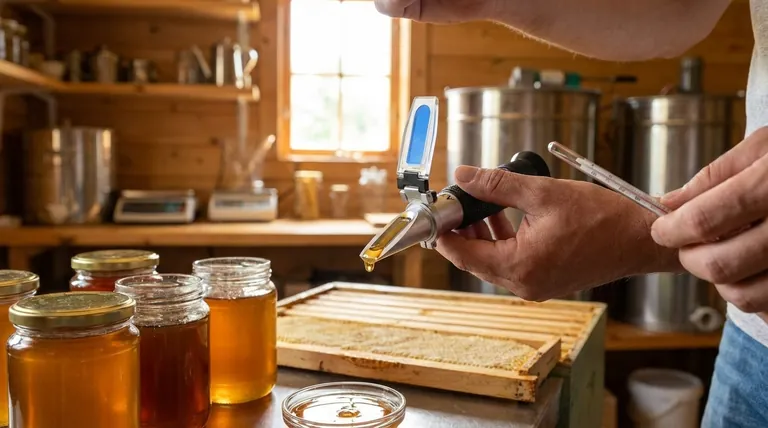
Imagine the scene: it’s late in the harvest season. A commercial beekeeper pulls a frame of honey from a cool hive and brings it into a warm extracting room. A drop of honey is placed on the refractometer. The reading comes back at 17.8% moisture—a perfect, stable number for bottling.
The entire tank is processed based on this single data point. Weeks later, calls come in about fermenting honey.
The beekeeper trusted the number. The problem is, the number was a lie. Not because the tool was broken, but because it was used without understanding the physics of its own measurement.
The Deception of a Simple Reading
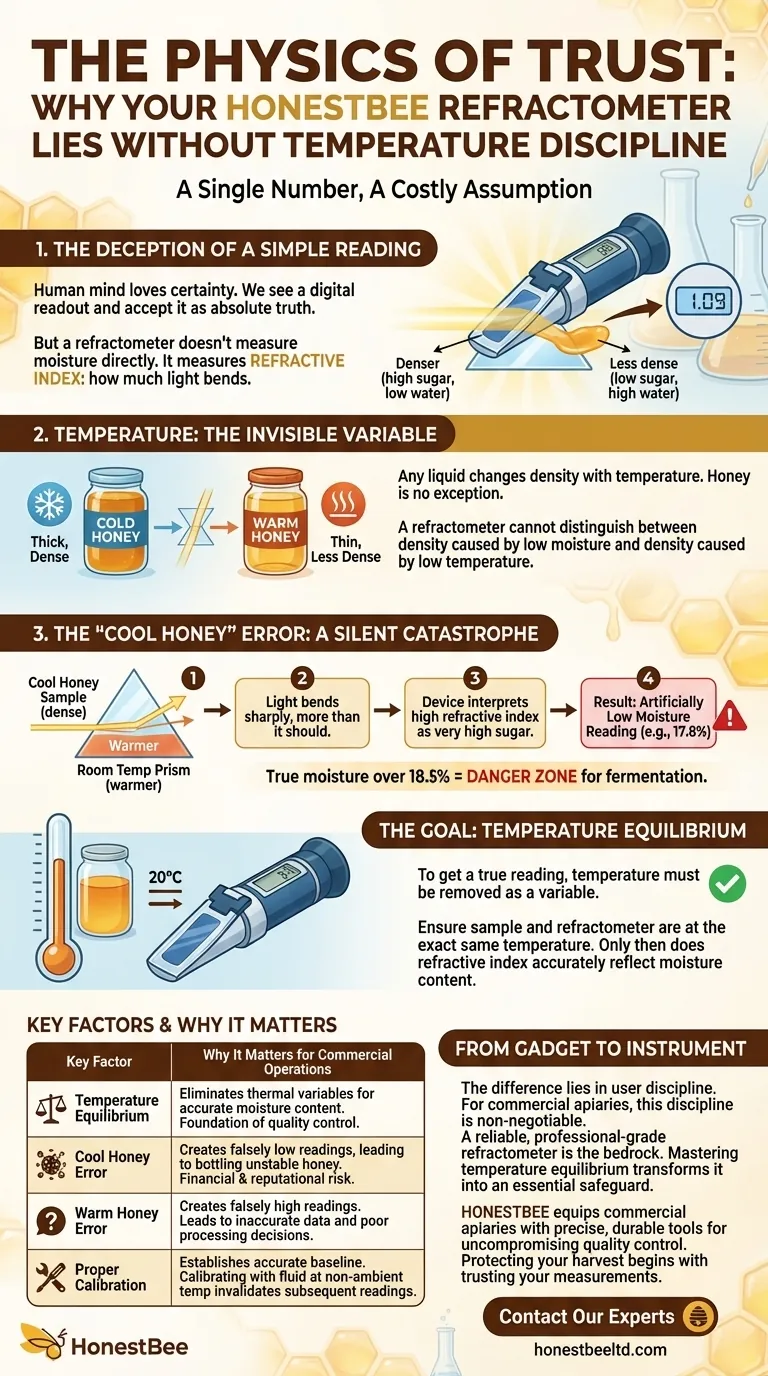
The human mind loves certainty. We see a digital readout and accept it as an absolute truth. But a honey refractometer doesn't actually measure moisture. It measures a proxy: the refractive index, or how much a beam of light bends when it passes through the honey.
How a Refractometer "Sees"
The device is built on a simple correlation:
- Denser fluid (high sugar, low water) bends light more.
- Less dense fluid (low sugar, high water) bends light less.
The refractometer is calibrated to translate that angle of bending into a moisture percentage. It’s an elegant and rapid method, but it operates on one critical assumption: that moisture content is the only thing affecting the honey's density.
This assumption is dangerously flawed.
Temperature: The Invisible Variable
Any liquid changes density with temperature. Honey is no exception.
- Cold honey is thick and dense.
- Warm honey is thin and less dense.
A refractometer is a simple machine. It cannot distinguish between density caused by low moisture and density caused by low temperature. It just sees "dense" and reports a low moisture content.
The "Cool Honey" Error: A Silent Catastrophe
This brings us back to our beekeeper. The honey sample was cool, but the refractometer was at room temperature.
- The cool, dense honey was placed on the warmer prism.
- The light bent sharply, more than it should have for its actual moisture content.
- The device interpreted this high refractive index as very high sugar concentration.
- It returned an artificially low moisture reading (17.8%).
The honey's true moisture content was likely over 18.5%, placing it squarely in the danger zone for fermentation. This single, misunderstood reading put an entire batch, and the operation's reputation, at risk.
The Goal: Temperature Equilibrium
To get a true reading, temperature must be removed as a variable. This is achieved through temperature equilibrium—ensuring the honey sample and the refractometer are at the exact same temperature.
When both are in thermal balance, the only significant factor influencing density is the water content. Only then can you trust the number the refractometer gives you.
| Key Factor | Why It Matters for Commercial Operations |
|---|---|
| Temperature Equilibrium | Eliminates thermal variables, ensuring refractive index accurately reflects moisture content. This is the foundation of quality control. |
| Cool Honey Error | Creates falsely low moisture readings, leading to the bottling of unstable honey. This is a direct financial and reputational risk. |
| Warm Honey Error | Creates falsely high moisture readings. Less dangerous, but still leads to inaccurate data and poor processing decisions. |
| Proper Calibration | Establishes an accurate baseline. Calibrating with fluid that isn't at ambient temperature invalidates every subsequent reading. |
From Gadget to Instrument
The difference between a simple gadget and a scientific instrument lies in the discipline of the user. For a commercial apiary, where consistency and quality are paramount, that discipline is non-negotiable.
A reliable, professional-grade refractometer is the bedrock of this process. It's a tool built to provide consistent results when operated with an understanding of the physics at play. Mastering this simple principle of temperature equilibrium transforms the device from a potential source of error into an essential safeguard for your product.
At HONESTBEE, we equip commercial apiaries and distributors with the precise, durable tools required for uncompromising quality control. Protecting your harvest begins with trusting your measurements, and that trust is only earned through superior equipment and proper procedure.
Ensure every batch meets the standard your customers expect. Contact Our Experts
Visual Guide
Related Products
- Digital Honey Refractometer for Precision Measurement of Optimal Honey Quality
- Precision Honey Refractometer Instrument for Quality Assessment
- Premium Heat-Resistant Glass Honey Dipper
- Modern Stainless Steel Honey Dipper Stirrer
- Heavy Duty 304 Stainless Steel Honey Dipper
Related Articles
- The Physics of Perfection: Why a Single Number Determines Your Honey's Fate
- How to Accurately Test Honey Readiness: Science-Backed Methods for Beekeepers
- How to Perfect Honey Moisture Levels: A Beekeeper’s Guide to Refractometer Mastery
- From Ambiguity to Certainty: The Practical Case for Digital Honey Refractometers
- Precision in a Drop: Why Your Honey Refractometer Might Be Lying to You