The Heaviest Thing You Lift is Risk
Consider the moment before you move a beehive. The colony hums with the energy of 50,000 lives. The honey supers, dense with nectar, can bring the total weight to over 100 pounds.
But the heaviest thing a beekeeper lifts is not the hive; it's the risk.
The modern beehive is a masterpiece of modular design—a stack of boxes that can be added or removed as the colony expands and contracts. This flexibility is its greatest strength. It is also its most profound weakness.
The Psychology of an Unstable Stack
A stacked hive is held together by gravity and the bees' own propolis. It's a system that works perfectly until the moment it doesn't.
The fear of a hive coming apart mid-lift is a powerful psychological barrier. This isn't an irrational fear. The consequence of a single box shifting is a cascade of problems: a gap opens, agitated guard bees pour out, and the beekeeper's focus shifts from a safe lift to damage control.
This hesitation—the mental calculus of risk—is where injuries and accidents happen. A lack of confidence in your equipment breeds insecurity in your actions.
Deconstructing the Failure Point
To understand the solution, we must first appreciate the engineering problem. A beehive isn't just a heavy box; it's a dynamic system vulnerable to specific forces.
The Stack as a System
Each box—the bottom board, brood chambers, honey supers—is an independent component. During transport over uneven ground or in the back of a truck, each component wants to move independently.
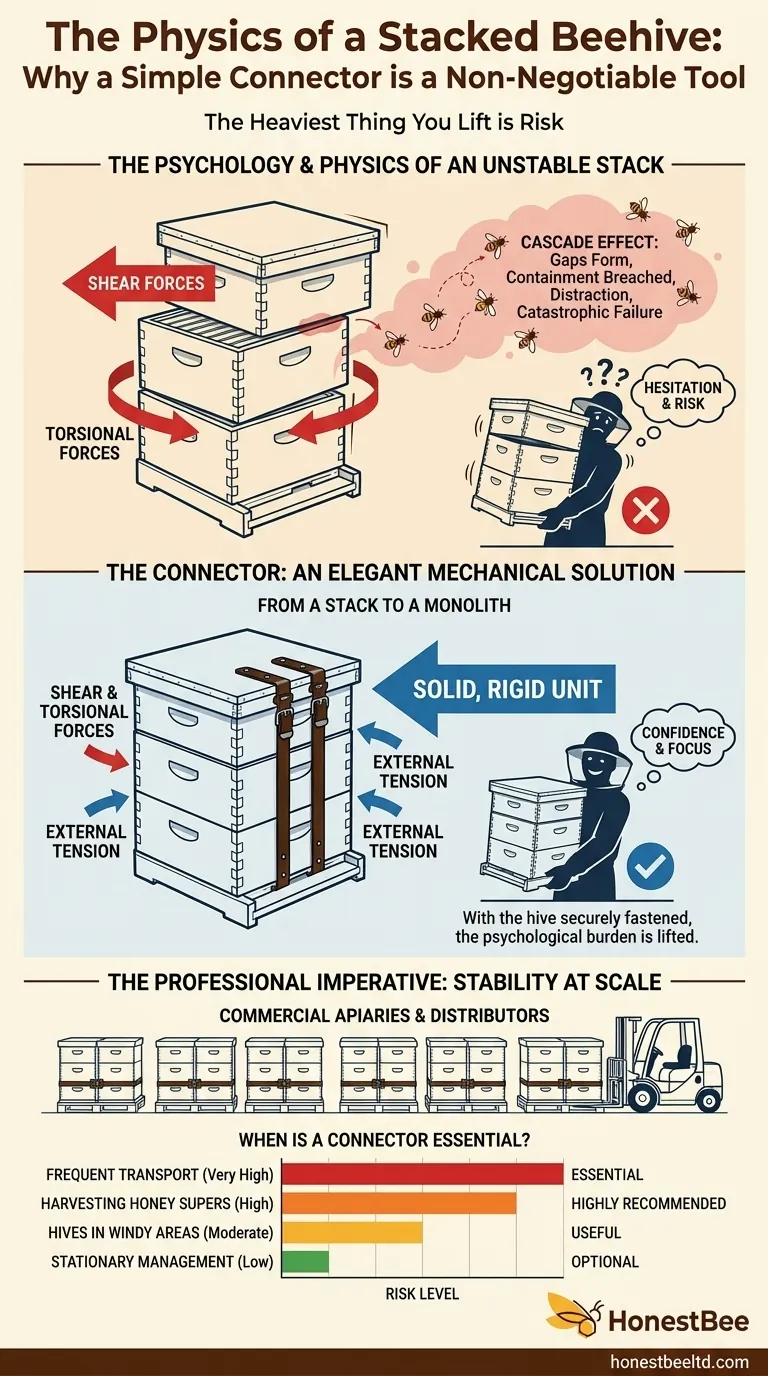
Vibrations create shear forces, encouraging boxes to slide horizontally. A slight tilt during a lift creates torsional forces, causing them to twist.
The Cascade Effect
A small shift is the first domino.
- A Gap Forms: A quarter-inch is all it takes for bees to escape.
- Containment is Breached: The colony's defensive response is triggered.
- The Beekeeper is Distracted: Attention is now divided between the heavy, unstable load and the defensive bees.
- Catastrophic Failure: The hive is dropped, boxes topple, and a manageable situation becomes a disaster.
The problem isn't just that the boxes can fall; it's that the threat of them falling compromises the safety of the entire procedure.
The Connector: An Elegant Mechanical Solution
The beehive connector is an elegantly simple answer to this complex problem. It's a mechanical handshake that transforms the physics of the system.
From a Stack to a Monolith
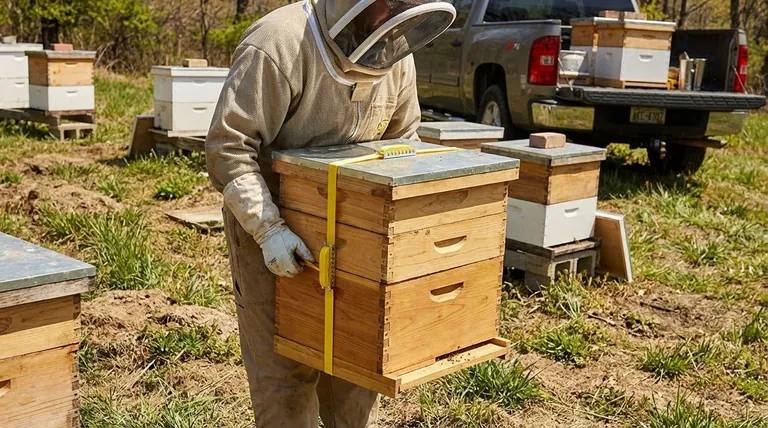
By clamping onto the edges of adjacent boxes, the connector locks them into a single, rigid unit. It introduces external tension, creating a structure that resists the shear and torsional forces that want to tear it apart.
The precarious stack becomes a solid block.
Confidence as a Tool
With the hive securely fastened, the psychological burden is lifted. The beekeeper can focus entirely on the ergonomics of a safe, heavy lift.
They are no longer managing a wobbly tower but moving a single, predictable object. This confidence is not just a feeling; it is a critical safety tool that prevents hesitation and promotes smooth, deliberate action.
The Professional Imperative: Stability at Scale
For hobbyists, moving a hive is an occasional task. For commercial apiaries and equipment distributors, it is a core business function.
When moving hundreds of hives for pollination contracts or distribution, instability is not an occasional risk—it is a systemic drag on efficiency and a major liability. Dropped hives, lost bees, and injured workers are unacceptable costs.
This is why professional-grade, reliable equipment is not an accessory but an operational necessity. Commercial apiaries and distributors depend on wholesale suppliers like HONESTBEE for heavy-duty hardware designed for the rigors of repeated, large-scale transport. The durability of a simple connector underpins the profitability of the entire operation.
When is a Connector Essential?
The decision depends entirely on your operational goals.
| Scenario | Risk Level | Connector's Role |
|---|---|---|
| Frequent Transport | Very High | Essential. Core safety and efficiency tool. |
| Harvesting Honey Supers | High | Highly Recommended. Secures top-heavy loads. |
| Hives in Windy Areas | Moderate | Useful. Prevents lids or boxes from blowing off. |
| Stationary Management | Low | Optional. Good for peace of mind, but less critical. |
Ultimately, a beehive connector is a small investment that pays significant dividends in safety, efficiency, and peace of mind. It ensures that the only thing you have to worry about is the weight of the box, not its integrity.
If your operation depends on moving bees safely and efficiently, ensuring your equipment is stable is the first and most critical step. Contact Our Experts
Visual Guide
Related Products
- Durable Plastic Interlocking Hive Connector for Beekeeping
- Heavy Duty Adjustable Hive Connector
- Stainless Steel Round Beehive Air Vents for Ventilation
- Heavy-Duty Nylon Beehive Hive Strap with Stainless Steel Cinch Buckle
- Steel Round Disc Entrance Reducer for Flexzion Bee Hive Nuc Box Gate
Related Articles
- Gravity is Not Your Friend: The Simple Physics of Safe Beehive Transport
- Plastic Bee Hives: A Smart Investment for Modern Beekeepers
- Stop Losing Bees in Transit: The Real Reason Your Hive Transport is Chaotic and How to Fix It for Good
- The Silent Killer in Beehive Transport: Why Sealing Your Hives is a Fatal Mistake
- The Aerodynamics of Survival: Why Hive Transportation Is a Race Against Heat