The Anatomy of a Risk
Every beekeeper knows the feeling. You bend your knees, get a firm grip, and lift. You are not just lifting boxes; you are lifting a city, a superorganism humming with life, heavy with honey and responsibility.
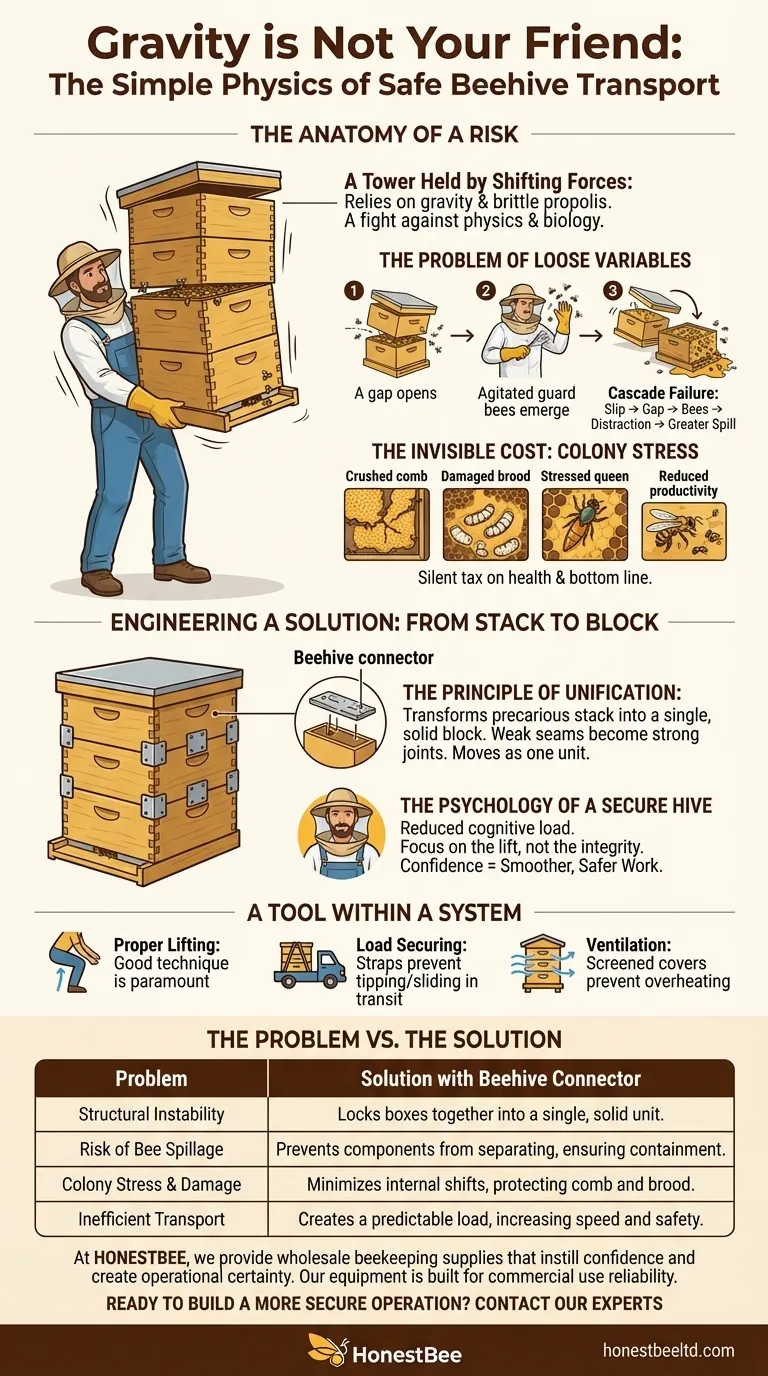
A standard beehive is a marvel of modular design. It’s a vertical stack of components: bottom board, brood boxes, honey supers, and a lid. But this modularity is also its greatest weakness during transport. The entire structure is held together by two things: gravity and the bees’ own propolis—a resinous glue that is strong, but brittle.
This is a system governed by hope. You hope the road is smooth. You hope your grip doesn't slip. You hope the propolis seal holds. For commercial apiaries, where dozens or hundreds of hives are moved, hope is not a scalable strategy.
The Problem of Loose Variables
The core challenge of moving a beehive isn't just its weight. It's a fight against physics and biology.
A Tower Held by Shifting Forces
Without a mechanical lock, each box in the hive is an independent variable. A slight tilt during lifting, a sharp turn in a vehicle, or an uneven patch of ground can cause one box to shift against another.
Once that seal is broken, the structural integrity is gone. You are no longer carrying a single unit; you're trying to balance a wobbly tower.
The Cascade Failure of a Single Slip
A minor shift can escalate in seconds.
- A gap opens.
- Agitated guard bees emerge.
- The beekeeper is distracted, their focus now split between managing the load and the immediate stinging threat.
- The load becomes more unstable, leading to a greater spill.
This chain reaction poses a danger to the handler and the public, and it results in significant bee loss, weakening a valuable colony.
The Invisible Cost: Colony Stress
Even if the hive doesn't come apart completely, the internal disruption is damaging. The jostling can cause frames of delicate comb to slam together, crushing bees and brood. The stress of the event impacts the queen's laying patterns and the colony's overall productivity.
It’s a silent tax on the colony’s health and your bottom line.
Engineering a Solution: From Stack to Block
The most elegant solutions are often the simplest. The beehive connector addresses the root of the problem with one direct action: it eliminates the variables.
The Principle of Unification
By firmly locking the individual boxes together, a beehive connector transforms a precarious stack into a single, solid block. It's a simple mechanical principle that fundamentally changes the physics of the task.
The weak points—the seams between boxes—are no longer weak. The structure becomes a unified whole, moving as one solid piece. This makes it dramatically easier and safer to lift, carry, and secure.
The Psychology of a Secure Hive
The most profound benefit may be psychological.
When you know the hive is locked solid, your cognitive load decreases. You can focus entirely on the lift and the path ahead, rather than worrying about the integrity of the stack. This confidence leads to smoother, more efficient, and safer work.
It replaces the anxiety of managing loose components with the certainty of handling a single, predictable object.
A Tool Within a System
A connector is a critical component, but it's the cornerstone of a larger safety system.
- Proper Lifting: Even a unified hive is heavy. Good physical technique is paramount.
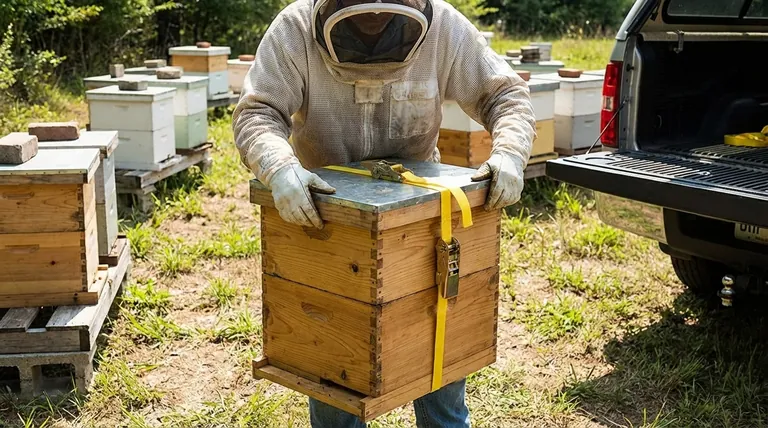
- Load Securing: In a vehicle, straps are still necessary to prevent the entire hive from tipping or sliding. The connector ensures the hive stays together; straps ensure it stays in place.
- Ventilation: Bees generate immense heat. Screened moving covers are essential to prevent the colony from overheating during transit.
The Problem vs. The Solution
| Problem | Solution with Beehive Connector |
|---|---|
| Structural Instability | Locks boxes together into a single, solid unit. |
| Risk of Bee Spillage | Prevents components from separating, ensuring containment. |
| Colony Stress & Damage | Minimizes internal shifts, protecting comb and brood. |
| Inefficient Transport | Creates a predictable load, increasing speed and safety. |
For commercial apiaries and equipment distributors, managing risk is everything. Your colonies are your assets. Your time is your inventory. The structural integrity of your hives during transport cannot be left to chance. At HONESTBEE, we focus on providing wholesale beekeeping supplies that instill confidence and create operational certainty. Our equipment is built to withstand the rigors of commercial use, because we know reliability is the bedrock of a successful apiary business.
If you are ready to build a more secure and efficient operation, we can help. Contact Our Experts
Visual Guide
Related Products
- Durable Plastic Interlocking Hive Connector for Beekeeping
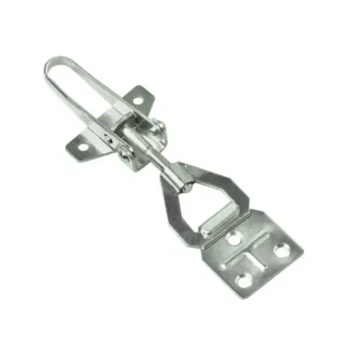
- Heavy Duty Adjustable Hive Connector
- V-Shaped Spring Hive Connector for Beekeeping
- Heavy-Duty Nylon Beehive Hive Strap with Stainless Steel Cinch Buckle
- Stainless Steel Round Beehive Air Vents for Ventilation
Related Articles
- The Physics of a Stacked Beehive: Why a Simple Connector is a Non-Negotiable Tool
- Plastic Bee Hives: A Smart Investment for Modern Beekeepers
- Stop Losing Bees in Transit: The Real Reason Your Hive Transport is Chaotic and How to Fix It for Good
- The Silent Killer in Beehive Transport: Why Sealing Your Hives is a Fatal Mistake
- The Aerodynamics of Survival: Why Hive Transportation Is a Race Against Heat