The Residue of a Harvest
Picture the scene after a long day of extraction. The air in the honey house is thick and sweet. Drums are filling up with golden liquid. By all measures, it's a successful harvest.
But in the corner, there's a growing pile of wax uncappings—sticky, messy, and saturated with honey. There are also a few broken frames with irregular burr comb that couldn't fit in the extractor.
For many, this is just the cost of doing business. A minor, acceptable loss. But this perspective overlooks a fundamental principle: value is often hidden in the byproducts we're not equipped to process. The human mind tends to discount what it cannot easily measure or manage.
The honey press exists to correct this blind spot. It's not a replacement for the high-speed centrifugal extractor; it's a complementary tool built on a different philosophy.
The Physics of Two Philosophies
Understanding when to use a press starts with understanding its mechanical principle, which stands in stark contrast to that of an extractor. They don't just do the same job differently; they do different jobs entirely.
Centrifugal Extraction: The Logic of Preservation
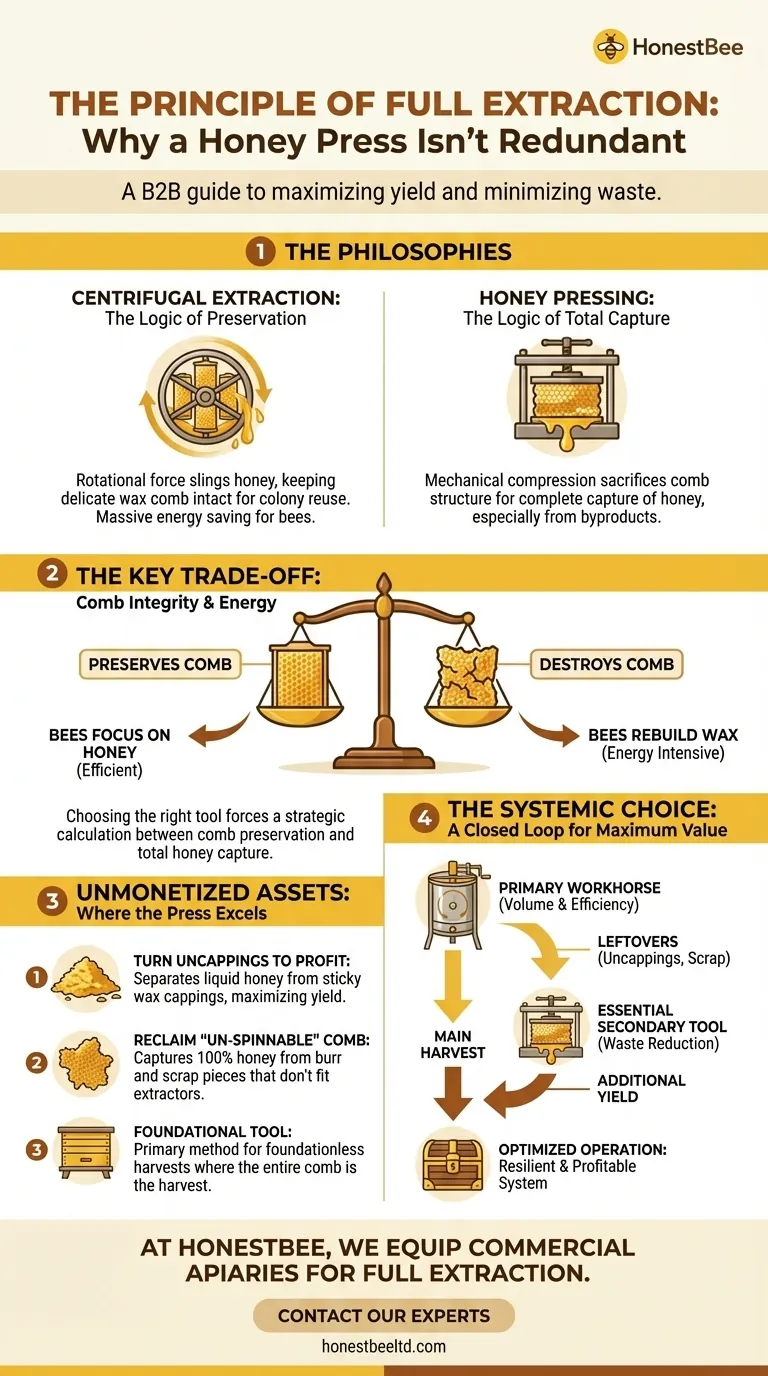
A centrifugal extractor is a marvel of efficiency. It uses rotational force to sling honey from the cells while keeping the delicate beeswax comb perfectly intact.
This is a massive advantage. Bees expend enormous energy—an estimated 6 to 8 pounds of honey—to produce a single pound of wax. By returning empty, "wet" frames to the hive, you give the colony a colossal head start. They can immediately begin refilling cells instead of rebuilding their entire infrastructure.
The extractor prioritizes the preservation of the bees' most valuable asset: their drawn-out comb.
Honey Pressing: The Logic of Total Capture
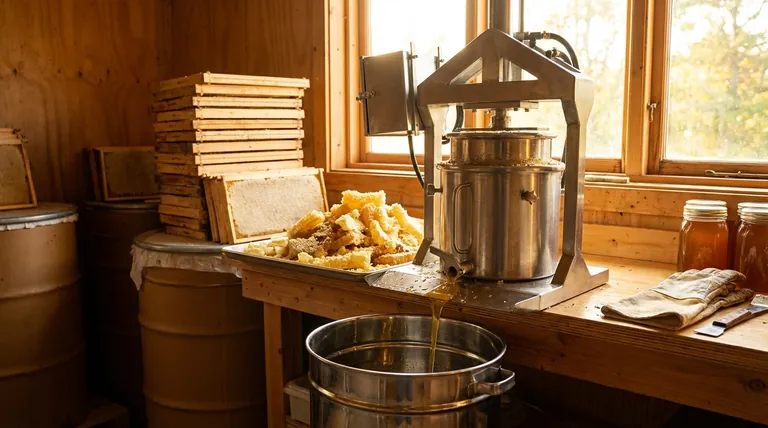
A honey press operates on a simpler, more direct principle: compression. Raw honeycomb, uncappings, or scrap pieces are placed in a basket, and mechanical pressure squeezes out every last drop of honey.
This process intentionally sacrifices the comb. It’s a deliberate choice to trade the structure of the wax for the complete capture of the honey contained within it. Its value isn't in speed, but in its thoroughness.
The Unmonetized Assets in Your Apiary
The real genius of a honey press is its ability to turn operational waste into a quantifiable revenue stream. It targets the materials the extractor is designed to leave behind.
Turning Uncappings from Waste into Profit
The wax cappings sliced off frames before extraction are rich with honey. Trying to separate this by melting is messy and can darken the honey. A press, however, neatly separates the liquid honey from the solid wax, maximizing your yield from a source that is otherwise difficult to process.
Reclaiming the "Un-spinnable" Comb
Bees don't always build where we want them to. Burr comb and other irregular pieces built in odd spaces cannot be placed in an extractor. A press allows you to reclaim 100% of the honey from this scrap comb, ensuring the bees' work is never wasted.
A Foundational Tool for a Different Model
For beekeepers who practice foundationless methods, such as in Warre or Top Bar hives, the entire comb is the harvest. Since the comb is not being reused in a frame, pressing is the primary and most logical extraction method. The tool perfectly aligns with the philosophy.
The Beekeeper's Calculus: Energy, Time, and Yield
Choosing your equipment requires weighing a series of trade-offs. It's a strategic calculation, not just a preference.
| Factor | Honey Press (Compression) | Centrifugal Extractor (Rotation) |
|---|---|---|
| Primary Goal | Maximize honey yield from all sources, including byproducts. | Maximize speed and preserve comb for bee reuse. |
| Comb Integrity | Destroys the comb. | Preserves the comb. |
| Energy Input | Manual, quiet, no electricity needed. | Typically requires electricity for high-volume operations. |
| Labor Intensity | Slower, more manual process per unit of honey. | Faster, more automated, ideal for large-scale harvests. |
| Ideal Use Case | Processing uncappings, scrap comb, foundationless harvests. | Primary extraction for standard Langstroth frames. |
The most significant trade-off is the comb. Destroying it forces the colony to divert resources from nectar collection to wax production. Preserving it allows them to focus solely on making more honey. The right choice depends entirely on the source of the comb you're processing.
Making the Systemic Choice
For a commercial apiary focused on efficiency, the honey press is not an "either/or" decision. It is an "and" proposition. It closes a loop in the production system.
- For maximum volume and efficiency, the centrifugal extractor remains the primary workhorse.
- For maximum yield and waste reduction, the honey press becomes an essential secondary tool to process the valuable leftovers.
- For operational versatility, a press can even be used for other homestead tasks, like pressing fruit for cider or juice, adding another layer of value.
By viewing your harvest not just as what comes out of the extractor, but as the sum total of everything the bees produce, you can optimize your entire operation. It’s about building a more resilient and profitable system.
At HONESTBEE, we equip commercial apiaries and distributors with the durable, professional-grade tools needed to implement this principle of full extraction. To optimize your workflow and capture the full value of your harvest, Contact Our Experts.
Visual Guide
Related Products
- Stainless Steel Manual Honey Press with Guard for Pressing Honey and Wax
- Stainless Steel Honey Press Wax Press with Tank
- Easy Use Manual Stainless Steel Honey Press for Honey Comb
- Electric Honey Press Machine for Squeezing Honey Comb Press Equipment
- 10L Stainless Steel Electric Honey Press Machine
Related Articles
- The Unseen System: Why a Honey Press is More Than Just a Tool
- Why a Honey Press is the Smart Choice for Small-Scale Beekeepers
- The Last Drop: Maximizing Yield and Purity with a Stainless Steel Honey Press
- Beyond Brute Force: Why Your Honey Press Is Costing You Quality and Yield
- Why Your Honey Press Is a Sticky, Contaminated Mess—And How to Fix It Permanently