The Beekeeper's Choice
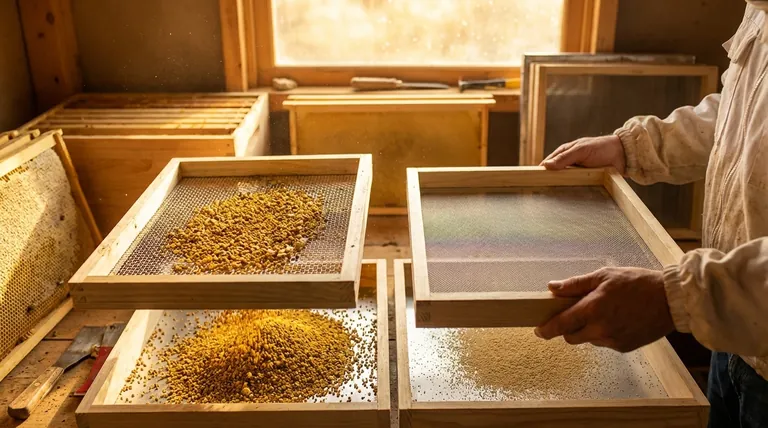
Imagine a commercial beekeeper after a successful pollen harvest. The raw product is valuable but mixed with small hive debris. To create a clean, marketable product, it must be sifted.
On the workbench are two screens: a 40-mesh and a 100-mesh.
Instinct might suggest that "40" and "100" are measures of the particle itself. This leads to a common misunderstanding. Our minds often map higher numbers to bigger things. But in the world of material science and processing, the opposite is true. The choice the beekeeper makes here will define both the purity of their product and the efficiency of their afternoon.
A Shift in the Mental Model
The confusion dissolves when we correct a fundamental assumption. The mesh number doesn't describe the particle passing through; it describes the tool doing the filtering.
It's About Wires Per Inch
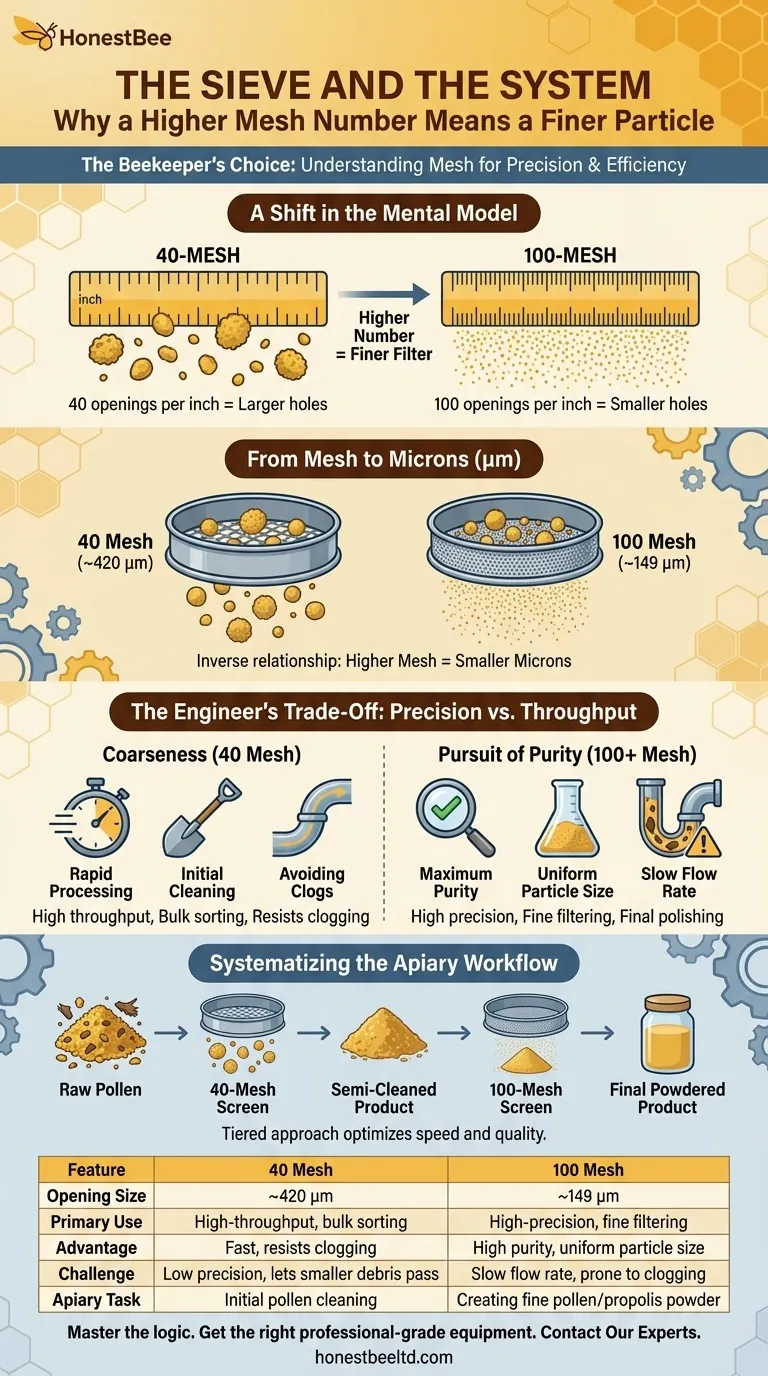
The term mesh number is a simple, elegant measure of density: it's the number of openings in one linear inch of a screen.
- A 40-mesh screen has 40 openings per inch.
- A 100-mesh screen has 100 openings per inch.
To fit 100 openings into the same inch where another screen fits only 40, the wires must be woven much closer together. This inherently creates smaller holes. The number describes the sieve, not the substance.
From Mesh to Microns
This principle has a direct physical correlation. We can translate the abstract mesh number into a precise, physical measurement using microns (µm)—one-millionth of a meter.
- 40 Mesh: The openings are approximately 420 microns.
- 100 Mesh: The openings are just 149 microns.
A particle that sails through the 420-micron gaps of a 40-mesh screen will be stopped dead by the 149-micron barrier of a 100-mesh screen. Suddenly, the inverse relationship is clear: a higher mesh number equals a finer filter.
The Engineer's Trade-Off: Precision vs. Throughput
Choosing a mesh size is never about finding the "best" one, but the right one for the task. It's a classic engineering balance between speed and precision.
The Case for Coarseness (40 Mesh)
A lower mesh number offers high throughput. Its larger openings are ideal for:
- Rapid Processing: Quickly sifting large volumes of material.
- Initial Cleaning: Removing only the largest debris without slowing down the workflow.
- Avoiding Clogs: Handling moist or irregularly shaped materials, like fresh pollen, that would blind a finer screen.
The trade-off is a lack of precision. It's a blunt instrument for a rough cut.
The Pursuit of Purity (100+ Mesh)
A higher mesh number is a tool of refinement. Its small openings provide:
- Maximum Purity: Filtering out very fine contaminants to create a premium product.
- Uniform Particle Size: Producing a consistent, fine powder for supplements or tinctures.
- Final Polishing: Acting as the last quality control step before packaging.
The cost is a significantly lower flow rate and a much higher susceptibility to clogging, requiring more attention and slower processing.
Systematizing the Apiary Workflow
For a commercial apiary, using a single screen is rarely enough. A systematic approach yields better results. An operator might first use a coarse screen (like 40-mesh) to quickly remove bees, wax, and large debris from raw pollen. Then, the semi-cleaned product can be passed through a finer screen (like 100-mesh) to achieve its final, powdered consistency.
This tiered approach optimizes for both speed and quality. But it relies entirely on having durable, accurately calibrated screens. For wholesale distributors and large-scale apiaries, equipment reliability isn't just a convenience—it's the bedrock of product consistency and operational profit.
| Feature | 40 Mesh | 100 Mesh |
|---|---|---|
| Opening Size | ~420 µm | ~149 µm |
| Primary Use | High-throughput, bulk sorting | High-precision, fine filtering |
| Advantage | Fast, resists clogging | High purity, uniform particle size |
| Challenge | Low precision, lets smaller debris pass | Slow flow rate, prone to clogging |
| Apiary Task | Initial pollen cleaning | Creating fine pollen/propolis powder |
Mastering the simple, counter-intuitive logic of mesh sizing transforms how you approach material processing. When your operation demands this level of precision and reliability, having the right professional-grade equipment is non-negotiable. Contact Our Experts
Visual Guide
Related Products
- Professional Grade Foldable Beehive Handles
- Precision Stainless Steel Frame Cleaner for Hive Grooves and Corners
- HONESTBEE Adjustable Voltage Wire Embedder with Digital Display
- HONESTBEE Premium Italian Style Hive Tool with Hardwood Handle
- Professional Plastic Honey Dipper for Easy Honey Drizzling
Related Articles
- The Compounding Value of an Overlooked Detail: Engineering the Perfect Hive Handle
- The Essential Guide to Hive Tools in Modern Beekeeping
- How to Choose Hive Tools That Match Your Beekeeping Workflow
- The Beekeeper's Scalpel: How a Simple Hive Tool Governs Apiary Health
- The Physics of Calm: How a Simple Hive Tool Dictates the Success of an Apiary










