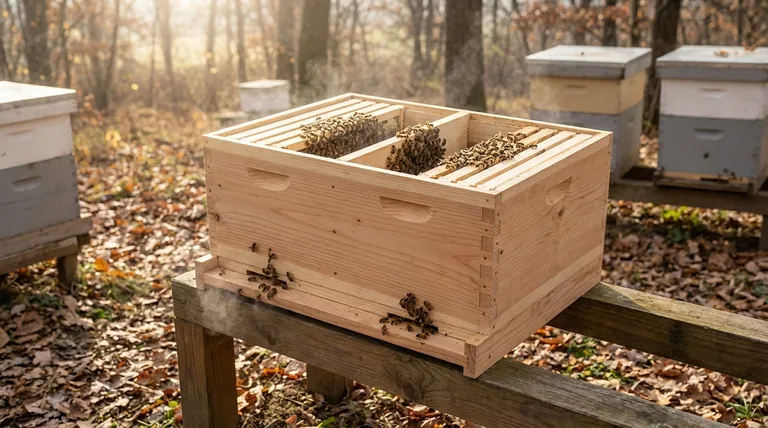
Every beekeeper knows the feeling. It's late autumn, and you have a nucleus colony with a fantastic, newly-mated queen. The genetics are valuable, the potential immense. But the colony is small. Too small.
You face a difficult calculation. Left alone, its chances of surviving the brutal thermodynamics of winter are slim. A small cluster simply cannot generate enough heat to offset the relentless cold. Combining it with another hive means sacrificing that precious queen. It feels like a choice between two losses.
This isn't a failure of beekeeping; it's a systems problem. And it has an elegantly simple systems solution.
The Counterintuitive Solution: Shared Walls
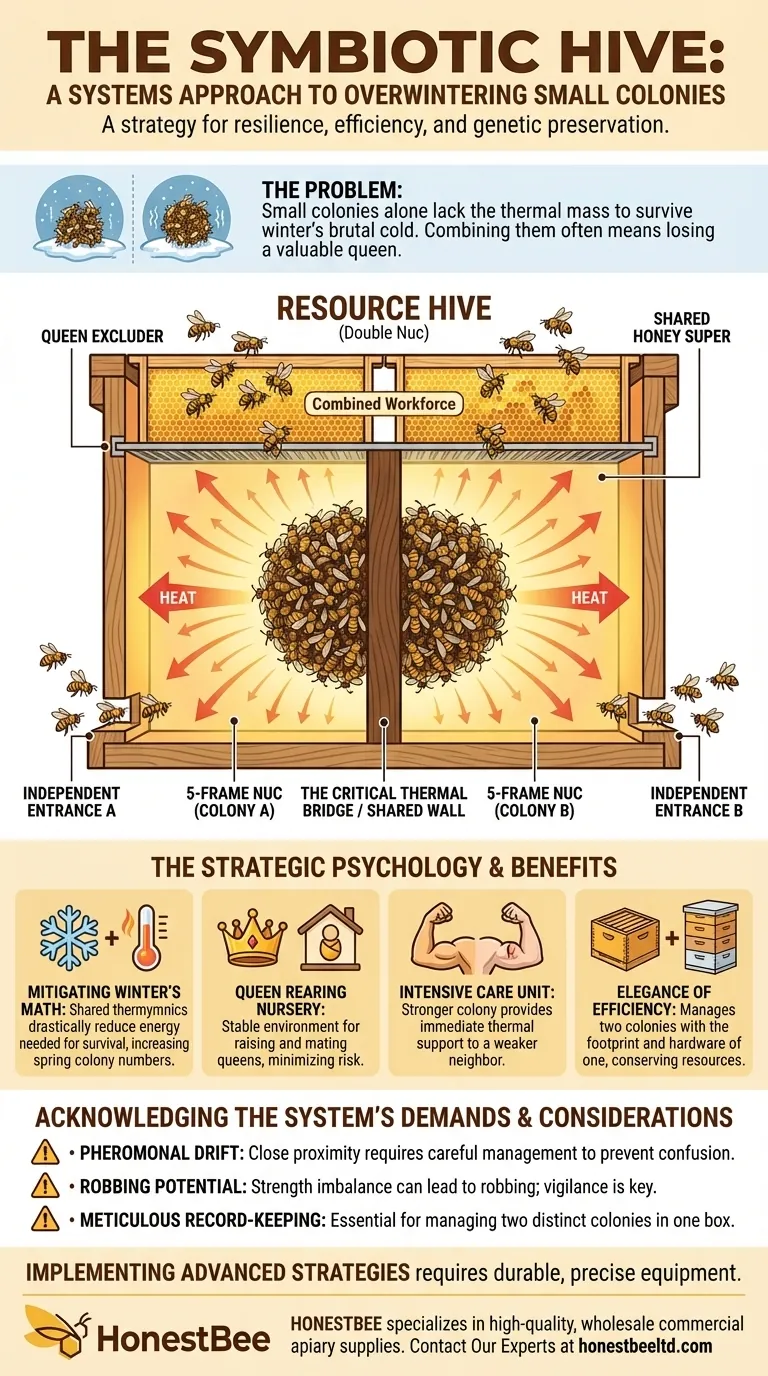
The solution is the resource hive, also known as a double nuc. It's a single hive body, internally divided, housing two independent nucleus colonies side-by-side.
From the outside, it appears as one unit. But internally, two colonies live separate lives, divided by a common wall. This single architectural change alters the math of winter survival. It transforms two independent, vulnerable colonies into one symbiotic, resilient system.
The core principle is not just about cohabitation; it's about shared thermodynamics.
The Anatomy of a Resilient System
The genius of the resource hive lies in its simplicity. It modifies standard equipment to solve a complex biological challenge.
A Single Box, Two Colonies
The system typically uses a standard 10-frame deep hive body, but a solid divider is installed down the middle. This instantly creates two 5-frame nuc boxes within a single structure.
The Critical Thermal Bridge
That central divider is the heart of the system. It's a shared wall that acts as a thermal bridge. As the two colonies form their winter clusters, they often cluster against this shared wall. The heat from one colony passively radiates through the wood, warming its neighbor. Their combined thermal output drastically reduces the energy expenditure required for each to survive.
Independent Operations
To prevent the colonies from merging or drifting, each has its own entrance, typically on opposite faces of the box. Each also has its own inner cover, allowing the beekeeper to inspect or feed one colony without disturbing the other. They are neighbors, not roommates.
A Shared Objective: The Honey Super
In a nectar flow, a single queen excluder and honey super can be placed over the entire box. The combined workforce from both colonies will work together to fill a single set of frames, demonstrating a powerful principle: separate, resilient foundations can collaborate on a single, productive goal.
The Strategic Psychology of a Double Nuc
Beyond the physics, the resource hive addresses core challenges in beekeeping management, reducing risk and anxiety for the apiarist.
Mitigating Winter's Brutal Math
This is the primary advantage. By allowing two small colonies to share heat, you fundamentally change their probability of survival. This isn't just about saving bees; it's about preserving valuable genetics and heading into spring with more viable production units. It provides peace of mind against winter's biggest threat.
The Queen Rearing Nursery
A resource hive is a perfect, self-sustaining nursery for raising and mating queens. One side can house a queenless cell builder or a mating nuc, while the other remains a stable, queenright colony providing a constant source of warmth and security. This minimizes the risk associated with the delicate process of queen rearing.
An Intensive Care Unit for Weaker Hives
Placing a struggling colony next to a strong one provides immediate thermal support—a form of intensive care. The beekeeper can also easily transfer a frame of brood or food from the strong side to the weak, providing a lifeline with minimal disruption.
The Elegance of Efficiency
For commercial operations, efficiency is paramount. A resource hive manages two colonies with the footprint and hardware of one. One bottom board, one outer cover, one stand. This conservation of space and equipment is a simple but powerful operational advantage.
Acknowledging the System's Demands
This is an advanced technique, not a beginner's setup. Its success relies on understanding its unique operational parameters.
- Pheromonal Drift: The close proximity means scents can mingle. Careful management and distinct entrances are key to preventing confusion or queen rejection.
- Robbing Potential: A significant imbalance in strength can be dangerous. If one colony weakens dramatically, it can be a target for robbing by its powerful neighbor. Vigilance is required.
- Meticulous Record-Keeping: You are managing two distinct colonies in a single box. Confusing the needs, temperaments, or health status of one with the other is a risk that demands careful, separate records.
The resource hive is the embodiment of an engineer's romance—a simple design that creates complex, beneficial behaviors. It's a strategic tool for the thinking beekeeper, turning two small risks into a single, more resilient asset.
Implementing advanced strategies like this at a commercial scale requires equipment that is as reliable and well-engineered as the system itself. Durable, precisely-milled hive bodies, frames, and dividers are not just conveniences; they are the foundation of a predictable, productive operation. HONESTBEE specializes in supplying commercial apiaries with the high-quality, wholesale equipment needed to build these stronger, more efficient systems.
If you're ready to improve your apiary's resilience and efficiency, we can provide the building blocks. Contact Our Experts
Visual Guide
Related Products
- Twin Queen Styrofoam Honey Bee Nucs Mating and Breeding Box
- In-Hive Dual Compartment Frame Bee Feeder for Targeted Colony Nutrition
- Automatic Heat Preservation 6 Frame Pro Nuc Box for Honey Bee Queen Mating
- 5 Frame Wooden Nuc Box for Beekeeping
- 4 Frame Plastic Nuc Boxes for Beekeeping Bee Nuc Box
Related Articles
- The Cooperative Engine: How Double Nucs Engineer Winter Survival
- The Thermodynamics of a New Colony: Why a Smaller Nuc Box Is a Stronger Start
- Architecting Royalty: The Nuc Box as a Queen's Crucible
- Why Your Bee Boxes Don't Match: The Secret to Flawless Apiary Scaling
- The Architect's Dilemma: How a Nuc Box Solves a Honeybee Swarm's Housing Crisis











