The Silence of a Spring Morning
There are few moments more disheartening for a beekeeper than opening a hive in early spring to find it silent. The cluster is gone. The winter stores are untouched. The potential of a booming production colony has vanished.
This isn't just a loss of bees; it's a loss of time, genetics, and revenue. It forces a reactive scramble to buy expensive packages or nucs, often with unknown genetics, just to get back to zero.
The real problem isn't that colonies sometimes die. The problem is operating without a system to absorb that predictable risk.
Shifting from Hope to Strategy
Psychologically, we are wired to feel the pain of a loss more acutely than the pleasure of an equivalent gain. A dead-out in spring feels like a failure. But in a system as complex as an apiary, winter loss is not a failure—it's a statistical probability.
Successful commercial beekeeping, therefore, is not about hoping for a perfect survival rate. It's about building a resilient system that anticipates and hedges against probable losses.
This requires a shift in mindset: from reacting to problems to engineering solutions. The double nucleus box is one of the most elegant tools for this job.
The Double Nuc: A System, Not Just a Box
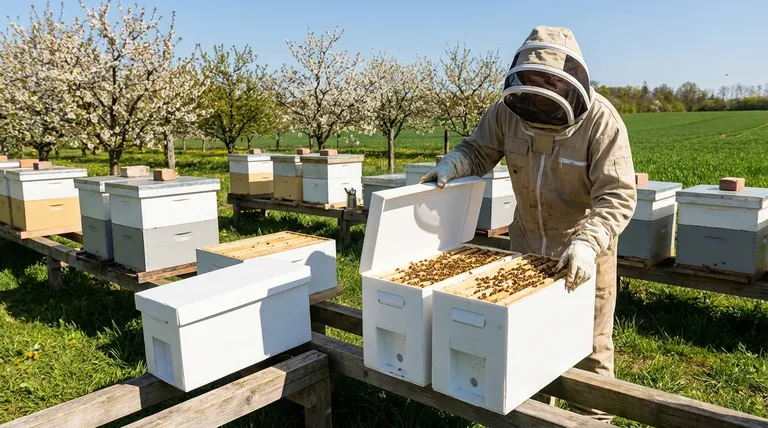
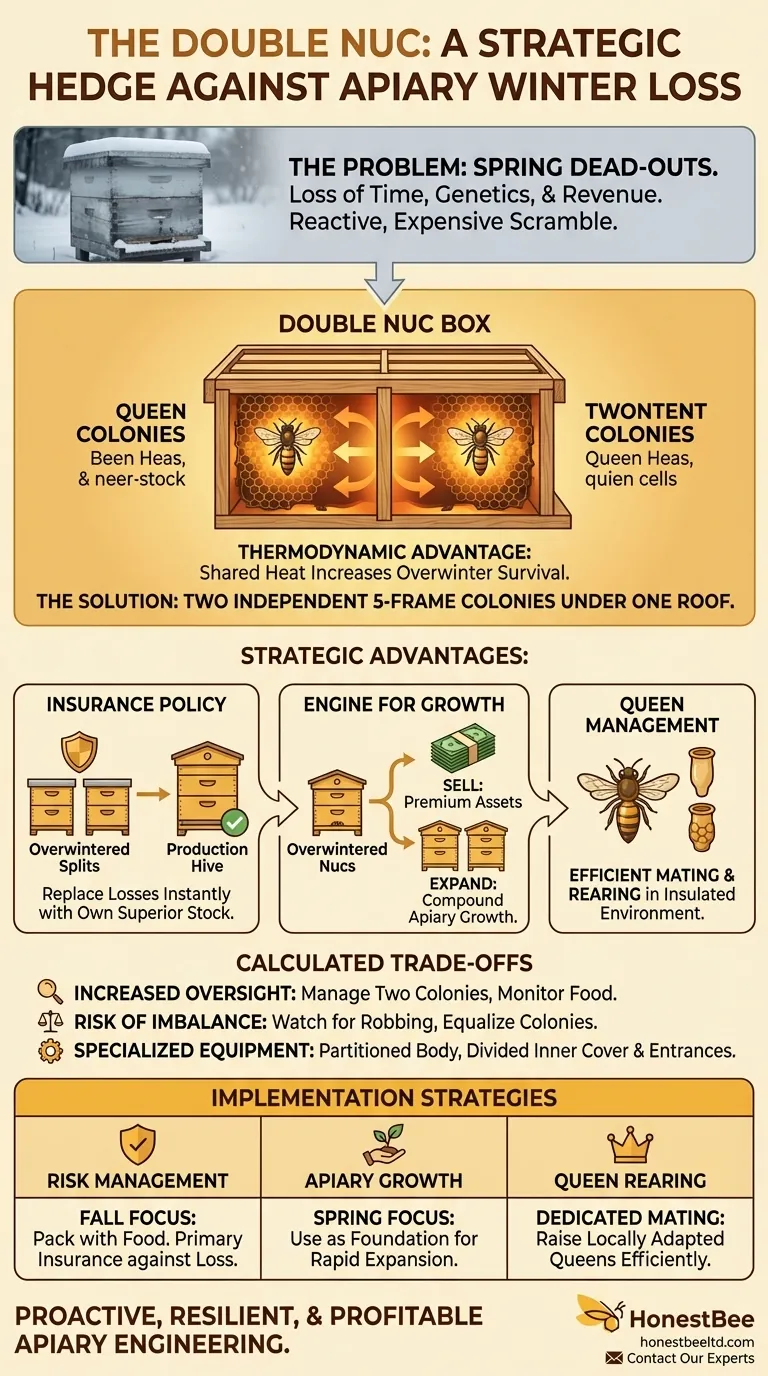
A double nuc box is a standard-sized hive body partitioned into two separate, five-frame colonies. It houses two independent queens and colonies under one roof.
But to see it as just a piece of wood is to miss the point entirely. The double nuc is a strategic management system. It allows you to manage two small colonies with the operational efficiency of managing one large one, unlocking several advantages.
An Insurance Policy Written in Beeswax
Its most powerful function is as an insurance policy. In late summer, you can make splits from your strongest production hives and establish them in the double nuc.
These two small colonies share a central wall, creating a profound thermodynamic advantage. The radiated heat from each cluster helps the other maintain its core temperature, dramatically increasing their collective chance of overwintering successfully compared to isolated nucs.
If a production hive fails, you don’t have to buy a replacement. You have a ready-made, locally adapted queen and colony ready for immediate deployment. You’ve replaced your loss instantly, with your own superior stock.
An Engine for Compounding Growth
What if all your production hives survive? Now your insurance policy pays out a dividend.
You enter the spring with two extra, overwintered nucleus colonies. These are premium assets.
- Sell Them: Overwintered nucs command a high price, as they are proven survivors and build up rapidly.
- Expand Your Apiary: Grow them into new, full-sized production hives, compounding the growth of your operation and increasing your honey or pollination potential.
This strategy turns a risk-mitigation tool into an engine for growth and profit.
An Ideal Setup for Queen Management
The double nuc is also a highly efficient queen-rearing environment. It allows you to raise and mate two new queens simultaneously in a single, well-insulated box, using a minimal population of bees to support them. It’s a resource-efficient way to improve your apiary's genetic stock.
The Calculated Trade-offs
No system is without its complexities. A double nuc is a powerful tool, but it demands thoughtful management.
- Increased Oversight: You are managing two distinct colonies in close proximity. This requires diligent monitoring to ensure both queens are laying well and each has adequate food stores.
- The Risk of Imbalance: It's common for one colony to become stronger than its neighbor. The beekeeper must watch for signs of robbing and be prepared to equalize the colonies by moving frames of brood or food.
- Specialized Equipment: Double nucs are non-standard. They require the partitioned hive body, a divided inner cover, and separate entrances. It's another piece of specialized gear to manage.
These aren't deterrents; they are simply variables to be managed within a superior strategic framework.
Implementing Your Strategy
How you manage a double nuc depends entirely on your primary goal.
| Goal | Management Approach |
|---|---|
| Risk Management | In fall, focus on packing both sides with ample food stores. Position them as your primary insurance against winter loss. |
| Apiary Growth | In spring, use your strong, overwintered nucs as the foundation for new production colonies, enabling rapid, cost-effective expansion. |
| Queen Rearing | Use the double nuc as a dedicated mating box to efficiently raise your own locally adapted queens with minimal resource input. |
Ultimately, incorporating a double nuc system is a proactive step toward a more predictable, profitable, and sustainable apiary. It’s the kind of strategic engineering that separates the hobbyist from the professional.
Building a more resilient operation starts with reliable, professional-grade equipment. HONESTBEE supports commercial apiaries and distributors with the durable supplies you need to implement advanced strategies like the double nuc system effectively.
Visual Guide
Related Products
- Twin Queen Styrofoam Honey Bee Nucs Mating and Breeding Box
- Pneumatic Double Nozzle Honey Filling Bottling Packaging Machine
- 5 Frame Langstroth Poly Nuc Corrugated Plastic Nuc Boxes
- Styrofoam Mini Mating Nuc Box with Frames Feeder Styrofoam Bee Hives 3 Frame Nuc Box
- Automatic Heat Preservation 6 Frame Pro Nuc Box for Honey Bee Queen Mating
Related Articles
- The Cooperative Engine: How Double Nucs Engineer Winter Survival
- The Thermodynamics of a New Colony: Why a Smaller Nuc Box Is a Stronger Start
- Architecting Royalty: The Nuc Box as a Queen's Crucible
- Why Your Bee Boxes Don't Match: The Secret to Flawless Apiary Scaling
- The Architect's Dilemma: How a Nuc Box Solves a Honeybee Swarm's Housing Crisis