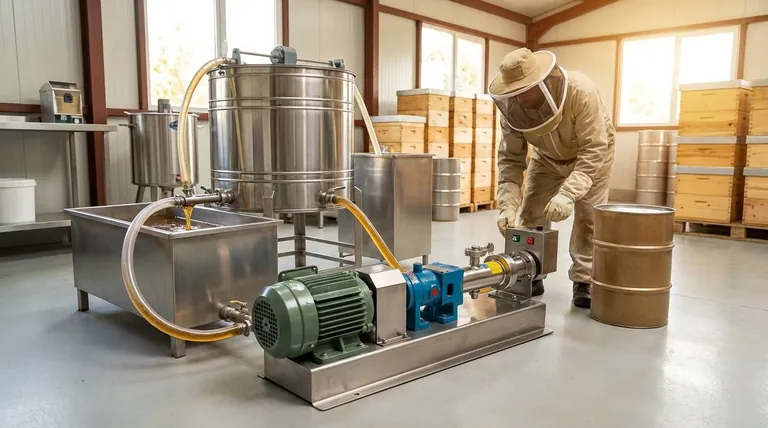
A commercial beekeeper stands between a gleaming stainless steel extractor, heavy with the season's gold, and a row of empty storage drums. The air is thick with the sweet smell of success. But between the two lies a challenge not of biology, but of physics: moving hundreds of pounds of a fluid so viscous it resists gravity itself.
The instinct is to solve the problem with force and speed. But honey is not water. It is a delicate structure, a testament to the meticulous work of thousands of bees. The decision made in this moment—how to move this liquid gold—is more than a logistical choice. It's a statement about your respect for the product and the viability of your business.
The Core Misunderstanding: A Pump for Flow, or a Pump for Precision?
The most common trap in honey processing begins with language. We use one term, "honey pump," to describe two fundamentally different machines with opposing goals.
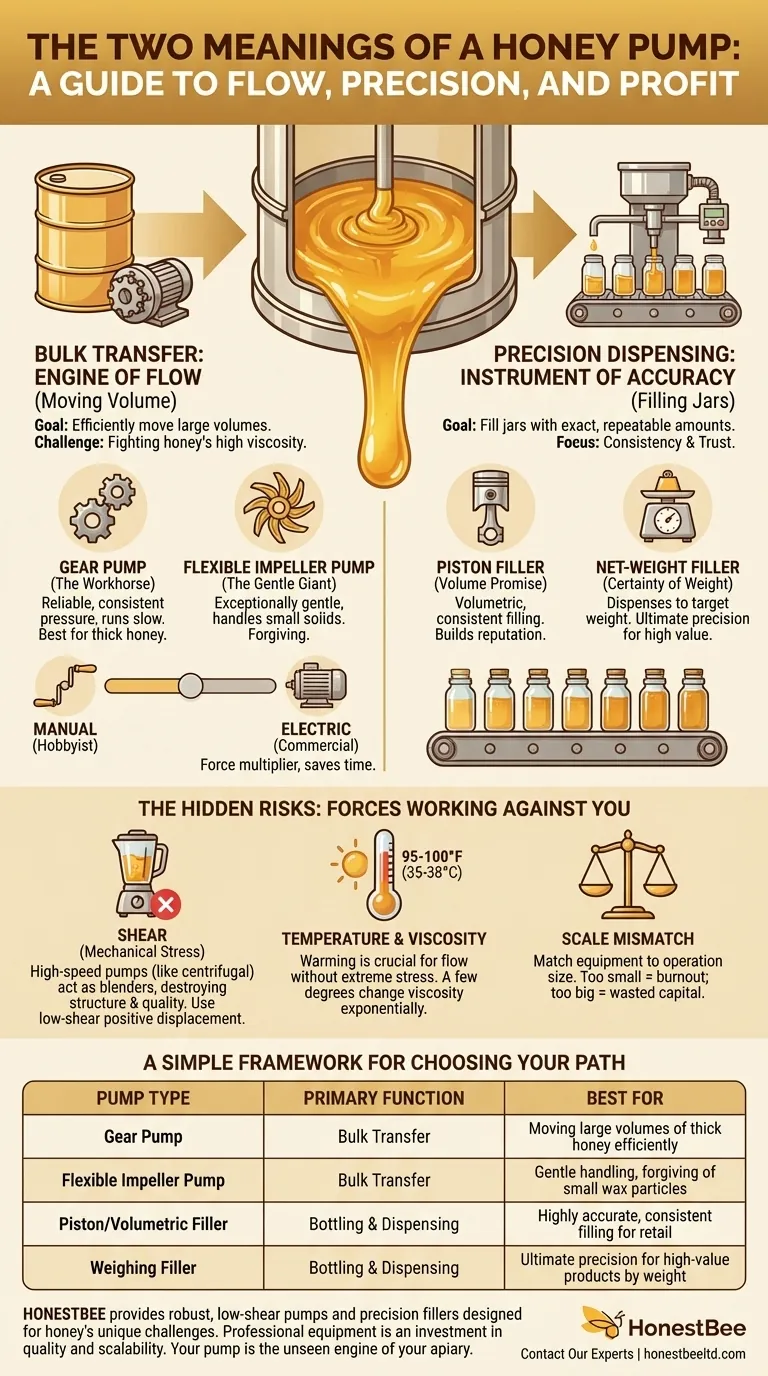
One machine's purpose is bulk transfer. Its job is to move large volumes efficiently, like transferring honey from an extractor to a settling tank. It is an engine of flow.
The other's purpose is precision dispensing. This is the mechanism inside a bottling machine, designed to fill jars with an exact, repeatable amount. It is an instrument of accuracy.
Confusing the two is like using a fire hose to fill a teacup. You might get the job done, but the result is waste, inefficiency, and a compromised product. The first step to mastery is knowing which job you need to do.
The Physics of Bulk Transfer: Respecting Viscosity
When your goal is simply to move honey from point A to point B, you are fighting against its single greatest physical property: viscosity. Positive displacement pumps are the industry standard because they move the honey in trapped, discrete volumes, gently persuading it to flow without causing damage.
The Workhorse: The Gear Pump
The gear pump is the mechanical heartbeat of many apiaries. It uses two meshing gears to pull honey into the chamber and push it out the other side. It is reliable, powerful, and when run at the correct slow speed, it generates the consistent pressure needed to move even cool, thick honey without destructive force.
The Gentle Giant: The Flexible Impeller Pump
This pump uses a soft, rubber-like impeller whose vanes bend and straighten as they rotate, creating pockets that gently carry the honey. It is exceptionally gentle on the product and can handle small solids like wax particles, making it a forgiving and valuable tool.
The Human Element: Manual vs. Electric
This choice is less about the power source and more about your operational ambition.
- Manual Pumps: Operated by a hand crank, these are perfect for hobbyists or small-scale operations. They represent a direct, physical connection to the work.
- Electric Pumps: These are essential for any serious sideline or commercial beekeeper. An electric pump is not just a motor; it's a force multiplier that buys back your most valuable asset: time.
The Art of Precision: The Bottling Machine's Heart
When you shift from moving honey to packaging it for sale, your primary concern is no longer flow, but trust. Your customer trusts that the jar they buy today is the same as the one they bought last month. This consistency is achieved with specialized filling systems.
The Promise of Volume: Piston Fillers
The most common system for bottling honey is the volumetric piston filler. A piston retracts, drawing a precise volume of honey into a cylinder, and then pushes it into the jar. Its accuracy is its promise—a guarantee of consistency that builds brand reputation.
The Certainty of Weight: Net-Weight Fillers
For high-value varietals or when absolute precision is paramount, net-weight fillers are the answer. They dispense honey until an integrated scale, or load cell, registers a target weight. This method removes all ambiguity, ensuring every package is perfect. It is the ultimate expression of accountability to your customer.
The Hidden Risks: Shear, Temperature, and Scale
Choosing the wrong pump is not just inefficient; it can be destructive. Three forces are constantly working against you.
- Temperature & Viscosity: Honey's viscosity is exponential. A drop of a few degrees can make it exponentially thicker and harder to pump. Most systems require honey to be warmed to 95-100°F (35-38°C) to flow without extreme stress on the equipment and the honey itself.
- Shear: This is the mechanical stress placed on the honey as it moves. The wrong pump type, like a common centrifugal pump, moves too fast and acts like a blender. It can introduce air, destroy the honey's delicate enzymatic and crystalline structure, and permanently alter its texture and flavor. It is the silent destroyer of quality.
- Scale Mismatch: A commercial-grade pump in a three-hive operation is a waste of capital. A manual pump in a 300-hive apiary is a recipe for burnout. The equipment must match the scale of the operation, not just for financial reasons, but for psychological sustainability.
A Simple Framework for Choosing Your Path
To select the right equipment, you only need to answer one question: What is my primary goal right now?
| Pump Type | Primary Function | Best For |
|---|---|---|
| Gear Pump | Bulk Transfer | Moving large volumes of thick honey efficiently |
| Flexible Impeller Pump | Bulk Transfer | Gentle handling, forgiving of small wax particles |
| Piston/Volumetric Filler | Bottling & Dispensing | Highly accurate, consistent filling for retail |
| Weighing Filler | Bottling & Dispensing | Ultimate precision for high-value products by weight |
Making the right choice is fundamental to protecting the quality of your harvest and the efficiency of your labor. It ensures the hard work of your bees is not undone in the final steps of processing. As a wholesale supplier focused on commercial apiaries and distributors, HONESTBEE understands that professional equipment is not an expense, but an investment in quality and scalability. We provide the robust, low-shear pumps and precision fillers designed to handle the unique challenges of honey.
Your pump is the unseen engine of your apiary. Choosing the right one ensures it runs smoothly for years to come. Contact Our Experts
Visual Guide
Related Products
- Honey Convey Pump Screw Honey Pump for Viscous Liquid
- Honey Convey Pump Economy Gear Pump for Viscous Liquid
- Economy Small Honey Filling Machine Honey Bottle Filler Packaging Machine
- Manual Honey Filling Machine Bottling Machine for Honey
- Automatic Honey Filling and Filtering Machine for Beekeeping Bottle Filling
Related Articles
- How Honey Pumps Protect Quality and Adapt to Modern Beekeeping Needs
- How Honey Screw Presses Deliver Higher Yields With Less Waste
- Preserving the Golden Harvest: The Gentle Engineering of Honey Pumps
- How Honey Screw Presses Solve Hygiene, Durability, and Efficiency Challenges for Small Beekeepers
- Is Your Honey Pump Holding Your Business Back? The Voltage Mistake You Can't Afford