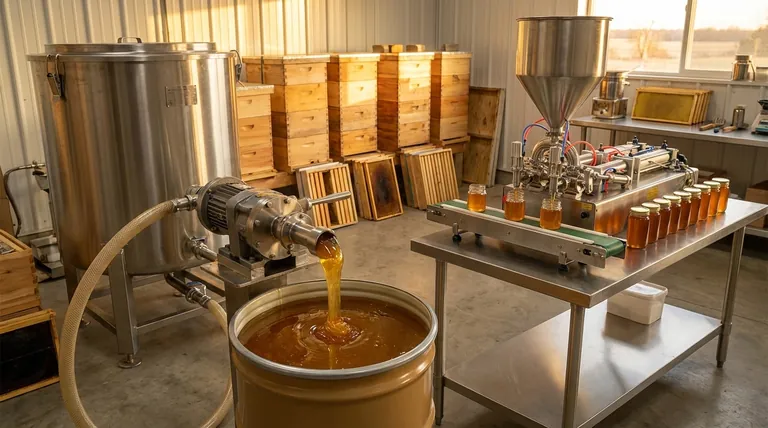
You’ve done the hard work. Months of tending to your hives have resulted in drums filled with beautiful, golden honey. Now comes the final—and often most frustrating—step: moving it. You fire up your new "honey pump," but instead of a smooth flow, you get a sluggish, groaning machine. Or worse, the pump whirs violently, churning your pristine honey into a frothy, aerated mess. The day ends with a sticky workshop, a fraction of the work done, and the nagging fear that you’ve just damaged the very product you worked so hard to create.
The Vicious Cycle: Why "Trying Harder" Doesn't Work
If that scene feels familiar, you are not alone. Across the industry, from sideline operations to established commercial apiaries, a fundamental misunderstanding around honey pumps creates a massive operational bottleneck.
Many beekeepers find themselves trapped in a cycle of frustration, trying solutions that only address the symptoms:
- Buying a more "powerful" pump: They invest in a high-speed pump, only to find it whips air into the honey, causing oxidation and froth that ruins its shelf appeal and texture.
- Overheating the honey: To make it flow better, they heat honey to temperatures that risk degrading its delicate enzymes and flavors, stripping it of its premium quality.
- Using the wrong tool for the job: They try to use a bulk transfer pump for bottling, resulting in inconsistent fills, spills, and lost profit. Or they use a slow bottling mechanism to empty a 55-gallon drum, wasting an entire day on a two-hour task.
These aren't just minor annoyances; they have severe business consequences. Wasted labor hours eat into your profit margins. Damaged product has to be sold at a discount or discarded. And when your processing can't keep up with your harvest, your entire operation grinds to a halt, capping your growth potential.
The Root of the Problem: Are You Transferring or Dispensing?
Here is the simple truth that changes everything: The problem isn't your pump's quality; it's your pump's purpose.
The term "honey pump" is dangerously ambiguous because it describes two completely different jobs in the workshop:
-
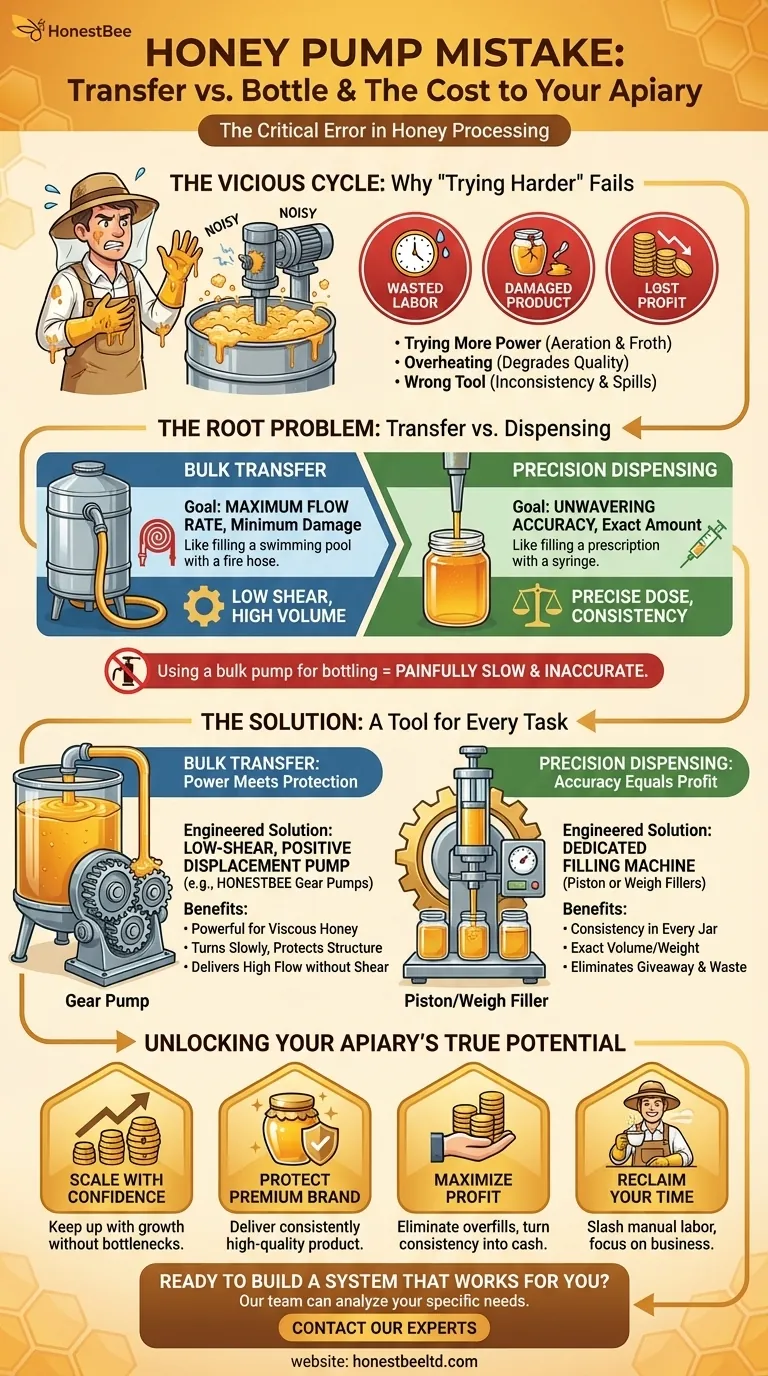
Bulk Transfer: This is about moving large volumes of honey efficiently—for example, from your extractor into a large holding tank. The goal here is maximum flow rate with minimum damage. Think of it like using a fire hose to fill a swimming pool.
-
Precision Dispensing: This is about bottling honey into jars for sale. The goal here is unwavering accuracy, ensuring every jar has the exact same amount. Think of it like using a medical syringe to measure a precise dose.
The common solutions fail because they apply the wrong principle to the task at hand. A high-speed water pump creates "high shear," a force that tears honey's delicate structure apart. A precision bottling machine is designed for milliliters, not gallons per minute, making it painfully slow for bulk transfer. You wouldn't use a fire hose to fill a prescription, so why use a bulk transfer pump to fill a honey jar?
The Solution Embodied: A Tool for Every Task
To escape this cycle, you don't need a single "miracle pump." You need an efficient system built with the right tool for each job. This is not about finding a lucky product; it's about choosing equipment that is engineered from the ground up to solve a specific physical challenge.
This is where understanding the mechanics makes all the difference.
For Bulk Transfer: Power Meets Protection
To move thick honey in bulk without damaging it, you need a low-shear, positive displacement pump. This is the engineered solution. At HONESTBEE, we supply robust Gear Pumps specifically for this purpose. Their intermeshing gears are powerful enough to move cool, viscous honey but turn slowly enough to protect its delicate structure. They deliver the high flow rate you need without the destructive shear, directly solving the "frothy honey" problem.
For Precision Dispensing: Accuracy Equals Profit
To bottle your honey for retail, you need a dedicated Filling Machine. These integrated systems are built for one thing: consistency. Piston Fillers use a cylinder to pull in and dispense an exact volume of honey, every single time. Weigh Fillers use a load cell to ensure every jar is filled to the precise target weight. This technology directly eliminates the inconsistency and product giveaway that erodes your profits during bottling.
Beyond the Fix: Unlocking Your Apiary's True Potential
When you stop fighting your equipment and start using the right tools, something remarkable happens. The bottlenecks disappear. Processing is no longer a source of dread but a smooth, predictable, and efficient part of your business.
With this problem permanently solved, you can:
- Scale with Confidence: Your processing capacity can finally keep up with your ambition. You can add more hives or take on larger wholesale orders without fear of a production logjam.
- Protect Your Premium Brand: Deliver a consistently high-quality product, free from froth and heat damage, that justifies a premium price and builds customer loyalty.
- Maximize Profit on Every Jar: Eliminate costly overfills and ensure every package meets its labeled weight, turning consistency into cash flow.
- Reclaim Your Time: Slash hours of manual labor and frustration, freeing you up to focus on what matters most—managing your bees and growing your business.
Your honey is a testament to a season of hard work. It deserves to be handled with equipment that honors its quality. Moving from a frustrating problem to a streamlined operation is about understanding the core task and choosing the tool designed for it.
If you're ready to build a processing system that works for you, not against you, our team can help you analyze your specific needs. Let's discuss your operation and find the right equipment to unlock your full potential. Contact Our Experts
Visual Guide
Related Products
- Honey Convey Pump Screw Honey Pump for Viscous Liquid
- Honey Convey Pump Economy Gear Pump for Viscous Liquid
- Precision Durable Efficient HONESTBEE Rotary Honey Filling Machine
- Manual Honey Filling Machine Bottling Machine for Honey
- Economy Small Honey Filling Machine Honey Bottle Filler Packaging Machine
Related Articles
- How Honey Pumps Protect Quality and Adapt to Modern Beekeeping Needs
- How Honey Screw Presses Deliver Higher Yields With Less Waste
- Preserving the Golden Harvest: The Gentle Engineering of Honey Pumps
- The Two Meanings of a Honey Pump: A Guide to Flow, Precision, and Profit
- How Honey Screw Presses Solve Hygiene, Durability, and Efficiency Challenges for Small Beekeepers