Before the Frame, There Was Chaos
For centuries, beekeeping was a brutal affair. To get the honey, you often had to destroy the hive. It was a zero-sum game, a destructive harvest that pitted the beekeeper's goals against the colony's survival.
The relationship was one of conflict, not collaboration.
Then, in the mid-19th century, a simple rectangular frame changed everything. It wasn’t just a new piece of equipment; it was the invention of a new language, a way to communicate with and manage a colony without tearing its world apart.
The hive frame transformed beekeeping from a conquest into a conversation.
The Psychological Contract of "Bee Space"
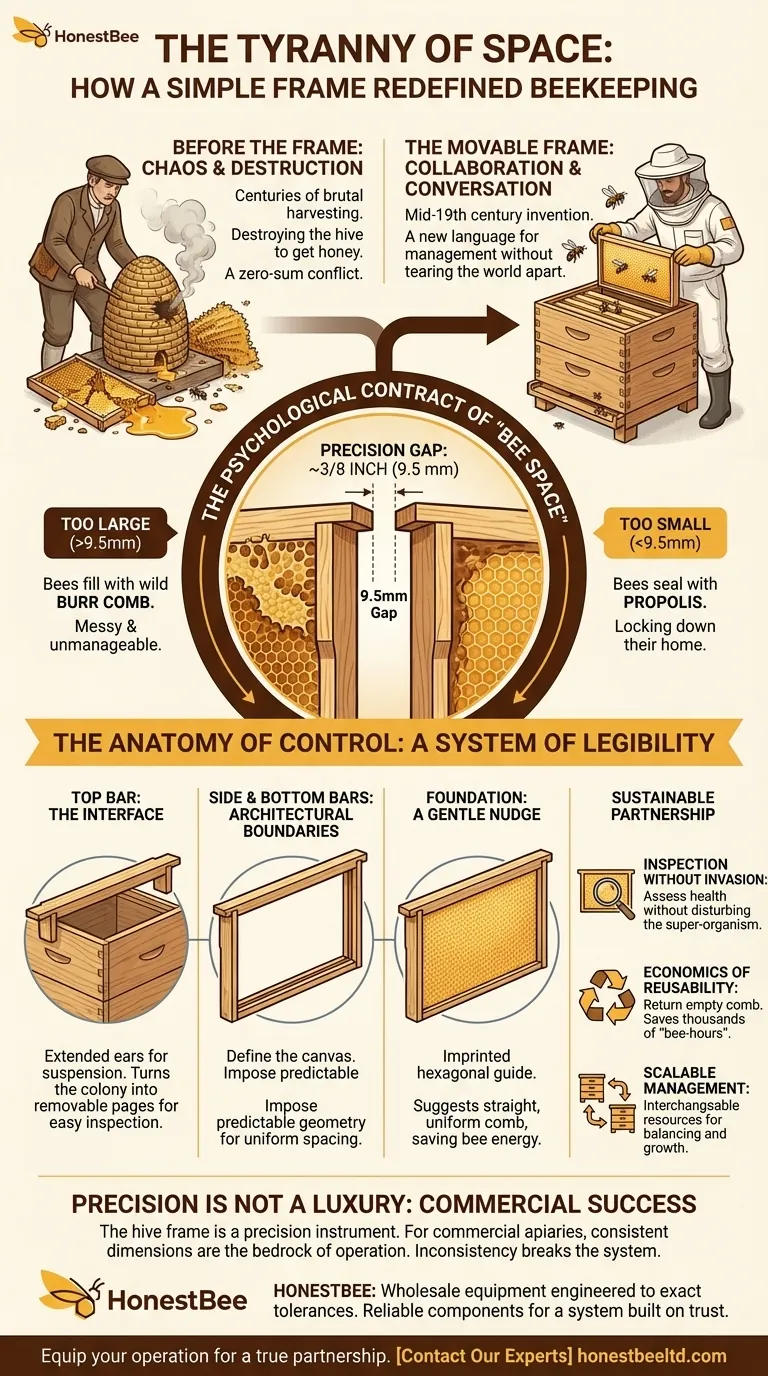
The genius of the modern hive isn't the box or the lid. It's the precise gap between the frames. This is known as "bee space"—a gap of roughly 3/8 of an inch (9.5 mm).
This isn't just a measurement. It's a psychological contract with the bees.
Bees are genetically programmed to build and seal. If a space is too large, they will fill it with wild, disorganized "burr comb," making a mess of the hive. If a space is too small, they will seal it shut with propolis, a resinous "bee glue," effectively locking down their own home.
The movable frame system works only when this contract is respected. It hinges on the beekeeper providing a predictable, orderly world that the bees' instincts can work within, not against. Violate that space, and the system breaks down.
The Anatomy of Control
Each component of the frame is an instrument of control, designed to make the colony's work legible and manageable.
The Top Bar: The Interface
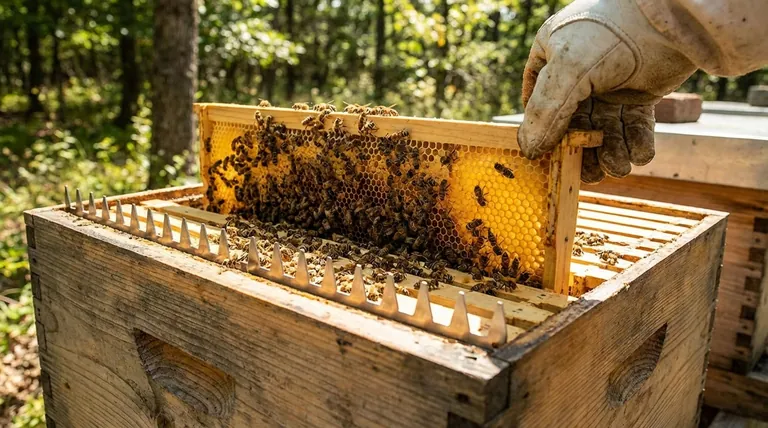
The extended "ears" of the top bar are the primary interface between the beekeeper and the hive. It allows the frame to hang like a file in a cabinet, turning the colony’s inner world into a series of removable pages. It’s the handle that makes inspection possible.
The Side and Bottom Bars: The Architectural Boundaries
These bars don't just hold the frame together; they define the canvas. They impose a predictable rectangular geometry on the bees' construction, ensuring each "page" is the same size and fits within the larger system.
The Foundation: A Gentle Nudge
Many frames hold a sheet of foundation imprinted with a hexagonal pattern. This isn't a command, but a powerful suggestion. It nudges the bees to build straight, uniform comb, saving them immense metabolic energy that can be redirected toward foraging and honey production.
This simple architecture provides a framework for collaboration.
| Component | System Function | Beekeeper's Advantage |
|---|---|---|
| Top Bar | Suspends the frame for access. | Provides a clean point of contact. |
| Side Bars | Define vertical structure. | Ensures uniform spacing. |
| Bottom Bar | Provides stability and anchoring. | Prevents comb warping and breakage. |
| Foundation | Offers a building guide. | Increases colony efficiency. |
From Destructive Harvest to Sustainable Partnership
The practical implications of this system are profound, especially for commercial operations where efficiency is paramount.
Inspection Without Invasion
A surgeon who could examine an organ without making an incision would be a miracle worker. The hive frame grants the beekeeper a similar power. You can lift a single frame to check the queen's health, diagnose disease, or assess food stores, leaving the rest of the super-organism undisturbed.
The Economics of Reusability
After honey is extracted, the empty (and undamaged) honeycomb can be returned to the hive. Building wax is one of the most energy-intensive tasks for a bee. By giving them back their comb, a beekeeper saves the colony thousands of "bee-hours," which directly translates into faster honey production and a healthier, more resilient colony.
The Foundation of Scalable Management
For a commercial apiary, standardization is everything. Uniform frames allow resources—frames of brood, pollen, or honey—to be moved between hives to balance colonies, create new splits, or prevent swarming. This level of granular, systemic management is only possible with precisely manufactured, interchangeable equipment.
Precision is Not a Luxury
The hive frame is more than just wood; it's a precision instrument built on a deep understanding of bee psychology. The entire system of modern beekeeping rests on its reliability.
For commercial apiaries and equipment distributors, where success is measured across hundreds or thousands of hives, this precision isn't a luxury—it is the bedrock of the entire operation. Inconsistent dimensions or weak construction don't just cause frustration; they break the system, reduce yields, and increase labor costs.
At HONESTBEE, we supply wholesale beekeeping equipment designed for the rigors of commercial use. Our frames are engineered to the exact tolerances that respect bee space, ensuring the seamless operation and scalability your business depends on. They are the reliable components for a system built on trust.
If you are ready to equip your operation with the durable, precision-engineered supplies that enable a true partnership with your bees, we can help. Contact Our Experts
Visual Guide
Related Products
- Wooden Bee Hive Frames for Beekeeping and Wholesale
- Plastic Bee Frame Beekeeping Hive Frames for Wholesale
- Professional Galvanized Steel Frame Rest for Beehives
- Ergonomic High Visibility Plastic Frame Grip Handles
- Precision Stainless Steel Frame Cleaner for Hive Grooves and Corners
Related Articles
- Wooden vs. Plastic Bee Hive Frames: Balancing Sustainability and Practicality
- Assembled vs. Unassembled Frames: A Beekeeper’s Time-Value Analysis
- The Beekeeper's Trade-Off: Engineering Efficiency vs. Honoring Instinct
- The Unseen Enemy: Why Mold on Beehive Frames Is a Symptom, Not the Disease
- Beyond the Scrape: A Risk Management Framework for Cleaning Beehive Frames