Standardized beehive frames combined with area grid tools provide a precise, quantitative method for assessing colony health and economic output. By overlaying the frame surface with a grid divided into one-square-decimeter units, apiarists can convert the organic spread of hive products into measurable data points, allowing for a direct comparison between healthy colonies and those suffering from Apis mellifera capensis parasitism.
Core Takeaway This measurement system moves apiary management from subjective observation to objective analysis. By quantifying the exact surface area of honey, pollen, and brood, producers can calculate the specific financial and biological losses attributed to parasitic infestation.
The Mechanics of Quantitative Evaluation
To accurately evaluate productivity losses, you must establish a baseline of measurement that is consistent across all colonies.
The Role of the Standardized Frame
The standardized frame acts as the basic production unit of the apiary. Unlike irregular traditional hives, these frames offer uniform specifications that are essential for scientific measurement.
Because every frame has identical dimensions, they serve as a reliable control variable. This uniformity ensures that a measurement taken in Hive A is mathematically equivalent to a measurement in Hive B.
Utilizing the Area Grid Tool
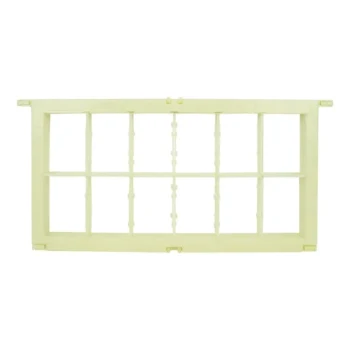
The area grid is the critical instrument for data collection. This tool divides the surface of the standardized frame into 1-square-decimeter units.
By placing this grid over a frame, an inspector can quickly count the number of units filled with specific hive products. This method eliminates estimation errors common in visual inspections.
Measuring Key Productivity Indicators
To assess the impact of Apis mellifera capensis, inspectors measure three specific biological assets: honey reserves, pollen stores, and brood quantities.
Reductions in brood coverage indicate reproductive failure due to parasitism, while lower honey and pollen counts directly correlate to lost revenue.
From Measurement to Strategic Management
Collecting data is only the first step; the value lies in how this standardized data drives decision-making.
Comparative Economic Analysis
This method allows for a direct and accurate comparison of economic output. By comparing the grid counts of parasitized colonies against healthy control groups, you can derive a precise percentage of loss.
This defines the "cost of parasitism" in tangible terms, rather than anecdotal evidence.
Objective Decision Support
Data derived from grid measurements provides objective support for apiary management.
Instead of guessing which hives are failing, managers can identify underperforming colonies based on strict numerical thresholds. This allows for timely interventions, such as quarantining or culling affected hives to protect the broader operation.
Understanding the Trade-offs
While standardized measurement offers high accuracy, it requires a commitment to specific hardware and operational standards.
The Necessity of Precision Hardware
The effectiveness of the grid tool relies entirely on the precision of the underlying frames. This requires access to specialized hive-making machines capable of automated manufacturing.
If frames vary in size due to poor manufacturing, the grid overlay becomes inaccurate. Operational risks increase if you attempt to use these tools with mismatched or "hobbyist-grade" equipment.
Structural Requirements for Scale
Implementing this system is most effective in an industrial model. Standardized beehives are designed to simulate natural habitats while facilitating large-scale professional management.
The trade-off is the initial investment in uniform equipment. However, without this standardization, components are not interchangeable, which increases maintenance costs and creates bottlenecks during critical inspection periods.
Making the Right Choice for Your Apiary
The goal of using these tools is to secure the stability of honey production levels through data-driven management.
- If your primary focus is assessing parasitism damage: Use the 1-dm² grid tool to record distinct surface area values for brood and honey, comparing affected hives against a healthy baseline.
- If your primary focus is operational efficiency: Ensure all hive components are manufactured via automated processes to guarantee the interchangeability required for rapid, accurate grid measurement.
By integrating standardized frames with precise grid tools, you transform the biological threat of parasitism into a calculated, manageable economic metric.
Summary Table:
| Metric Category | Measurement Tool | Data Unit | Management Value |
|---|---|---|---|
| Biological Assets | Standardized Frame | Surface Area Coverage | Establishes a baseline for healthy vs. parasitized hives |
| Quantitative Data | 1-dm² Area Grid | Square Decimeters | Converts visual observations into objective numerical data |
| Economic Impact | Comparative Analysis | Percentage Loss | Calculates specific financial impact of A. m. capensis |
| Hardware Quality | Automated Machinery | Dimensional Precision | Ensures component interchangeability and measurement accuracy |
Secure Your Apiary’s Productivity with Precision Engineering
Don’t let parasitism or inefficient measurements undermine your commercial success. HONESTBEE empowers commercial apiaries and distributors with the high-precision tools necessary for data-driven management. From standardized hive-making machines that ensure every frame is a perfect measurement unit to advanced honey-filling machinery and a full spectrum of beekeeping consumables, we provide the industrial foundation your business requires.
Our Value to You:
- Scalability: Industrial-grade hardware designed for large-scale professional operations.
- Precision: Automated manufacturing that guarantees accurate data collection and component interchangeability.
- Comprehensive Support: A complete portfolio of tools, machinery, and honey-themed cultural merchandise to grow your brand.
Ready to transform your apiary management from subjective observation to calculated profit?
Contact HONESTBEE Today for a Wholesale Consultation
References
- Vincent Dietemann, Robin M. Crewe. Human Factors Facilitating the Spread of a Parasitic Honey Bee in South Africa. DOI: 10.1603/0022-0493(2006)099[0007:hfftso]2.0.co;2
This article is also based on technical information from HonestBee Knowledge Base .
Related Products
- Wooden Bee Hive Frames for Beekeeping and Wholesale
- Professional Galvanized Steel Frame Rest for Beehives
- Assembled Wooden Bee Frames with Plastic Foundation for Durability and Convenience by HONESTBEE
- HONESTBEE Wired and Assembled Wooden Bee Frames Foundation for a Thriving Hive
- Plastic Bee Frame Beekeeping Hive Frames for Wholesale
People Also Ask
- How do wooden and plastic hive frames compare in terms of durability? Wood vs. Plastic Longevity & Repairability
- How does balancing the number of frames impact hive productivity? Optimize Your Apiary's Biological Output
- What are the main considerations when choosing between wooden and plastic bee hive frames? Optimize Your Apiary's Efficiency
- How should beehive frames be maintained to prolong their lifespan? 5 Pro Tips for Durable Beekeeping Equipment
- What are frames and combs used for in beekeeping? The Foundation of Modern Hive Management