Commercial queen rearers and royal jelly producers should build their schedules around larval age, not calendar convenience. Grafting must occur while female larvae are still within their queen-development window, generally before 48 hours old and no later than the first 2.5 to 3 days after hatching. For royal jelly production, one-day-old larvae are commonly placed in artificial cell cups, fed for approximately 72 hours, and harvested before nurse bees transition the larvae toward worker food.
The central principle is simple: transfer young larvae early, maintain strong nurse-bee support, harvest royal jelly at roughly 72 hours, and handle developing queen cells only during biologically safe transfer windows.
Aligning Operations With Larval Development
The First Three Days Determine Caste Potential
Female honey bee larvae initially have the physiological potential to become either queens or workers. During roughly the first 2.5 to 3 days, all female larvae receive royal jelly.
Around day three, larvae destined to become workers are shifted toward a honey, pollen, and bee-bread diet. Their reproductive development then declines sharply, while larvae receiving abundant royal jelly continue along the queen pathway.
Grafting Must Happen Before the Nutrition Shift
For commercial queen rearing, the preferred grafting material is usually very young larvae, often around one day old. This leaves enough time for the transferred larva to establish successfully in the artificial cell before the natural worker-diet transition would occur.
The practical operating limit is strict: breeders should complete grafting within approximately 48 hours of larval age whenever possible, and never treat the full three-day period as an equally safe working window.
Royal Jelly Harvesting Follows a Different Clock
Royal jelly producers typically graft one-day-old larvae into artificial queen cell cups and leave them with nurse bees for approximately 72 hours. During this period, the nurse bees deposit royal jelly into the cups as they feed the developing larvae.
Harvesting at the end of this period captures substantial jelly accumulation while keeping the production cycle standardized. Delaying collection can reduce schedule control and complicate consistent yield measurement.
Designing Equipment Around the Biological Window
Use Standardized Cell Cup Strips
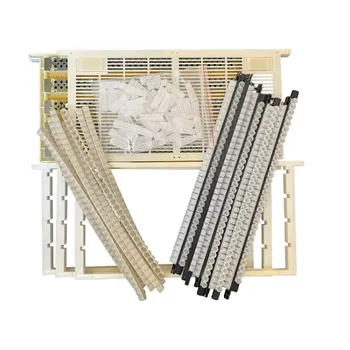
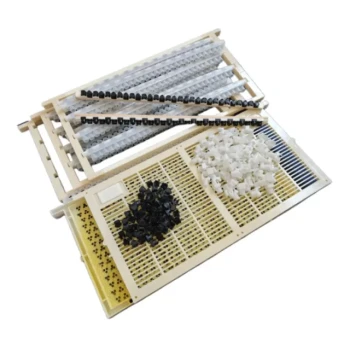
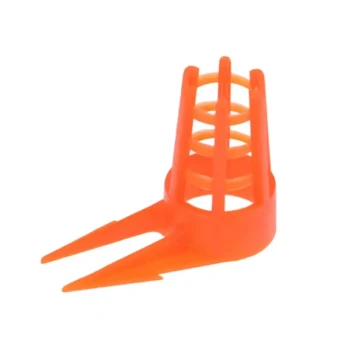
Plastic strips fitted with queen cell cups provide a repeatable production platform for royal jelly operations. A commonly cited setup uses two strips with a combined capacity of approximately 128 cups per colony.
Standardized cup spacing helps commercial teams coordinate grafting, colony assignment, harvest labor, cleaning, and replacement inventory. It also gives distributors and wholesalers a clear basis for stocking cell cups, strips, and compatible frame hardware.
Match Grafting Tools to Larval Age
Grafting needles and related transfer tools must allow precise movement of very young larvae without damaging them. The tool should support consistent placement at the bottom of each cell cup and reduce variation between operators.
Because the usable larval window is short, commercial operations need enough grafting tools and replacement components to complete the work promptly. Equipment availability is therefore part of biological risk management, not merely a purchasing preference.
Combine Starter and Finisher Equipment
Starter colonies establish acceptance of grafted larvae, while finishing colonies provide the sustained nurse-bee population required for continued development. Cell bar frames, starter frames, and finisher hive equipment should be scheduled as one integrated workflow.
A shortage of any one component can waste the entire grafting batch. Distributors serving commercial apiaries should therefore offer compatible kits or complete equipment portfolios rather than isolated parts that create fulfillment delays.
Optimizing Nurse-Bee Support
Target Six- to Twelve-Day-Old Nurse Bees
Nurse workers between approximately six and twelve days old have highly active hypopharyngeal glands, the primary organs involved in royal jelly secretion. Colonies with a strong population in this age range can support more consistent feeding and production.
Apiary managers should plan colony strength, frame placement, and graft timing so that the nurse-bee population is ready when larvae are introduced. A technically correct graft can still underperform if the receiving colony lacks adequate nurse support.
Protect Colony Stability
The receiving colony must maintain stable conditions while larvae are being accepted and fed. Temperature stress, inadequate nurse populations, and poorly organized frames can reduce acceptance or royal jelly deposition.
Starter and finisher equipment should make it easy to maintain dense nurse-bee coverage around the grafted cells. The objective is consistent biological support across the full 72-hour production period.
Measure Yield Consistently
Precision digital scales allow producers to compare royal jelly output between colonies, batches, and equipment configurations. Standardized cell cup layouts make these measurements more meaningful because the number and arrangement of cups remain consistent.
Reliable records should connect each harvest to larval age, graft date, colony identity, cup count, nurse-bee condition, and collected weight. This turns harvesting from an approximate task into a controllable production process.
Scheduling Queen Cell Transfers Safely
Avoid the Fragile Pupal Period
Queen cells are especially vulnerable between approximately days 10 and 14 after egg laying, when the queen pupa is undergoing adult metamorphosis. Jostling, tipping, or rough handling during this period can cause irreversible developmental damage.
Transport and frame movements should therefore be minimized during this stage. This is particularly important when nuc boxes or queen-rearing frames must be moved between apiary locations.
Transfer Around Day 15
The preferred transfer point for developed queen cells is around day 15 after egg laying, when the pupa is generally more robust but emergence has not yet occurred. Queen emergence is expected around day 16 under stable conditions.
Nucleus hive preparation, transport planning, and labor allocation should be completed before this transfer window. Waiting until the queen is close to emergence increases the risk of missed timing or an emerged queen being introduced incorrectly.
Control Temperature During Handling
Extreme heat or cold can delay emergence by approximately one to two days and can disrupt mating-nuc scheduling. Stable temperatures around nuc equipment are therefore essential for predictable production.
Commercial operations should coordinate insulated transport, protected holding areas, and suitable nuc placement with the cell-transfer schedule. Equipment decisions should support temperature stability as well as physical protection.
Calculating Capacity From Target Output
Work Backward From Productive Queens
Queen-rearing capacity should be calculated from the desired number of productive laying queens rather than from the number of grafts alone. Prepared graft starters commonly produce capped royal cells at rates of approximately 70% to 90%, while around 85% of introduced royal cells may result in productive laying queens.
These figures are planning benchmarks, not guarantees. Each apiary should record its own acceptance, capping, emergence, mating, and laying performance to refine equipment requirements.
Size Starters, Finishers, and Nucs Together
A target number of laying queens determines the required number of graft starters, builder or finisher colonies, mating nuclei, cell cups, and frames. These capacities must be balanced across the same production cycle.
For example, increasing graft volume without adding enough finisher capacity can create a bottleneck after initial acceptance. Similarly, producing more queen cells than available mating nuclei can leave valuable cells without a suitable destination.
Maintain a Reliable Supply Position
Because grafting and harvesting windows are time-sensitive, delayed equipment delivery can directly reduce biological success. Commercial suppliers should maintain inventory across grafting needles, artificial cell cups, cell strips, cell bar frames, starter and finisher frames, nuc equipment, and harvesting scales.
Rapid response and compatibility checks are especially valuable when a producer needs to replace damaged components or expand capacity during an active rearing cycle.
Understanding the Trade-offs
Early Grafting Improves Potential but Increases Handling Sensitivity
Younger larvae retain stronger queen-development potential, but they are also more difficult to see and handle accurately. Operators need suitable grafting tools, good lighting, and practiced technique.
Using older larvae may simplify handling, but it reduces the biological margin for successful queen development. The gain in convenience can therefore come at the cost of queen quality or acceptance.
Larger Batches Improve Efficiency but Increase Exposure
High-capacity cell cup strips and coordinated starter-finisher systems can reduce labor per queen or per harvest. However, a problem in the receiving colony, grafting process, or temperature environment can affect many cells at once.
Batch size should match the apiary's ability to monitor colonies, complete harvesting within the defined window, and process the material promptly.
Standard Benchmarks Do Not Replace Local Records
The 70% to 90% capped-cell rate and approximately 85% productive-queen rate are useful for initial planning. They can vary with colony strength, season, operator skill, weather, nutrition, and mating conditions.
Treating benchmarks as fixed guarantees leads to under-ordering and missed targets. Production records should be used to adjust the number of grafts and mating nuclei required for future cycles.
Maximum Equipment Count Does Not Guarantee Maximum Yield
Adding more cups or frames does not compensate for insufficient nurse bees, poor timing, or unstable temperatures. Biological capacity remains the limiting factor.
Equipment should be selected to support larval nutrition, colony organization, precise handling, and repeatable measurement rather than simply increasing nominal cell count.
Making the Right Choice for Your Goal
Select equipment and scheduling capacity according to the output you need and the biological stage you are managing.
- If your primary focus is queen production: Use precise grafting tools, artificial cell cups, starter and finisher frames, and mating nuclei sized around your target number of productive laying queens.
- If your primary focus is royal jelly production: Graft approximately one-day-old larvae, use standardized cup strips, maintain strong six- to twelve-day-old nurse-bee populations, and harvest after the planned 72-hour feeding period.
- If your primary focus is operational reliability: Coordinate inventory, labor, colony preparation, and delivery schedules around the 48-hour grafting limit and the 72-hour harvest cycle.
- If your primary focus is equipment distribution: Stock compatible, full-spectrum product packages so breeders can source grafting, cell-handling, nuc, harvesting, and measurement equipment from one dependable supply channel.
- If your primary focus is yield forecasting: Track acceptance, capped-cell, productive-queen, and royal jelly weight results by colony and use those records to refine future orders.
When schedules, colony management, and equipment all follow larval biology, commercial producers gain more predictable queen quality, royal jelly yield, and fulfillment performance.
Summary Table:
| Production Focus | Key Timing | Critical Equipment | Biological Principle |
|---|---|---|---|
| Queen Rearing | Graft within 48 hours | Grafting tools, cell cups, starter/finisher frames | Preserve queen potential before worker diet shift |
| Royal Jelly | Harvest at ~72 hours | Cell cup strips, grafting tools, scales | Maximize jelly accumulation before larval diet change |
| Nucleus & Transfer | Transfer ~day 15 | Nuc boxes, transport equipment | Avoid fragile pupal period (days 10-14) |
| Colony Support | Use 6-12 day old nurse bees | Starter/finisher frames | Ensure high royal jelly secretion |
| Yield Planning | Backward from target output | Scales, data records | Account for 70-90% capping rate, 85% productive queens |
Ready to optimize your apiary operations with precise timing and reliable equipment? Contact HONESTBEE today (#ContactForm) for a comprehensive wholesale offering that includes queen rearing kits, royal jelly production tools, grafting supplies, and more. Our dedicated team offers rapid response, OEM/ODM support, and ultra-fast delivery to keep your production on schedule. Let us help you achieve predictable yields and quality — get in touch now!
Related Products
- Retractable Chinese Queen Rearing Grafting Tools Equipment
- HONESTBEE Improved No Grafting Queen Rearing Kit For Queen Rearing and Royal Jelly Production
- No Grafting Queen Rearing Kit: System for Royal Jelly Production and Queen Rearing
- Nicot Queen Rearing Kit for Beekeeping and Grafting in Nicot System
- Premium Nicot Style Queen Rearing Kit with Hair Roller Bee Cages
People Also Ask
- Which specialized tools are necessary for implementing standardized queen rearing? Scale Your High-Yield Apiary
- Why are specialized queen rearing tools necessary to mitigate winter hive losses? Boost Apiary Survival and Recovery
- What operational workflows and queen rearing tools are required for implementing instrumental insemination and isolated mating in commercial queen breeding programs?
- How do queen-rearing tools facilitate the sustainability and expansion of a commercial apiary? Drive Scalable Growth
- In what ways do modern queen rearing equipment and grafting tools improve competitiveness? Boost Breeding Success Rate