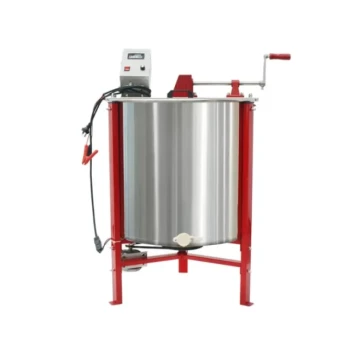
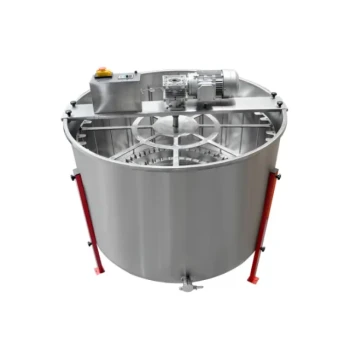
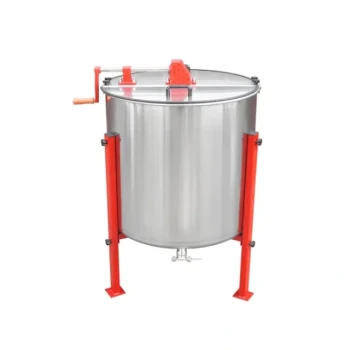
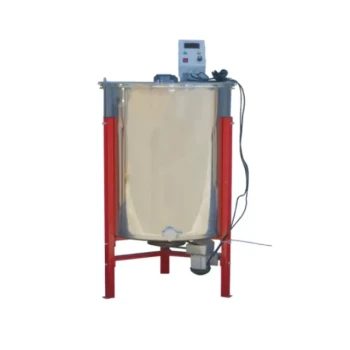
Automated honey extractors leverage high-speed centrifugal force to maximize extraction efficiency. Unlike manual methods, these machines spin frames at precise speeds to separate liquid honey from the comb. This process recovers a significantly higher percentage of raw honey from every cell while simultaneously protecting the delicate wax structure.
The Core Insight Increasing honey yield is not just about extracting more fluid; it is about conserving bee energy. Automated extractors allow for the reuse of intact honeycombs, enabling colonies to bypass wax reconstruction and focus entirely on foraging and production.
The Mechanics of Maximum Recovery
Utilizing Centrifugal Force
Industrial-grade extractors use high-speed rotation to generate centrifugal force. This physical force throws liquid honey out of the honeycomb cells more effectively than gravity draining or manual crushing.
Precision and Consistency
Automated systems operate with mechanical precision, ensuring that every frame is subjected to the exact force required to empty the cells. This eliminates the inconsistency of manual labor, ensuring that no harvestable honey is left behind in the hive frames.
Complete Extraction
Radial honey extractors are designed to separate honey without damaging the physical structure of the wax combs. This design ensures that yield assessments are based on complete extraction, maximizing the volume of product obtained from each cycle.
The Biological Advantage: Comb Preservation
Protecting the Wax Structure
A critical contribution to yield is the machine's ability to extract honey without destroying the beeswax. Manual methods often damage the comb, requiring bees to rebuild it. Automated centrifugal extraction leaves the foundation and cell walls intact.
Reducing Energy Consumption
Bees consume a significant amount of honey to produce the energy required to secrete wax. By reusing preserved honeycombs, the energy cost for the colony drops dramatically.
Redirecting Colony Focus
When bees do not need to rebuild wax, they can dedicate more energy to foraging activities. This biological efficiency loop results in faster colony reproduction and, ultimately, a higher net production of honey over the season.
Integration and Scalability
Reduced Contamination Risks
Automated production lines perform extraction in a closed, sterile environment. This minimizes secondary contamination, ensuring that the high yield obtained is also of high enough quality for export and commercial distribution.
Streamlined Processing
Automation integrates extraction with filtration and bottling. While the extractor increases raw yield, the integration prevents loss during transfer and processing, ensuring the final volume packaged for sale remains high.
Understanding the Trade-offs
Initial Capital Investment
High-precision automated systems represent a significant financial barrier. While they increase yield, the return on investment (ROI) relies on having a large enough apiary to justify the cost of the machinery.
Maintenance Complexity
Automated systems are complex industrial machines. They require regular technical maintenance and sterilization to prevent mechanical failure, which can halt production entirely during critical harvest windows.
Risk of Cross-Contamination
While automation generally improves hygiene, a failure to clean the central extractor properly can spread pathogens across multiple batches of honey, potentially ruining a large volume of product at once.
Making the Right Choice for Your Goal
- If your primary focus is Maximum Volume: Prioritize radial centrifugal extractors that offer the highest rotation speeds to ensure every drop of honey is removed from the comb.
- If your primary focus is Colony Health and Sustainability: Choose equipment with variable speed controls to ensure combs are preserved for reuse, reducing the metabolic stress on your bees.
Automation transforms beekeeping from a labor-intensive craft into a precise science, turning saved energy into higher yields.
Summary Table:
| Feature | Manual Extraction | Automated Extraction | Impact on Yield |
|---|---|---|---|
| Mechanism | Gravity or Manual Force | High-Speed Centrifugal Force | Extracts significantly more honey per cell |
| Comb Integrity | Often Damaged/Crushed | Preserved Wax Structure | Bees reuse combs, redirecting energy to production |
| Consistency | Variable/Human Dependent | Precision Speed Control | Uniform extraction across all frames |
| Energy Cost | High Labor Intensity | High Electrical Efficiency | Lowers biological cost for the bee colony |
| Processing Speed | Slow / Batch-limited | Rapid / Scalable | Increases harvest volume over a season |
Maximize Your Harvest with HONESTBEE Professional Equipment
At HONESTBEE, we specialize in empowering commercial apiaries and distributors with the tools needed to scale production and enhance efficiency. From high-capacity radial honey extractors that ensure complete recovery to industrial honey-filling machines and hive-making hardware, our comprehensive wholesale portfolio is designed for the modern beekeeping industry.
By choosing our advanced machinery, you protect your colony's energy and preserve your wax foundations, turning biological efficiency into commercial profit.
Ready to upgrade your apiary’s yield? Contact HONESTBEE Today for Wholesale Solutions
Related Products
- HONESTBEE 72 Frame Industrial Electric Honey Extractor for Beekeeping
- 32 Frame Commercial Electric Honey Extractor for Beekeeping and Honey Production
- Commercial Electric 12 Frame Honey Extractor Spinner Motorized Honey Extractor
- Stainless Steel Manual 8 Frame Radial Honey Extractor Machine for Beehives
- HONESTBEE 4 Frame Manual Self Reversing Honey Extractor for Beekeeping
People Also Ask
- What is the importance of balancing honeycomb frames within a honey extractor? Ensure Stability and Protect Machinery
- How is honey separated from the frames after they are uncapped? Efficient Extraction Methods for High Yields
- What are the main benefits of using a honey extractor? Maximize Yields and Protect Your Honeycomb
- What are the recommended methods for removing honey from the honeycomb? Top Extraction Techniques for Maximum Efficiency
- How do manual honey extractors compare to electric honey extractors? Choosing the Right Tool for Your Apiary Growth