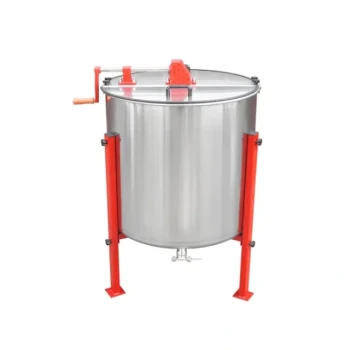
Balancing honeycomb frames within a honey extractor is the single most critical factor for ensuring the stability and safety of the extraction process. By meticulously arranging frames to create an even weight distribution, you prevent dangerous vibrations that threaten both the integrity of the machinery and the quality of the operation.
Proper balance is not merely a suggestion for smooth operation; it is a mechanical necessity. Without an evenly distributed load, an extractor cannot safely reach the high rotational speeds required to remove honey efficiently without risking severe equipment failure.
The Mechanics of Stable Extraction
Preserving Machinery Integrity
The primary purpose of balancing frames is to protect the internal mechanisms of the extractor. When a load is unbalanced, the spinning basket generates erratic forces that hammer against the central shaft and bearings. Over time, this stress leads to premature wear and potential breakdown of the unit.
Preventing Excessive Vibration
A balanced load ensures that the centrifugal force generated during spinning is symmetrical. If frames are unevenly spaced, the machine experiences excessive vibration. This vibration is the first sign that the machine is fighting against physics, which creates a chaotic and noisy extraction environment.
Ensuring High-Speed Stability
To extract honey effectively, the frames must spin at high velocities. An unbalanced unit becomes unsteady and "shaky" as speed increases. Proper balancing allows the operator to ramp up the RPMs smoothly without the machine "walking" across the floor or becoming hazardous.
Operational Risks of Imbalance
Avoiding Catastrophic Failure
In severe cases, the consequences of an unbalanced load go beyond simple noise. The supplementary data indicates that significant weight disparities can cause the honey extractor to fall over completely. This poses a safety risk to the operator and is likely to result in permanent mechanical damage to the extractor.
Maintaining Process Efficiency
When a machine is unbalanced, the operator is often forced to intervene physically. You may find yourself having to hold the unit in place or run it at significantly lower speeds to maintain control. This negates the efficiency benefits of using an extractor, turning a quick process into a labor-intensive chore.
Understanding the Trade-offs
Preparation Time vs. Run Time
Achieving perfect balance requires a time investment before you flip the switch. You must assess the weight of each uncapped frame and arrange them in opposition to one another. While this preparation adds minutes to the setup, it drastically reduces the active spinning time by allowing for higher speeds.
Variable Frame Weights
A common pitfall is assuming all frames weigh the same. Frames full of honey are heavier than those with partial capped honey or stored pollen. Failing to account for these specific weight differences—rather than just the number of frames—will lead to an imbalance, regardless of spacing.
Making the Right Choice for Your Goal
To maximize the lifespan of your equipment and the efficiency of your harvest, apply these principles:
- If your primary focus is Equipment Longevity: Prioritize meticulous weight matching of opposing frames to eliminate stress on the motor and bearings.
- If your primary focus is Processing Speed: invest time in the initial setup balance so you can run the machine at maximum RPM without stopping for adjustments.
The goal is to let the physics of the extractor do the work for you, rather than fighting against the machine to keep it upright.
Summary Table:
| Factor | Impact of Balanced Load | Impact of Unbalanced Load |
|---|---|---|
| Equipment Health | Protects bearings and central shaft | Causes premature wear and mechanical failure |
| Vibration Level | Symmetrical forces; smooth operation | Excessive vibration and loud noise |
| Extraction Speed | Stable at high RPMs for efficiency | Limited to low speeds; high labor input |
| Safety Risk | Stable and secure positioning | Risk of machine "walking" or tipping over |
| Honey Yield | Maximum extraction via high velocity | Reduced yield due to lower rotational speeds |
Maximize Your Harvest Efficiency with HONESTBEE
At HONESTBEE, we understand that high-performance honey extraction requires more than just technique—it requires precision-engineered machinery. Whether you are a commercial apiary or a global distributor, our comprehensive wholesale portfolio provides the industrial-grade honey extractors, honey-filling machines, and hive-making equipment you need to scale your operations.
From essential consumables to specialized hardware, we empower beekeeping professionals to achieve superior stability and productivity. Contact HONESTBEE today to discover how our specialized beekeeping tools and machinery can optimize your production line and protect your investment.
Related Products
- HONESTBEE 72 Frame Industrial Electric Honey Extractor for Beekeeping
- Commercial Electric 12 Frame Honey Extractor Spinner Motorized Honey Extractor
- HONESTBEE 6 Frame Self Reversing Electric Honey Extractor for Beekeeping
- HONESTBEE 3-Frame Manual Acrylic Honey Extractor
- Stainless Steel Manual 8 Frame Radial Honey Extractor Machine for Beehives
People Also Ask
- How is honey separated from the frames after they are uncapped? Efficient Extraction Methods for High Yields
- What are the main benefits of using a honey extractor? Maximize Yields and Protect Your Honeycomb
- What are the recommended methods for removing honey from the honeycomb? Top Extraction Techniques for Maximum Efficiency
- How do manual honey extractors compare to electric honey extractors? Choosing the Right Tool for Your Apiary Growth
- What is the primary benefit of using a honey extractor compared to older methods? Boost Yield & Save Your Bees' Energy