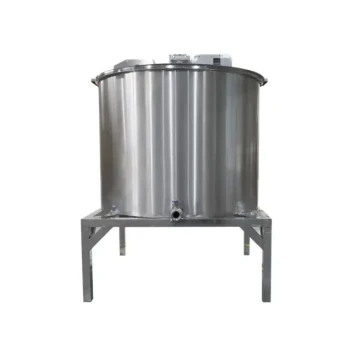
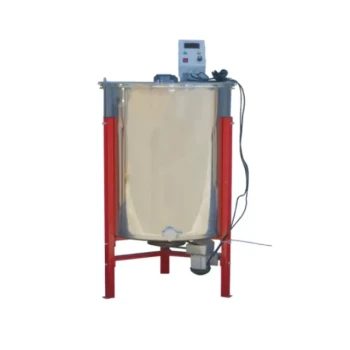
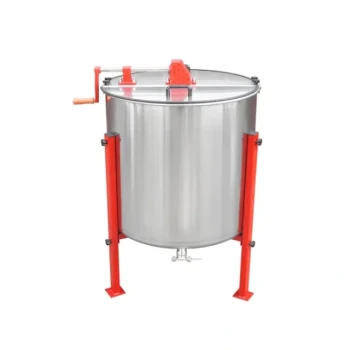
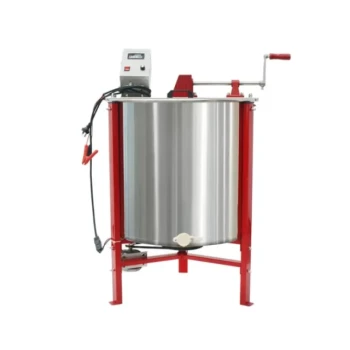
Automatic honey extractors operate by utilizing an electric motor to generate consistent, high-speed rotation within a drum. Rather than relying on a hand crank, you simply place uncapped frames into a central basket and activate the machine. This automated spinning creates strong centrifugal force that pulls liquid honey out of the comb, allowing it to splash against the drum's inner walls and flow down to a drainage tap.
By replacing manual labor with electric automation, these extractors maximize efficiency for high-volume beekeeping. They allow operators to process significantly more frames per hour while ensuring the delicate wax combs remain intact for future reuse.
The Mechanics of Automated Extraction
The Power of Centrifugal Force
The core scientific principle behind the extractor is centrifugal force. As the central basket spins, the inertia forces the honey out of the open cells of the honeycomb.
The Role of the Electric Motor
Unlike manual models, automatic extractors are powered by an electric motor. This allows for the automated spinning of frames at consistent speeds without physical exertion.
Control and Speed Variability
Most modern units allow you to adjust the spinning speed. Operators often start with a slow rotation to prevent breaking heavy combs, gradually increasing speed as the honey empties out.
Comb Preservation
Crucially, this process extracts the liquid without destroying the structure of the comb. Because the frames remain intact, bees can immediately reuse them to store more honey, saving them the energy required to rebuild wax.
Frame Orientation: Radial vs. Tangential
Radial Configuration
In a radial extractor, frames are positioned like the spokes of a wheel, with the top bar facing the outer wall. This design utilizes centrifugal force to pull honey from both sides of the comb simultaneously.
Efficiency of Radial Models
Because both sides are emptied at once, there is no need to stop the machine to flip the frames. This makes radial models the preferred choice for commercial operations prioritizing speed.
Tangential Configuration
In a tangential extractor, the frames are placed with one broad side facing the drum wall. This method extracts honey from only one side at a time.
The Flip Requirement
To empty a frame completely in a tangential model, the operator must stop the machine, manually flip the frames, and spin them again. While more labor-intensive, this method can sometimes extract difficult or thick honey more thoroughly.
Understanding the Trade-offs
Higher Initial Investment
Automatic extractors are significantly more expensive than manual hand-crank models. They are engineered for larger production volumes, making them overkill for a hobbyist with only one or two hives.
Complexity and Maintenance
With added electrical components and motors comes the need for maintenance. Unlike a simple mechanical gear system, an automatic extractor requires access to power and care for its electronic speed controllers.
Size and Storage
These units are often larger to accommodate high capacities, ranging from 2 to 72 frames. They require dedicated floor space and storage, unlike compact manual units that can be easily tucked away.
Making the Right Choice for Your Goal
While the operating principle is simple, the configuration you choose dictates your workflow.
- If your primary focus is commercial efficiency: Choose a radial automatic extractor to eliminate the need for flipping frames and to maximize the volume processed per hour.
- If your primary focus is thorough extraction on a budget: A tangential model may offer a lower price point, provided you accept the additional labor of flipping frames mid-cycle.
- If your primary focus is small-scale hobbyist beekeeping: Consider if the cost of an electric motor is justified, as the time saved on small batches (2-4 frames) is negligible compared to the setup cost.
Ultimately, automatic extractors transform honey harvesting from a physical endurance test into a streamlined, push-button industrial process.
Summary Table:
| Feature | Radial Automatic Extractor | Tangential Automatic Extractor |
|---|---|---|
| Mechanism | Honey extracted from both sides at once | One side extracted at a time |
| Manual Labor | Lowest; no need to flip frames | Moderate; requires manual frame flipping |
| Best For | High-volume commercial apiaries | Thorough extraction of thick honey |
| Efficiency | Maximum speed and throughput | High, but limited by flipping time |
| Frame Capacity | Typically 8 to 120+ frames | Typically 2 to 12 frames |
Streamline Your Commercial Apiary with HONESTBEE
Transitioning to professional-grade automation is essential for scaling your honey production. HONESTBEE specializes in empowering commercial apiaries and global distributors with a comprehensive range of premium beekeeping tools and industrial machinery.
From high-capacity radial honey extractors and hive-making machines to precision honey-filling equipment and essential consumables, we provide the hardware you need to maximize efficiency and preserve comb integrity. Our wholesale solutions are designed to turn labor-intensive harvests into streamlined industrial successes.
Ready to scale your production? Contact us today to explore our wholesale catalog and expert machinery solutions.
Related Products
- HONESTBEE 72 Frame Industrial Electric Honey Extractor for Beekeeping
- 32 Frame Commercial Electric Honey Extractor for Beekeeping and Honey Production
- Commercial Electric 12 Frame Honey Extractor Spinner Motorized Honey Extractor
- HONESTBEE 4 Frame Manual Self Reversing Honey Extractor for Beekeeping
- Stainless Steel Manual 8 Frame Radial Honey Extractor Machine for Beehives
People Also Ask
- What is the importance of balancing honeycomb frames within a honey extractor? Ensure Stability and Protect Machinery
- How is honey separated from the frames after they are uncapped? Efficient Extraction Methods for High Yields
- What are the main benefits of using a honey extractor? Maximize Yields and Protect Your Honeycomb
- What are the recommended methods for removing honey from the honeycomb? Top Extraction Techniques for Maximum Efficiency
- How do manual honey extractors compare to electric honey extractors? Choosing the Right Tool for Your Apiary Growth