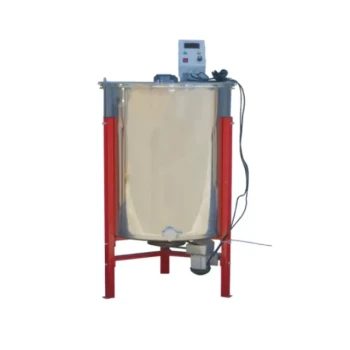
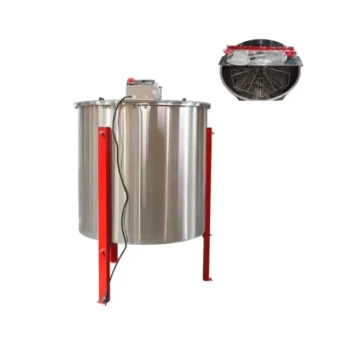
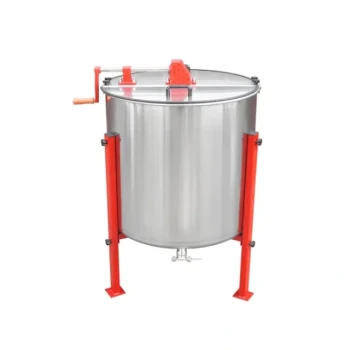
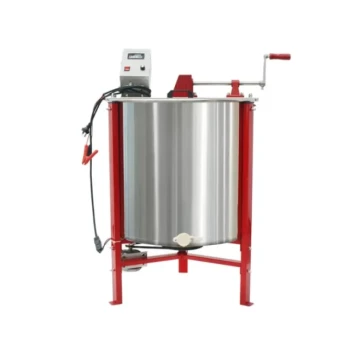
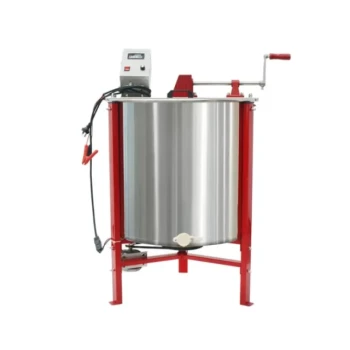
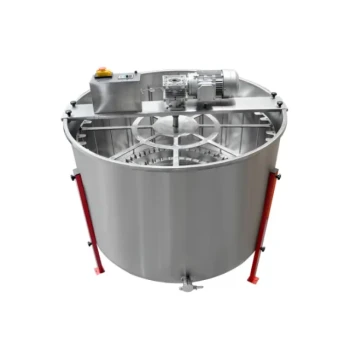
Centrifuge honey extractors operate on the fundamental principle of rotational physics to separate liquid from solid. You place uncapped honeycomb frames into a central basket or reel located within a cylindrical drum. When the device spins, centrifugal force pulls the honey out of the comb cells and flings it against the inner walls of the drum, where it drains to the bottom for collection.
The Core Value The primary advantage of a centrifuge extractor is that it harvests honey without destroying the wax comb. This preserves the structural integrity of the frames, allowing bees to reuse them immediately and saving the colony the immense energy required to rebuild wax.
The Mechanics of Extraction
The Spinning Process
Inside the extractor, frames are loaded into a specialized basket. As the basket rotates, the inertia of the honey overcomes the surface tension holding it in the comb.
Separation and Collection
The honey is expelled from the uncapped cells and strikes the extractor's inner wall. Gravity then pulls the liquid down the sides of the drum, where it pools at the bottom to be removed via a tap or pump.
Preservation of the Comb
Unlike crush-and-strain methods, this process leaves the wax structure intact. This is critical for efficiency, as it significantly shortens the preparation time for the next honey production cycle.
Operational Configurations
Radial Extraction
In a radial extractor, frames are arranged like the spokes of a wheel, with the top bars facing the outer wall and bottom bars toward the center. This design utilizes natural slopes in the comb cells to extract honey from both sides simultaneously.
Speed Management
Radial extraction typically requires a specific speed protocol. The process begins with a slow rotation to remove heavy honey without breaking the comb, then increases speed to extract the remaining liquid.
Power Sources
Manual extractors rely on a hand crank and a gearbox to generate speed. While cost-effective, they require significant physical effort to maintain the necessary RPMs for thorough extraction.
Electric extractors automate this process with a motor. By simply pushing a button, the machine manages the spinning consistency, reducing physical labor and increasing throughput for larger harvests.
Understanding the Trade-offs
Risk of Comb Damage
While the goal is to save the comb, incorrect operation can still cause damage. If the extractor spins too fast too quickly, the weight of the honey can blow out the wax foundation.
Complexity vs. Cost
Radial and electric models offer the highest efficiency but come with a higher price tag and larger footprint. Manual models are portable and affordable but limit the volume of honey you can process comfortably in a single session.
Making the Right Choice for Your Goal
To select the right extraction method, you must balance your budget against the volume of hives you manage.
- If your primary focus is efficiency and volume: Choose an electric radial extractor, as it extracts both sides of the frame at once and automates the labor, maximizing honey yield per hour.
- If your primary focus is budget or small-scale hobbyist beekeeping: Choose a manual extractor, which utilizes the same centrifugal principles to preserve your combs but requires more time and physical effort.
Ultimately, the best extractor is one that allows you to harvest your crop while returning intact frames to the hive, ensuring a faster start for your bees next season.
Summary Table:
| Feature | Manual Extractor | Electric Radial Extractor |
|---|---|---|
| Core Mechanism | Hand-cranked gear system | Motorized rotation |
| Frame Orientation | Tangential (usually) | Radial (spoke-like) |
| Efficiency | Moderate (one side at a time) | High (both sides simultaneously) |
| Labor Intensity | High physical effort | Low (automated) |
| Best For | Hobbyists & Small-scale | Commercial apiaries & Distributors |
| Comb Preservation | Good (with careful speed) | Excellent (steady speed control) |
Scale Your Honey Production with HONESTBEE Precision Equipment
Are you looking to enhance your apiary's output or expand your wholesale inventory? HONESTBEE provides commercial apiaries and distributors with high-performance honey-filling machines, specialized hive-making hardware, and a full spectrum of beekeeping tools. Our industrial-grade centrifuge extractors are designed to maximize honey recovery while keeping your wax combs intact for faster reuse.
From essential consumables to heavy-duty machinery and honey-themed cultural merchandise, we offer the comprehensive wholesale solutions you need to succeed. Contact us today to discuss your bulk equipment needs and see how HONESTBEE can streamline your operations.
Related Products
- Manual Hand Crank 4 Frame Honey Extractor Centrifuge for Beekeeping
- electric honey extractor honey centrifuge 3 frame honey extractor stainless steel honey frame extractor
- Professional 4 Frame Self Reversing Electric Honey Extractor for Beekeeping
- 24 Frame Honey Extractor Commercial Radial Honey Frame Extraction Machine
- Electric 4 Frame Tangential Honey Extractor
People Also Ask
- What are some tips for achieving efficient honey extraction with a centrifuge extractor? Maximize Your Yield & Efficiency
- What is the proper procedure for maintaining a centrifuge honey extractor? Expert Tips for Longevity and Hygiene
- What are the advantages of using a centrifuge honey extractor? Maximize Yields and Protect Your Honeycombs
- Which type of honey extractor is generally more durable? Focus on Material & Build Quality for Longevity
- What is a manual honey extractor? The Essential Guide to Cost-Effective Beekeeping for Beginners