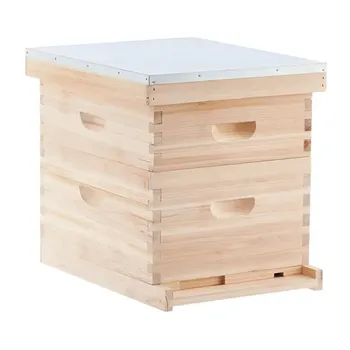
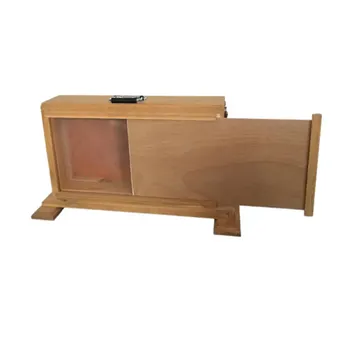
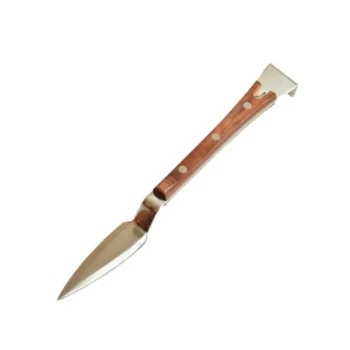
Langstroth hives are larger, higher-capacity systems, while native-bee hives use smaller boxes and scaled-down frames to match smaller colonies. A typical 10-frame Langstroth brood frame is approximately 440 × 228 mm, with a top bar around 475 mm long. Hives designed for smaller species such as Apis cerana commonly use frames around 250 × 144 mm to 300 × 195 mm, with capacities ranging from 7 to 10 frames, depending on the hive pattern.
The correct hive is determined by colony size, not simply by available space. Oversized Langstroth equipment can make smaller colonies difficult to keep warm, while putting a large Apis mellifera colony into a reduced hive can cause rapid overcrowding.
How the Hive Bodies Differ
Langstroth hives provide greater internal volume
A standard Langstroth configuration generally uses 10 frames per brood box and honey super. Its larger chambers support populous colonies such as Apis mellifera, including Italian honeybees, and provide room for substantial brood rearing and honey storage.
The vertical design also allows beekeepers to add supers as the colony expands. This makes Langstroth equipment particularly suitable for commercial or high-output honey production.
Smaller native-bee hives reduce unused space
Hives designed for smaller species use reduced box dimensions and fewer or smaller frames. Jeolikote-style equipment commonly holds seven frames, while some ISI-style designs accommodate ten scaled-down frames.
The important difference is not only the number of frames. The entire chamber volume, frame area, and spacing are reduced to better match the smaller population and body size of species such as Apis cerana.
Hive shape and pattern affect compatibility
“Native-bee hive” is not a single universal standard. ISI, Jeolikote, Newton, and other regional patterns may differ in external dimensions, frame size, and frame count.
For distributors and resellers, the hive pattern should therefore be treated as a compatibility specification, not merely a product name. Replacement frames, boxes, covers, stands, and accessories must match the same pattern.
How the Frame Sizes Differ
Langstroth frames share a common top-bar length
Langstroth frames typically use a top bar approximately 19 inches, or 475 mm, long. The main standard variations are based on frame height:
- Deep: approximately 19 × 1-1/16 × 9-1/8 inches, commonly used in brood chambers.
- Medium: approximately 19 × 1-1/16 × 6-1/4 inches, frequently used in honey supers.
- Shallow: approximately 19 × 1-1/16 × 5-3/8 inches, used for lighter honey supers.
These frame types fit the Langstroth system but are not interchangeable by height without using compatible boxes. A deep frame requires a deep box, while a medium or shallow frame requires the corresponding super.
Smaller-species frames have reduced length and height
Frames for smaller hives are substantially smaller than Langstroth frames. Representative brood-frame dimensions range from approximately 250 × 144 mm to 300 × 195 mm, depending on the hive standard.
This smaller comb area reduces unused space and helps the colony maintain an appropriate brood-nest environment. It also limits the amount of honey storage per frame compared with a Langstroth deep frame.
Frame spacing is also part of the design
Smaller hive systems may use a tighter frame clearance of approximately 6 mm, according to the referenced specifications. This spacing must be preserved because incorrect gaps can interfere with comb construction, colony movement, and equipment compatibility.
A frame that is the correct length but has the wrong lug, side-bar, or spacing specification may still be unusable in the target hive body.
Why Matching the Species Matters
Smaller colonies can lose heat in oversized equipment
A large Langstroth chamber gives a smaller colony more volume than it can effectively occupy. The resulting unused space can make temperature regulation more difficult, particularly around the brood area.
Reduced hive dimensions help the colony occupy the comb efficiently and avoid maintaining unnecessary internal space.
Larger colonies can outgrow small equipment
The reverse problem occurs when a populous Apis mellifera colony is placed in a small-species hive. The available brood and storage area can be filled quickly, leading to overcrowding and limiting expansion.
For commercial beekeeping, this can reduce operational flexibility because the colony may need more frequent intervention or earlier transfer to larger equipment.
Correct frame area improves comb utilization
A properly scaled frame allows bees to use the available comb for brood, pollen, and honey without leaving excessive empty areas. This is especially important when the hive is selected for colony establishment, seasonal development, or honey production.
The objective is not to maximize box volume in isolation. It is to provide a usable working volume that corresponds to the colony’s actual population.
What This Means for Product Selection and Supply
Langstroth equipment supports a broad commercial ecosystem
Langstroth systems have widely recognized frame categories, including deep, medium, and shallow formats. This creates a broad product range covering brood boxes, supers, frames, foundations, extractors, uncapping equipment, and replacement components.
For wholesalers and distributors, this can simplify portfolio planning when serving commercial beekeepers using Apis mellifera. It also creates clear opportunities to stock compatible components across multiple hive sizes.
Smaller hives require more precise specification control
Native-bee equipment may have fewer universally interchangeable parts because regional patterns differ. A seven-frame Jeolikote component should not be assumed to fit a ten-frame ISI box, even if both are intended for Apis cerana.
Product listings should clearly state hive pattern, frame count, frame dimensions, top-bar length, and bee-space specification. This reduces ordering errors and supports faster fulfillment.
Accessories should be matched to the frame system
Frame dimensions affect more than the woodenware. They also influence foundation sheets, frame holders, transport boxes, extractors, and other processing equipment.
Standardized Langstroth frames are generally suited to centrifugal extraction, while smaller frames may require compatible extractor dimensions or carefully selected universal equipment. A one-stop supplier should verify the complete equipment chain rather than selling the hive body alone.
Understanding the Trade-offs
Langstroth systems prioritize capacity and standardization
The main advantages of Langstroth equipment are large colony capacity, scalable vertical expansion, and broad accessory availability. These benefits make it a strong choice for high-population colonies and commercial honey operations.
The trade-off is that the equipment is physically larger and may be unsuitable for smaller colonies unless the internal volume is managed carefully.
Smaller hives prioritize colony fit and thermal efficiency
Reduced hives provide a closer match for smaller species and colonies. Their smaller frames and chambers can improve comb utilization and reduce excess internal volume.
The trade-off is lower total storage capacity and potentially less interchangeability between regional hive patterns. Buyers must pay closer attention to exact specifications.
Similar names do not guarantee interchangeability
A “Langstroth-style” product may still differ in frame depth, box height, wall construction, or manufacturing tolerances. Likewise, two hives marketed for Apis cerana may follow different local standards.
Before ordering, confirm the complete dimensional drawing or technical specification, especially when supplying replacement parts or building a mixed inventory.
Making the Right Choice for Your Goal
Select the hive and frame system based on the bee species, expected colony strength, and equipment ecosystem you need to support.
- If your primary focus is commercial Apis mellifera production: Choose 10-frame Langstroth equipment with the required deep, medium, or shallow frame configuration for scalable brood and honey production.
- If your primary focus is smaller native species such as Apis cerana: Choose a reduced hive pattern with appropriately sized frames, such as a seven-frame Jeolikote-style or scaled ISI-style configuration.
- If your primary focus is distribution and wholesale supply: Stock clearly identified, pattern-compatible components and publish frame dimensions, capacities, and bee-space specifications to prevent fulfillment errors.
- If your primary focus is replacement parts or expansion: Match the new frames and boxes to the existing hive standard rather than relying on the species name alone.
The most reliable approach is to match hive volume, frame dimensions, and spacing to the colony species and the exact equipment standard.
Summary Table:
| Hive Type | Frame Dimensions | Frame Count | Best For |
|---|---|---|---|
| Langstroth Deep | 475 x 228 mm (approx.) | 10 frames | Apis mellifera, commercial honey production |
| Langstroth Medium | 475 x 159 mm (approx.) | 10 frames | Honey supers, lighter lifting |
| Langstroth Shallow | 475 x 137 mm (approx.) | 10 frames | Honey supers, minimal weight |
| Native Bee (Jeolikote) | 250 x 144 mm to 300 x 195 mm | 7 frames | Apis cerana, smaller colonies |
| Native Bee (ISI style) | Similar scope, exact specs vary | 7-10 frames | Apis cerana, regional standards |
Ensure you select the right hive and frames for your operation. At HONESTBEE, we supply a comprehensive range of beekeeping equipment, including Langstroth and native-bee hives, with clear specifications and reliable sourcing. As a one-stop partner for distributors and commercial apiaries, we offer rapid response, dedicated support, and ultra-fast delivery. Contact us today to optimize your inventory and meet your customers' needs. Reach out to our team now!
Related Products
- Long Langstroth Style Horizontal Top Bar Hive for Wholesale
- High-Performance Langstroth Bee Hives for Global Professional Beekeeping
- Langstroth Honey Bee Box Hive Boxes for Different Depths
- Australian Langstroth Beehive Boxes for Beekeeping Wholesales
- Professional Observation Hive: The Ultimate Portable Solution for Beekeeping Education, Exhibitions, and Colony Displays
People Also Ask
- What are the potential applications of top bar hives in resource-limited settings? Empower Communities with Sustainable Beekeeping
- What are the benefits of extra wax production in top bar hives? A Natural Byproduct for Craft & Efficiency
- How does the top bar hive help control varroa mites? A Natural Approach to Mite Management
- What does the general management of a top bar hive entail? Master Horizontal Beekeeping with Ease
- How is a top bar hive used to start a new colony? Master Incremental Expansion for a Thriving Hive