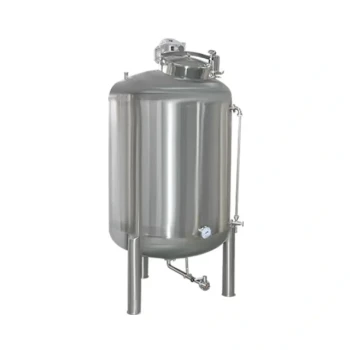
Industrial-grade storage and transport systems preserve commercial value primarily through precise environmental isolation. By maintaining a temperature-controlled and light-shielded environment, this equipment prevents the degradation of flavor profiles and biological activity that typically occurs during the harvest and distribution cycles. This ensures that bulk honey retains the specific sensory characteristics required for wholesale acceptance and retail pricing.
The commercial viability of honey relies heavily on stability; industrial equipment mitigates the risks of crystallization, fermentation, and flavor loss by creating a sealed, consistent atmosphere that bridges the gap between the hive and the final market.
The Pillars of Value Preservation
To protect the economic value of honey, industrial equipment must address three fundamental threats: thermal fluctuation, light exposure, and atmospheric contamination.
Stabilizing Biological Activity
The primary reference for honey quality is its biological activity and enzyme content. Industrial storage units provide a temperature-controlled environment that arrests the natural degradation of these components.
By shielding the product from heat spikes during the distribution cycle, the equipment preserves the honey’s original nutritional profile. This allows producers to market the product as high-quality or raw, commanding a premium price point.
Preventing Sensory Degradation
Honey is chemically complex, and its flavor notes are volatile. Industrial transport containers are designed to be light-shielded, blocking UV rays that can alter the chemical structure of the honey.
This protection ensures that the flavor and color—the primary sensory traits used by buyers to grade honey—remain consistent from the farm to the processing facility.
Managing Moisture and Odor Absorption
Honey is highly hygroscopic, meaning it aggressively absorbs moisture and odors from the surrounding air. Industrial-grade containers utilize specialized food-grade sealing to create an impermeable barrier.
This prevents the absorption of ambient humidity, which can dilute the honey and lead to fermentation (spoilage). It also blocks external smells, ensuring the honey does not acquire off-flavors from the logistics environment, such as diesel fumes or warehouse odors.
Controlling Physical State and Consistency
Beyond chemical preservation, the physical state of the honey determines its marketability and ease of processing.
Inhibiting Unintended Crystallization
Temperature fluctuations are the leading cause of accelerated crystallization during transport. Specialized logistics equipment maintains a stable thermal profile to keep honey in its desired liquid state.
This is critical for efficiency; if honey crystallizes during transport, it requires aggressive reheating to be bottled, which can damage the product. Proper thermal management during transport eliminates this need.
Ensuring Hygiene and Purity
Industrial storage often integrates with closed-loop filtration and filling systems. This infrastructure minimizes human contact and environmental exposure.
By utilizing high-precision sealing and hygienic vacuum systems, the equipment prevents cross-contamination. This is particularly vital when transporting honey harvested from specific floral sources or mite-resistant colonies, where purity is the main selling point.
Understanding the Trade-offs
While industrial equipment is essential for scale, there are operational considerations to weigh regarding cost and complexity.
The Cost of Precision
Implementing full-scale temperature control and light shielding requires significant capital investment compared to standard bulk containers.
Operators must balance the cost of this hardware against the potential loss of value. For commodity-grade honey, standard drums may suffice, but for high-value varietals, the cost of specialized equipment is offset by the preservation of the premium price tag.
Logistics vs. Quality
Strictly maintaining a controlled environment adds complexity to the supply chain. Heated or insulated transport adds weight and energy costs to the logistics equation.
However, failing to maintain these conditions can result in a rejected shipment due to crystallization or fermentation. The trade-off is higher upfront logistics costs in exchange for zero product loss at the destination.
Making the Right Choice for Your Goal
Selecting the right storage and transport configuration depends on your position in the supply chain and the specific market you serve.
- If your primary focus is Raw/Biological Value: Prioritize equipment with strict temperature controls and absolute light shielding to protect enzyme activity.
- If your primary focus is Logistics Efficiency: Invest in high-quality sealing technologies to prevent leaks and fermentation without the ongoing energy cost of active heating.
- If your primary focus is Retail Presentation: Ensure your transport equipment integrates with filtration systems that prevent crystallization, guaranteeing liquid transparency on the shelf.
The goal of industrial honey equipment is not just to move product, but to freeze time—delivering the harvest to the consumer exactly as it existed in the hive.
Summary Table:
| Protection Feature | Primary Benefit | Commercial Impact |
|---|---|---|
| Temperature Control | Preserves enzymes & bio-activity | Commands premium 'raw honey' pricing |
| Light Shielding | Prevents UV degradation | Ensures consistent flavor & color grading |
| Food-Grade Sealing | Blocks moisture & odors | Eliminates fermentation & contamination risks |
| Thermal Stability | Inhibits crystallization | Reduces reheating costs & simplifies bottling |
Maximize Your Honey's Market Value with HONESTBEE
At HONESTBEE, we specialize in empowering commercial apiaries and distributors with professional-grade beekeeping infrastructure. Our comprehensive wholesale offering covers the full spectrum of industry needs—from specialized hardware like hive-making and honey-filling machines to essential beekeeping tools and industry consumables.
Whether you are scaling a commercial apiary or supplying the global market, we provide the machinery and equipment necessary to ensure your product reaches consumers in its purest state. Contact us today to learn how our tailored solutions can enhance your production efficiency and preserve your harvest's commercial value.
References
- Sobhy M. Ismaiel, Abdu Zulail. Factors That Affect Consumption Patterns and Market Demands for Honey in the Kingdom of Saudi Arabia. DOI: 10.4236/fns.2014.517186
This article is also based on technical information from HonestBee Knowledge Base .
Related Products
- Stainless Steel Honey Storage and Settling Tank with Double Strainer
- Professional Honey Storage Tank with Agitation System
- Stainless Steel Honey Storage Tank with Lid for Honey
- Hexagonal Glass Honey Jar with Wooden Lid Integrated Dipper Elegant Functional Storage
- Hexagonal Glass Honey Jars with Metal Lug Caps Elegant Versatile Packaging
People Also Ask
- What economic role do honey storage tanks play? Boost Your Revenue Through Strategic Inventory Management
- What roles do industrial honey storage tanks and filtration meshes play in processing? Ensure Purity & Consistency
- What is the purpose of a honey storage tank? Streamline Your Honey Processing for Quality & Efficiency
- What role do settling tanks play in honey production? Achieve Pure, High-Clarity Honey Naturally
- Why are large settling tanks used in the honey clarification process? Achieve Natural Purity & Batch Consistency