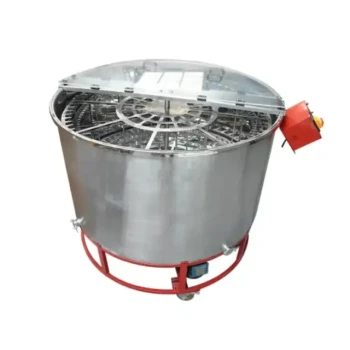
Industrial honey harvesting and processing machines act as critical force multipliers for commercial apiaries by converting raw biological output into a stable, marketable commodity. These systems maximize yield by enabling rapid extraction during short flowering windows, while simultaneously driving economic efficiency through precise moisture control, automated filling, and significant reductions in labor costs.
Core Takeaway Success in commercial beekeeping relies not just on the bees, but on the speed and precision of the extraction workflow. Industrial machinery bridges the gap between the apiary and the market, transforming perishable raw honey into a standardized, high-value product suitable for international distribution.
Maximizing Yield Through Harvesting Efficiency
Capitalizing on Limited Flowering Windows
The primary contribution of industrial harvesting machinery is speed. Beekeepers operate within strict flowering windows, where nectar availability is finite and time-sensitive.
Efficient harvesting technology allows operators to extract honey rapidly. This speed supports management techniques like vertical migration, where colonies are moved to different altitudes or regions to chase peak floral sources.
Optimizing Extraction Rates
Traditional methods often leave viable honey trapped in the comb. Industrial centrifugal honey extractors utilize controlled physical force to separate mature honey from the honeycomb efficiently.
This method ensures the maximum possible volume is recovered from each frame without destroying the comb structure, allowing it to be reused by the colony for immediate refilling.
Enhancing Economic Value via Processing
Improving Stability and Shelf Life
Raw honey often contains excess moisture and physical impurities. Industrial processing equipment utilizes filtration and dehydration technologies to reduce moisture content in both mature and immature honey.
By strictly controlling moisture levels, these machines prevent fermentation and bacterial growth. This stabilization is essential for meeting food safety standards and ensuring the product remains viable for long-term storage and export.
Standardization for Premium Markets
Economic efficiency is heavily influenced by the ability to access high-value markets. Integrated processing lines remove physical contaminants and ensure chemical consistency.
This standardization transforms local, raw honey into a traceable export good. It allows producers to meet international hygiene and quality standards, which is a prerequisite for entering premium retail networks.
The Role of Automation in Profitability
Reducing Labor and Contamination Risks
Manual extraction and bottling are labor-intensive and prone to human error. Automated honey filling equipment enables continuous, high-efficiency operation.
This automation significantly lowers labor costs, a major overhead in large-scale operations. Furthermore, by minimizing human contact, these machines reduce the risk of secondary contamination, preserving the hygienic integrity of the final product.
Precision Dosage and Waste Reduction
Professional filling machines are designed for quantitative packaging with high precision. They accurately dispense honey into retail or industrial containers, eliminating the financial loss associated with overfilling.
These systems also utilize advanced sealing technologies. This not only minimizes material waste but also speeds up the final packaging process, ensuring the product moves from factory to consumer faster.
Understanding the Operational Trade-offs
Balancing Processing Force with Quality
While machinery increases yield, it introduces physical force and heat. Industrial extractors must provide controlled physical force to separate honey without degrading its nutritional components or natural flavors.
Over-processing or excessive heat during dehydration can damage the delicate chemical properties of honey. Operators must calibrate equipment to balance efficiency with the preservation of the honey's natural profile.
The Scale Requirement
These technologies represent a significant capital investment. They are designed for regions with high annual production output.
For smaller operations, the cost of automated lines may outweigh the efficiency gains. The economic benefit is realized only when the volume of honey produced is sufficient to utilize the machinery's continuous operational capacity.
Making the Right Choice for Your Goal
To maximize the return on investment in industrial honey machinery, align the technology with your specific production targets:
- If your primary focus is Volume and Export: Prioritize automated filtration and dehydration systems to ensure your product meets the strict moisture and hygiene standards required for international shipping.
- If your primary focus is Brand Consistency: Invest in high-precision automated filling machines to eliminate dosage variance and ensure uniform packaging for retail shelves.
Ultimately, industrial machinery does not just process honey; it standardizes the variable nature of agriculture into a reliable, scalable commercial operation.
Summary Table:
| Feature | Impact on Yield & Efficiency | Key Economic Benefit |
|---|---|---|
| Centrifugal Extractors | High-speed honey recovery without damaging combs | Maximizes volume and enables comb reuse |
| Dehydration Systems | Precise moisture control and stabilization | Prevents fermentation; meets export standards |
| Automated Filling | Quantitative precision and high-speed bottling | Reduces labor costs and eliminates overfill waste |
| Filtration Units | Removal of physical impurities and contaminants | Ensures premium product quality and traceability |
| Vertical Migration Support | Enables rapid harvesting during peak flows | Capitalizes on limited flowering windows |
Scale Your Honey Production with HONESTBEE Professional Solutions
Transitioning from a traditional apiary to a high-efficiency commercial operation requires more than just bees—it requires precision engineering. HONESTBEE empowers commercial apiaries and distributors with the tools needed to dominate the market.
From advanced hive-making machinery and high-speed honey-filling lines to a comprehensive array of beekeeping tools and industry consumables, we provide the end-to-end equipment necessary to maximize your yield and minimize your overhead. Whether you are looking to improve your export quality or expand your retail reach with honey-themed merchandise, our wholesale solutions are tailored to your growth.
Ready to transform your honey processing efficiency?
Contact HONESTBEE Today to discover how our machinery can drive your profitability.
References
- Irene Asensio, Matilde Carballo. Importance of Ecological Factors and Colony Handling for Optimizing Health Status of Apiaries in Mediterranean Ecosystems. DOI: 10.1371/journal.pone.0164205
This article is also based on technical information from HonestBee Knowledge Base .
Related Products
- HONESTBEE 72 Frame Industrial Electric Honey Extractor for Beekeeping
- Fully Automatic Honey Filling Packaging Machine for Processing Line
- Heavy Duty Stainless Steel Honey Processing Machine Decrystallizing Tank
- Economy Honey Homogenizer Mixer and Melting Machine for Beekeeping
- Double Wall Honey Heating Stirring Homogenizer Mixing Machine with Various Capacity
People Also Ask
- What is the importance of balancing honeycomb frames within a honey extractor? Ensure Stability and Protect Machinery
- How is honey separated from the frames after they are uncapped? Efficient Extraction Methods for High Yields
- What are the main benefits of using a honey extractor? Maximize Yields and Protect Your Honeycomb
- What are the recommended methods for removing honey from the honeycomb? Top Extraction Techniques for Maximum Efficiency
- How do manual honey extractors compare to electric honey extractors? Choosing the Right Tool for Your Apiary Growth