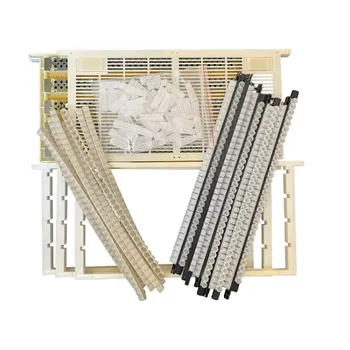
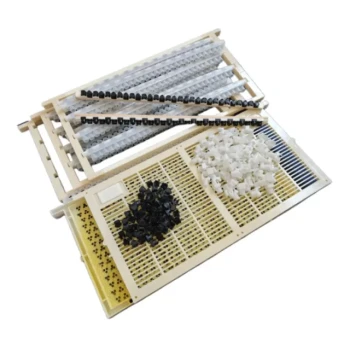
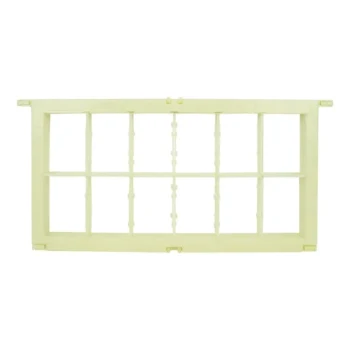
The breeding objective determines the entire production system. Commercial honey production selects colonies for broad, repeatable performance—honey yield, docility, disease resistance, and reliable wintering—while specialized royal jelly production applies intensive annual selection focused primarily on royal jelly yield per colony. Accordingly, honey operations prioritize high-throughput extraction and filling equipment, whereas royal jelly operations require precision queen-rearing tools, grafting equipment, cell cups, and cold-chain handling.
The central principle is alignment: breed bees for the product you intend to sell, then equip the apiary around that product’s harvesting speed, labor requirements, and quality controls.
How the Breeding Objectives Differ
Honey production favors balanced colony performance
Honey-focused breeding is broad rather than narrowly optimized for one production trait. The goal is a productive colony that remains manageable, healthy, and capable of surviving seasonal conditions.
Key selection priorities typically include:
- Colony productivity: Strong nectar collection and dependable honey yields.
- Docility: Safer and more efficient handling for commercial teams.
- Disease resistance: Reduced operational disruption and treatment dependence.
- Wintering capability: Better colony continuity across production seasons.
This combination supports scalable honey production because commercial returns depend on more than peak yield from a single colony.
Royal jelly production favors a specialized yield trait
Royal jelly operations concentrate selection much more intensely on royal jelly yield per colony. The breeding program is therefore more specialized and commonly involves annual selection based on the performance of colonies used for royal jelly production.
This approach reflects a different commercial model. The objective is not simply to maintain a strong honey-producing colony, but to repeatedly generate a valuable specialty product through a carefully controlled production cycle.
The distinction is breadth versus specialization
Honey breeding seeks a robust package of traits that supports large-scale colony management. Royal jelly breeding gives greater weight to a specific output, requiring closer coordination between queen rearing, grafting, harvesting, and product handling.
Neither strategy is universally superior. The appropriate choice depends on the product being sold, the production volume, the available labor, and the required level of process control.
How Equipment Should Follow the Production Strategy
Honey operations need throughput and durability
Commercial honey production generates substantial product volume during concentrated honey flows. Equipment must therefore move product efficiently while reducing bottlenecks in extraction, processing, and packaging.
A honey-focused equipment package commonly includes:
- Heavy-duty honey extractors for efficient processing of large quantities of comb.
- Honey processing tanks for settling, holding, and managing product flow.
- Automated or semi-automated filling equipment for consistent packaging at commercial volumes.
For distributors and commercial buyers, the priority is not simply acquiring individual machines. It is assembling a compatible workflow from extraction through final filling.
Royal jelly operations need precision and controlled handling
Royal jelly production involves a meticulous, short-cycle harvesting process. The equipment must support accurate queen-rearing work and careful collection rather than primarily maximizing bulk extraction speed.
Relevant equipment and consumables include:
- Specialized queen-breeding equipment for managing production colonies and queens.
- Grafting tools for transferring larvae accurately.
- Cell cups to support controlled royal cell development.
- Cold-chain handling tools to protect product quality after harvesting.
In this setting, small tools and consumables can have an operational importance equal to larger equipment. A missing grafting tool or unsuitable handling component can interrupt the production cycle even when the broader apiary is fully equipped.
Workflow compatibility matters more than isolated specifications
Equipment should be evaluated as part of a production system. A machine with high nominal capacity is not automatically suitable if it creates downstream delays or does not match the operation’s labor model.
For honey, assess the complete path from hive collection to packaged product. For royal jelly, assess the timing and compatibility of breeding, grafting, harvesting, cooling, and storage activities.
Why Equipment and Breeding Must Be Planned Together
Genetics determine what the operation is trying to optimize
Selective breeding establishes the biological capability and commercial objective of the apiary. Equipment then determines how efficiently that capability can be converted into a saleable product.
For example, selecting colonies for honey productivity without sufficient extraction and filling capacity can create labor bottlenecks during peak flows. Conversely, investing in bulk honey machinery does not address the precision requirements of a royal jelly program.
Equipment determines labor efficiency
Honey processing equipment is designed to reduce manual effort in high-volume operations. Royal jelly equipment supports accuracy, repeatability, and rapid completion of a time-sensitive sequence.
This distinction is especially important for B2B buyers. A portfolio should cover both major machinery and the specialized tools that prevent production interruptions.
The product value changes the return-on-investment calculation
Honey production generally depends on volume and efficient processing. Royal jelly production depends more heavily on specialized colony performance, skilled labor, and careful product handling.
As a result, the best investment is not necessarily the equipment with the greatest capacity. It is the equipment that removes the most important constraint in the selected production strategy.
Understanding the Trade-offs
Broad honey selection can dilute specialization
A honey-focused breeding program balances several traits, which can make it less narrowly optimized for royal jelly output. Its strength is operational resilience and versatility rather than maximum performance in one specialty product.
Commercial operators should avoid treating general honey productivity as a substitute for dedicated royal jelly selection.
Intense royal jelly selection can increase operational dependence
A specialized royal jelly strategy requires consistent breeding decisions, precise grafting, appropriate cell cups, and controlled short-cycle harvesting. It may therefore demand more specialized labor and closer process discipline.
The equipment portfolio must remain reliably available because delays can affect the production cycle and reduce the value of the breeding investment.
Over- or under-specifying equipment creates waste
Oversized honey machinery can tie up capital if the apiary cannot supply sufficient product volume. On the other hand, undersized extractors, tanks, or filling systems can create costly bottlenecks during peak production.
Royal jelly operations face a similar risk when buyers source general-purpose tools instead of equipment designed for queen breeding, grafting, and cold handling.
Availability and fulfillment are part of the technical decision
For distributors, wholesalers, and commercial beekeepers, procurement reliability directly affects operational continuity. A supplier with a full-spectrum portfolio, rapid response, dedicated support, and efficient fulfillment can reduce the risk of assembling an incompatible or incomplete equipment package.
The practical requirement is not only product availability, but dependable access to the machinery, specialized consumables, and support services required by the chosen strategy.
Making the Right Choice for Your Goal
Select the breeding program and equipment package as one integrated commercial decision.
- If your primary focus is high-volume honey production: Prioritize colonies selected for productivity, docility, disease resistance, and wintering capability, then invest in durable extraction, processing, and automated filling capacity.
- If your primary focus is specialized royal jelly production: Prioritize annual selection for royal jelly yield per colony and source queen-breeding equipment, grafting tools, cell cups, and cold-chain handling tools.
- If your primary focus is distribution or wholesale supply: Build a product portfolio that covers complete workflows, from heavy-duty machinery to specialized consumables, with dependable response and fulfillment.
- If your primary focus is return on investment: Match equipment capacity and specialization to actual colony output, labor availability, harvesting cycles, and the commercial value of the target product.
When breeding objectives and equipment choices are aligned, the apiary can convert biological performance into greater labor efficiency, product consistency, and commercial return.
Summary Table:
| Aspect | Commercial Honey Production | Specialized Royal Jelly Production |
|---|---|---|
| Breeding Focus | Broad: yield, docility, disease resistance, wintering | Specialized: royal jelly yield per colony |
| Selection Intensity | Balanced across multiple traits | Intensive, often annual |
| Key Priorities | Manageability, health, high-volume production | Productivity, precise grafting, controlled cycles |
| Equipment Needs | High-throughput extractors, processing tanks, automated filling | Queen-rearing tools, grafting equipment, cell cups, cold-chain handling |
| Production Model | Large-scale, bulk processing | Short-cycle, meticulous handling |
| ROI Driver | Volume and processing efficiency | Colony performance and product value |
Ready to equip your operation for optimal honey or royal jelly production? At HONESTBEE, we support commercial apiaries and distributors with a comprehensive range of beekeeping tools, machinery, and consumables. From heavy-duty extractors and filling lines to grafting kits and cell cups, we ensure your equipment matches your breeding goals. Benefit from our one-stop sourcing, rapid response, and expert support. Contact us today to discuss your needs and boost your productivity!
Related Products
- HONESTBEE Improved No Grafting Queen Rearing Kit For Queen Rearing and Royal Jelly Production
- No Grafting Queen Rearing Kit: System for Royal Jelly Production and Queen Rearing
- Plastic Chinese Queen Grafting Tool for Bee Queen Rearing
- Double Nozzle Small Honey Filling Machine Honey Sachet Packing Packaging Equipment
- Manual Honey Filling Machine Bottling Machine for Honey
People Also Ask
- How can commercial queen rearers and royal jelly producers align their harvesting schedules and equipment with the biological timing of larval development? Master the 48-Hour Grafting Window and 72-Hour Harvest Cycle
- How do honeybee reproductive traits affect queen rearing and hive equipment?
- What equipment and systems are utilized in queen rearing operations to scale queen bee production? Essential Tools for Commercial-Scale Queen Rearing
- How can commercial queen breeders and apiaries utilize low-density SNP screening alongside queen rearing equipment to maintain genetic purity in native honey bee populations? Achieve Genetic Purity with Efficient Screening
- What biological principles govern honeybee queen rearing, and why should commercial beekeepers use controlled queen-rearing equipment rather than relying on natural queen cells?