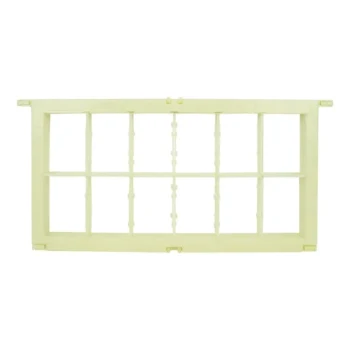
Standard mesh measurement frames facilitate quantitative assessment by overlaying a precise geometric grid onto the irregular biological patterns of a honeycomb. Typically divided into 25-square-centimeter sections (often a 5x5 cm grid), these tools allow beekeepers to convert visual estimates of worker bees, sealed brood, pollen, and honey into exact surface area data. This standardization provides the objective metrics required to evaluate colony health and the specific impact of equipment, such as queen excluders, on hive productivity.
The Core Insight Biological data is inherently messy and irregular; measurement frames solve this by translating organic patterns into standardized geometric units. This turns subjective observations into hard data, enabling precise comparisons of colony genetics, health thresholds, and equipment efficiency.
The Mechanism of Standardization
Translating Biology to Geometry
Honeybees do not build comb or rear brood in perfectly linear patterns. Measurement frames impose order on this chaos by utilizing a standard grid, most commonly featuring cells of 25 square centimeters.
By placing this grid over a comb, an apiarist can move from guessing percentages to recording specific area counts.
From Area to Population
The physical measurement of surface area serves as a proxy for population and resource counts. Using established conversion factors—such as approximately 4 worker cells per square centimeter—data derived from the grid can be mathematically translated into accurate population estimates.
This allows for the calculation of total biomass and brood numbers without the impossible task of counting individual bees.
Key Performance Indicators Measured
Quantifying Reproductive Vitality
The most critical metric assessed is the area of sealed (capped) brood.
By measuring the exact surface area of capped brood, managers can determine the egg-laying capacity of the queen and the colony's future workforce potential. This provides a technical basis for comparing the fertility of different bee strains or hybrids.
Assessing Resource Management
The frames facilitate the distinct measurement of pollen and honey stores.
Tracking these areas allows beekeepers to monitor the colony’s nutritional reserves and hoarding behavior. It distinguishes between colonies that are merely surviving and those that are actively building a surplus.
Applications in Management and Research
Evaluating Equipment Efficiency
Standard measurement frames are the primary tool for determining how hardware impacts biology.
As noted in the primary reference, these frames provide the objective data necessary to determine if specific equipment, like queen excluders, impedes worker movement or reduces overall hive productivity.
Genetic Screening
Data-driven breeding requires more than anecdotal evidence of a "strong hive."
By consistently applying grid measurements, apiarists can screen for high-performance genotypes based on verifiable reproductive rates. This leads to informed decisions regarding stock selection and investment.
Understanding the Trade-offs
Precision vs. Labor
While measurement frames offer high precision, utilizing them is a manual, invasive process.
Unlike external weighing scales, which provide a passive "total yield" metric, grid measurement requires opening the hive and manipulating frames. This disturbs the colony's internal microclimate and requires significant time investment per hive.
Snapshot vs. Aggregate Data
Measurement frames provide a detailed "snapshot" of the colony's internal state at a specific moment.
However, they must be used periodically to identify trends. A single measurement confirms current status (e.g., brood area), but does not automatically predict annual honey yield without consistent tracking over the season.
Making the Right Choice for Your Goal
To effectively utilize measurement frames, align your usage with your specific management objectives:
- If your primary focus is Equipment Auditing: Use grid measurements to compare brood and honey areas in hives with and without specific modifications (e.g., queen excluders) to calculate efficiency loss.
- If your primary focus is Genetic Breeding: Use the grid to calculate precise brood counts to select queen lines with the highest verified reproductive capacity.
- If your primary focus is Commercial Production: Balance grid usage with total colony weight; use grids for spot-checking health, but rely on scales for harvest efficiency to minimize labor.
By converting the organic complexity of a hive into standardized data points, you move from keeping bees to engineering colony performance.
Summary Table:
| Metric Category | Measurement Proxy | Key Performance Indicator (KPI) |
|---|---|---|
| Reproductive Vitality | Sealed Brood Area (cm²) | Queen egg-laying capacity & future population potential |
| Resource Status | Pollen & Honey Storage Area | Nutritional reserves, hoarding behavior, and surplus potential |
| Population Estimate | Total Comb Coverage | Biomass calculation (approx. 4 worker cells per cm²) |
| Equipment Impact | Grid Area Comparisons | Assessing efficiency of hardware like queen excluders |
Maximize Your Apiary Efficiency with HONESTBEE
Transition from guesswork to precision engineering with professional-grade beekeeping solutions. At HONESTBEE, we specialize in empowering commercial apiaries and distributors with a comprehensive wholesale portfolio.
Whether you need specialized hardware like hive-making and honey-filling machines, or essential industry consumables and beekeeping tools, we provide the technical edge required for high-performance operations. Our equipment is designed to complement data-driven management, ensuring your colony metrics translate into maximum commercial yield.
Ready to scale your operation? Contact us today to explore our wholesale equipment and cultural merchandise.
References
- Desta Gemedi. Effect of Queen Excluder Placing on Honey Yield and Honeybee Colony Performance in Selected Beekeeping Areas of East Shewa and West Arsi Zones of Oromia, Ethiopia. DOI: 10.7176/jbah/13-10-01
This article is also based on technical information from HonestBee Knowledge Base .
Related Products
- Heart-Shaped Comb Honey Frame and Honeycomb Cassette
- Durable Plastic Frame Spacer
- Professional Sectional Comb Honey Frame with 250g Cassette System for Beekeeping
- Wooden Bee Hive Frames for Beekeeping and Wholesale
- Plastic Bee Frame Beekeeping Hive Frames for Wholesale
People Also Ask
- How are honeybee combs utilized for non-destructive colony monitoring? Master Population Density Tracking
- What is a honeycomb frame? The Key to Modern, Sustainable Beekeeping
- What is the technical purpose of exchanging honeycomb frames? Master Apiary Equalization for Growth
- What frame to use for honeycomb? Choose the Right System for Pure, Edible Comb
- What is the significance of sampling honeycomb frames and hive bottoms? A Guide to Scientific Sanitation Monitoring