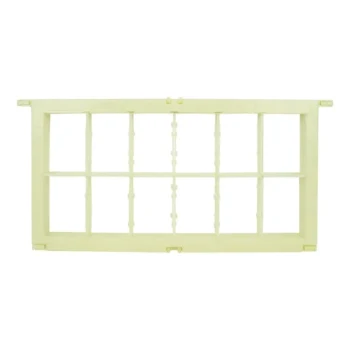
Standard-sized beehive frames serve as a fundamental calibration tool for converting complex biological activity into objective data. By acting as a uniform unit of measurement, these frames allow beekeepers and researchers to quantify colony biomass and reproductive vitality through the estimation of adult bee coverage and capped brood density. This standardization is the prerequisite for establishing health thresholds and ensuring that management efficiency can be accurately compared across different apiaries.
By providing a fixed spatial reference, standard frames allow beekeepers to transition from subjective observation to quantitative analysis. This enables the precise calculation of food stores and population density, ensuring data is comparable across different colonies and experimental treatments.
The Mechanics of Quantitative Assessment
The Frame as a Standardized Unit
The primary contribution of the standard-sized frame is its role as a uniform unit of measurement. Because the physical dimensions of the hardware are constant, the frame itself becomes a reliable metric. Beekeepers do not need to guess the size of the colony; they can count the number of frames covered by bees, providing an immediate, objective assessment of colony strength.
Quantifying Biomass and Vitality
Standard frames allow for the direct measurement of two critical health indicators: adult worker population and capped brood. By visually estimating the coverage on these frames, you can determine the colony's biomass. This moves the assessment from a qualitative "looks strong" to a quantitative "10 frames of bees," which is essential for tracking reproductive vitality over time.
Establishing Health Thresholds
Once colony data is quantified using frame counts, you can establish health thresholds. This allows for the categorization of colonies based on specific numerical values. If a colony falls below a certain frame count of brood or bees, it triggers specific management protocols, eliminating guesswork from the decision-making process.
Enhancing Precision with Spatial Baselines
Calculating Area and Volume
Beyond simple frame counts, standard Langstroth frames provide a spatial baseline for more granular calculations. Researchers can convert visual observations into specific area measurements, such as square decimeters. This enables the calculation of honey stores, pollen volume, and precise adult bee populations based on the known surface area of the standard hardware.
Evaluating Nutritional Status via Grids
For high-precision assessment, standard frames can be paired with standardized grid tools (e.g., 5x5 cm overlays). This technique allows technicians to count the exact area occupied by bee bread or capped brood. By converting these abstract storage volumes into specific cell counts, you can scientifically assess the colony's protein nutritional status with a high degree of accuracy.
Comparing Treatment Protocols
The consistency of standard frames makes them invaluable for comparative analysis. When testing different treatment protocols, the standard deep frame acts as a unified control variable. Changes in brood area or honey stores can be directly attributed to the treatment rather than hardware inconsistencies, facilitating a clear understanding of how interventions impact overall colony strength.
Understanding the Trade-offs
The Risk of Observer Error
While the frame provides a standard unit, the act of visual estimation introduces a margin of human error. Two different beekeepers may estimate "coverage" slightly differently. While frame standardization reduces this subjectivity significantly compared to unstructured hives, it does not eliminate it entirely in the way a digital scale or sensor might.
Invasive Data Collection
Using frames for measurement requires physical manipulation of the hive. Unlike remote monitoring systems that use sensors to track temperature or weight non-invasively, counting frame coverage requires opening the colony. This process can cause stress to the bees and temporarily disrupt the internal thermoregulation you are trying to preserve.
Making the Right Choice for Your Goal
Standardized frames are powerful tools, but how you utilize them depends on the precision required for your specific project.
- If your primary focus is general apiary management: Rely on whole-frame counts of adult bees and brood to quickly establish health thresholds and identify weak colonies.
- If your primary focus is scientific research: Utilize grid overlays and square-decimeter conversions on standard Langstroth frames to generate granular, comparable data on nutritional status and population density.
Ultimately, the standard frame transforms the beehive from a biological black box into a measurable system, allowing for data-driven decisions that secure colony health.
Summary Table:
| Assessment Metric | Method of Measurement | Quantitative Output |
|---|---|---|
| Colony Biomass | Visual adult bee coverage per frame | Total frame count (e.g., 10 frames of bees) |
| Reproductive Vitality | Capped brood area estimation | Square decimeters or cell counts |
| Nutritional Status | Grid overlays on storage area | Honey and pollen volume (cm²/dm²) |
| Health Thresholds | Comparative frame count data | Categorized colony strength (Strong/Weak) |
Maximize Your Apiary Productivity with HONESTBEE
Precision in colony health assessment starts with high-quality, standardized equipment. At HONESTBEE, we specialize in supporting commercial apiaries and distributors by providing the industry's most reliable wholesale beekeeping solutions. From precision-engineered standard frames and hives to advanced honey-filling machines and hive-making hardware, our comprehensive portfolio ensures your operations remain data-driven and efficient.
Whether you are scaling a commercial operation or supplying the next generation of beekeepers, our specialized machinery and essential consumables offer the durability and accuracy you need. Contact us today to explore our full range of wholesale equipment and see how we can streamline your honey production and colony management.
References
- Dennis vanEngelsdorp, Jeffery S. Pettis. Idiopathic brood disease syndrome and queen events as precursors of colony mortality in migratory beekeeping operations in the eastern United States. DOI: 10.1016/j.prevetmed.2012.08.004
This article is also based on technical information from HonestBee Knowledge Base .
Related Products
- Wooden Bee Hive Frames for Beekeeping and Wholesale
- HONESTBEE Wired and Assembled Wooden Bee Frames Foundation for a Thriving Hive
- Assembled Wooden Bee Frames with Plastic Foundation for Durability and Convenience by HONESTBEE
- Professional Galvanized Steel Frame Rest for Beehives
- Plastic Bee Frame Beekeeping Hive Frames for Wholesale
People Also Ask
- How does balancing the number of frames impact hive productivity? Optimize Your Apiary's Biological Output
- How do wooden and plastic hive frames compare in terms of durability? Wood vs. Plastic Longevity & Repairability
- What are the main considerations when choosing between wooden and plastic bee hive frames? Optimize Your Apiary's Efficiency
- How should beehive frames be maintained to prolong their lifespan? 5 Pro Tips for Durable Beekeeping Equipment
- Can I reuse old beehive frames? Save Money and Boost Hive Productivity